

(CLO) Greenland, a large, sparsely populated island between the Arctic and North Atlantic Oceans, has been severely affected by the climate crisis. Melting ice is giving way to wetlands, scrubland, and barren rocks, opening up opportunities for mineral exploitation.
The melting of the ice in Greenland not only exposed natural resources but also made many of the world's largest mineral reserves more accessible.
Greenland, a vast but sparsely populated island situated between the Arctic and North Atlantic Oceans, has undergone significant changes due to the climate crisis over the past few decades.
According to a large-scale analysis of satellite imagery published by researchers at the University of Leeds, human-induced global warming has made Greenland increasingly "greener".
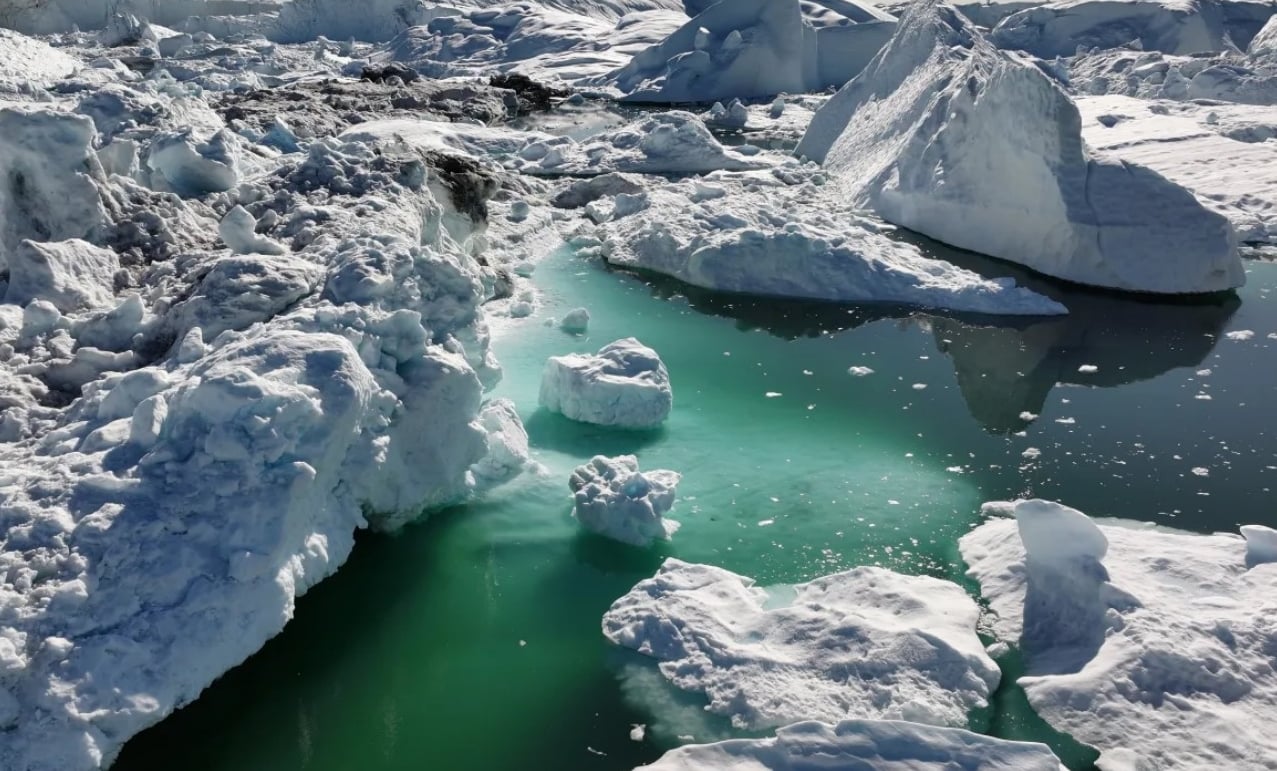
Melting icebergs spill into Ilulissat Icefjord, Greenland. (Photo: GI/Getty)
This environmental change is replacing ice and glaciers with wetlands, scrubland, and barren rocks. Scientists have repeatedly warned about the risk of melting ice, leading to rising sea levels and increased greenhouse gas emissions.
For mining companies, melting ice opens up opportunities for resource development. "The waters around Greenland are opening up earlier and freezing later each year, making it easier to access remote areas than it was a few decades ago," said Roderick McIllree, CEO of mining company 80 Mile.
Currently, ice only forms for about 3-4 months at the northernmost latitudes, while much of the island is experiencing melting, revealing previously unseen potential mineral deposits.
Geopolitical storm
Tony Sage, CEO of Critical Metals Corporation, said the new conditions make it easier for the company to transport large ships from the North Atlantic to the Tanbreez mine in southern Greenland, taking advantage of deep bays without the need for fixed ports. He predicted Greenland could experience a mineral "boom," similar to that in the icy regions of Siberia.
However, Sage emphasized that mining in Greenland faces many challenges due to its remote location, sparse population, and lack of infrastructure such as roads and railways, forcing the company to rely on helicopters for transportation.
In this context, Greenland has become a strategic choice for the West to reduce its dependence on China for rare earth elements. Recently, President Donald Trump has expressed his intention to control Greenland for national security reasons and has not ruled out the possibility of using force.
Nevertheless, Greenland's Prime Minister Mute Egede affirmed that the island "is not for sale" but is ready to cooperate with the US, particularly in the mining sector, while calling on the international community to respect Greenland's aspirations for independence.
Many valuable minerals
Jakob Kløve Keiding, senior advisor at the Geological Survey of Denmark and Greenland (GEUS), said the 2023 survey assessed 38 raw materials on the island, many of which have high potential, including rare earth elements, graphite, niobium, platinum, molybdenum, tantalum, titanium, along with significant reserves of lithium, hafnium, uranium and gold.
These minerals are considered essential for the energy transition, use in electric vehicle batteries, energy storage technology, and national security.
Keiding emphasized that Greenland is a new exploration area with many potential deposits for which there is insufficient data to exploit, although several large deposits with known resources have been confirmed.
While melting ice helps ease logistical barriers, Keiding notes that developing mining operations in Greenland will still take time, requiring more data and infrastructure to realize its potential.
Ha Trang (according to CNBC)
Source: https://www.congluan.vn/bang-tan-o-greenland-mo-ra-con-sot-khoang-san-post330985.html





































































Comment (0)