

 |
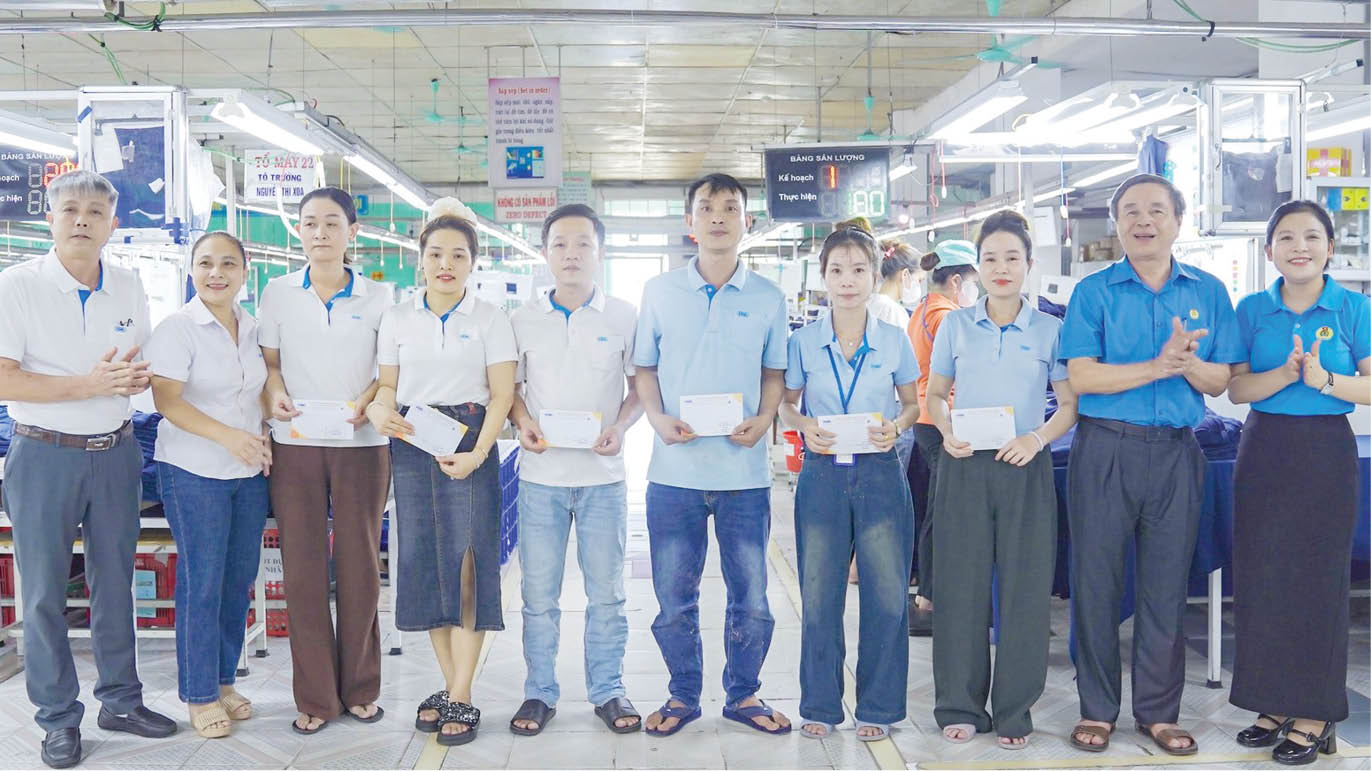
| Awards for "Excellent Workers, Creative Workers" were presented right on the sewing line. |
Effective initiatives
Previously, for buttons with smooth surfaces on both sides, workers had to manually sort each button by surface and then place them into a machine. This small operation was time-consuming and prone to errors. In early 2025, the "Surface Sorting System with Sensors and Relays" was implemented, yielding significant improvements.
This sensor system identifies the color, correctly sorts the buttons, arranges them, and feeds them directly into the sewing machine. No more workers fumbling with buttons, and no more sewing errors. The entire production line is "freed."
"In the past, distinguishing the front and back of buttons was a nightmare. Looking at them for too long would make your eyes dizzy, and if you put them on the wrong side, the product would be defective, and the whole production line would have to stop to make corrections. Now, with the automatic sensor system, it's much easier for the workers," shared Ms. Hoang Thuy Trang, a worker on the sewing line.
Mr. Vo Nhat Duy, from the Research and Development Department and the project leader for the "Surface Sorting System with Sensor and Relay," stated: "This technology supports button sorting based on color, especially useful for orders using buttons with smooth surfaces on both sides, which are difficult to distinguish with the naked eye. The sensor system, combined with a switching and control signal transmission device, is a new innovation, the first of its kind applied at the company. This technology uses color sensors combined with an automatic programmable controller to sort buttons completely automatically, replacing manual operation. The system is adjustable to suit various types of buttons, allowing for widespread deployment throughout the factory or at other units and partners in the garment industry, optimizing investment costs and synchronizing production lines."
If button sorting was once the "bottleneck," then attaching hangers is the "obstacle" in the finishing process. In garment manufacturing, products requiring hangers account for up to 65% of total production. Previously, workers spent 8 seconds manually attaching each hanger. This resulted in a daily labor waste of dozens of people.
With the "Automatic Hook and Clip Feeding and Unloading Device" initiative, the processing time is reduced to just 4 seconds per product. Productivity doubles: from 3,500 to 7,000 products in 8 hours. Calculated this way, one factory alone can reduce its workforce by 3 employees per day, saving approximately 300 million VND per year.
Notably, this device reuses cylinders, air lines, and sliders from old machines, resulting in very low manufacturing costs. Currently, this innovation is being implemented in five garment factories under the company's ownership.
Besides the two initiatives mentioned above, Hue Textile and Garment Joint Stock Company has hundreds of other initiatives, ranging from small improvements in operations and equipment to larger-scale technological solutions. The common thread is that they all help save costs, reduce material waste, and improve productivity and product quality. This diversity has created a rich "bank of initiatives," significantly contributing to the company's growth and stability in the current volatile textile and garment industry.
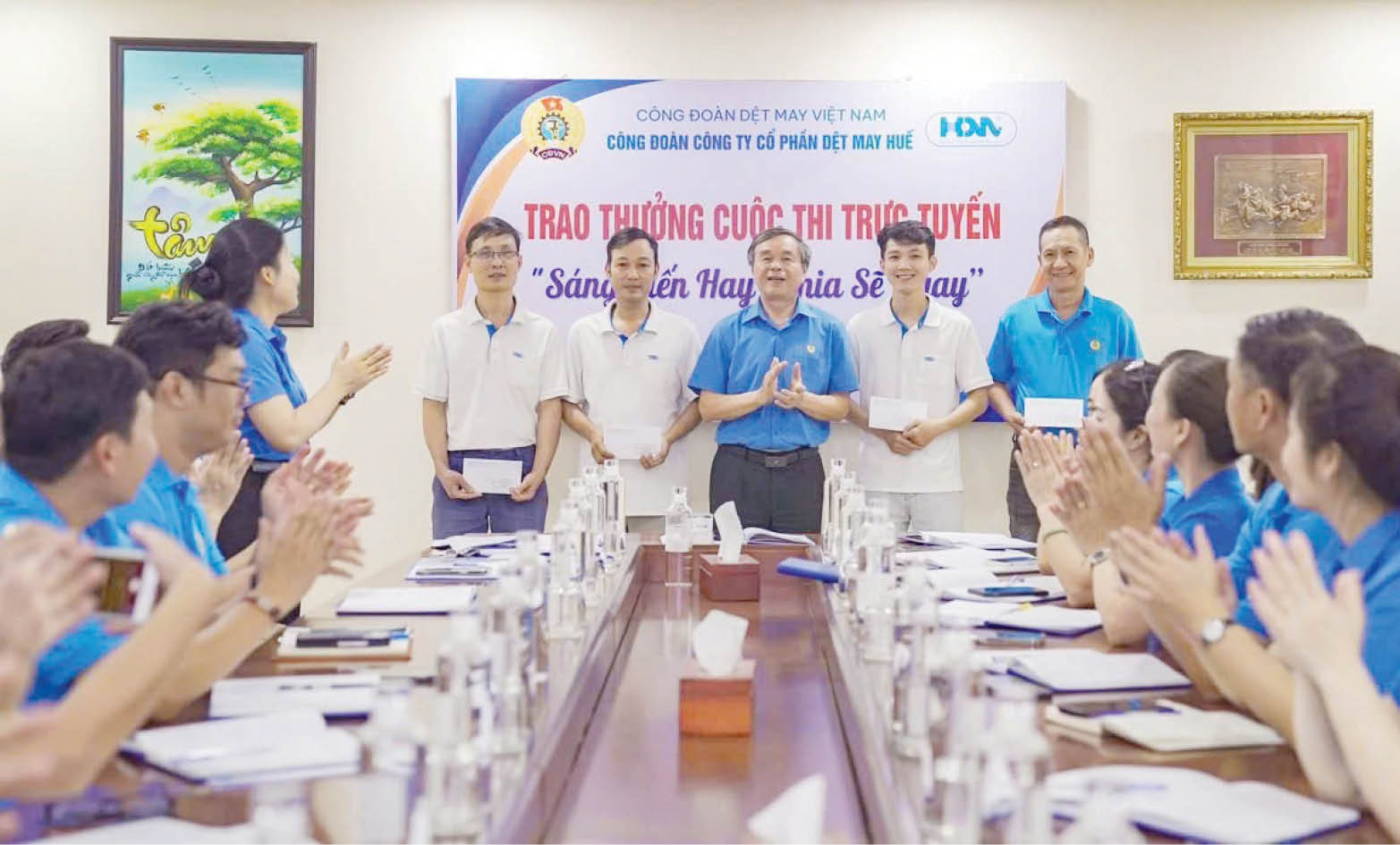 |
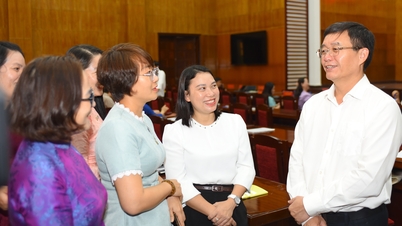
| Officials, union members, and workers receive awards from the "Great Ideas - Share Now" competition launched by the Trade Union of Hue Textile and Garment Joint Stock Company. |
Motivation
Mr. Nguyen Tien Hau, Deputy General Director and Chairman of the Trade Union of Hue Textile and Garment Joint Stock Company, said that the "Excellent Worker, Creative Worker" emulation movement has always been highly valued by the company and the trade union, creating a driving force to encourage all union members and employees to enthusiastically participate. The implemented initiatives have helped the company save billions of dong each year.
According to Mr. Hau, the most important thing in organizing the movement is to promptly motivate and reward to encourage creativity. Whenever a new initiative with clear effectiveness in production emerges, employees receive immediate rewards at the factory; subsequently, the initiative is considered for further awards in the quarter and at the end of the year. This approach ensures that all innovative efforts are recognized fairly and promptly. "Periodically, every quarter, the company, in coordination with the trade union, allocates 100 million VND to reward individuals and groups with outstanding initiatives and improvements in the creative labor movement," Mr. Hau shared.
What sets Hue Textile and Garment Joint Stock Company apart is that no idea is overlooked. For workers with innovative ideas that are difficult to articulate in writing, the innovation council assigns staff to accompany and support them in rewriting, explaining, and defending their ideas before the council. Thanks to this support, many innovations from practical production, originating from simple operations on the sewing line, have become useful solutions and are widely applied throughout the company.
The process of identifying and replicating innovative ideas is implemented systematically from the grassroots level. Each workshop and factory maintains an innovation council, which serves both as an evaluation body and a breeding ground for ideas. Outstanding innovations are selected by the company, further refined, and presented in innovation competitions at the city, national textile and garment industry, and even central levels. As a result, for many years, Hue Textile and Garment Joint Stock Company has consistently been named among the top award winners in the "Excellent Worker, Creative Worker" movement from the industry level to the central level.
Source: https://huengaynay.vn/kinh-te/suc-bat-tu-lao-dong-sang-tao-157667.html


![[Photo] General Secretary and President visit the China-ASEAN AI Application Cooperation Center](https://vphoto.vietnam.vn/thumb/1200x675/vietnam/resource/IMAGE/2026/04/17/1776404277677_vna-potal-tong-bi-thu-chu-tich-nuoc-tham-trung-tam-hop-tac-ung-dung-ai-trung-quoc-asean-8706616-2286-jpg.webp)

![[Photo] Speaker of the National Assembly meets with the Vietnamese community in Türkiye](https://vphoto.vietnam.vn/thumb/1200x675/vietnam/resource/IMAGE/2026/04/18/1776483346102_1-8136-jpg.webp)





















































![[Podcast Essay] On the Street in April](https://vphoto.vietnam.vn/thumb/402x226/vietnam/resource/IMAGE/2026/04/18/1776483290439_nhipsonghanoi-hanoimoi-com-vn-uploads-images-phananh-2021-04-15-_minh-hoa-3.jpeg)






Comment (0)