

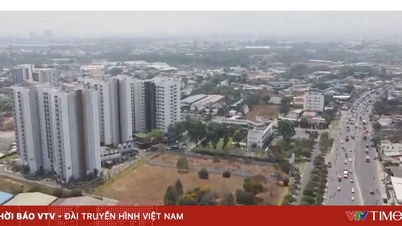
Due to bottlenecks in land valuation, many commercial housing projects have not been able to determine the land use fee to fulfill their financial obligations to the State, and therefore cannot proceed with transfer transactions.
Due to bottlenecks in land valuation, many commercial housing projects have not been able to determine the land use fee to fulfill their financial obligations to the State, and therefore cannot proceed with transfer transactions.
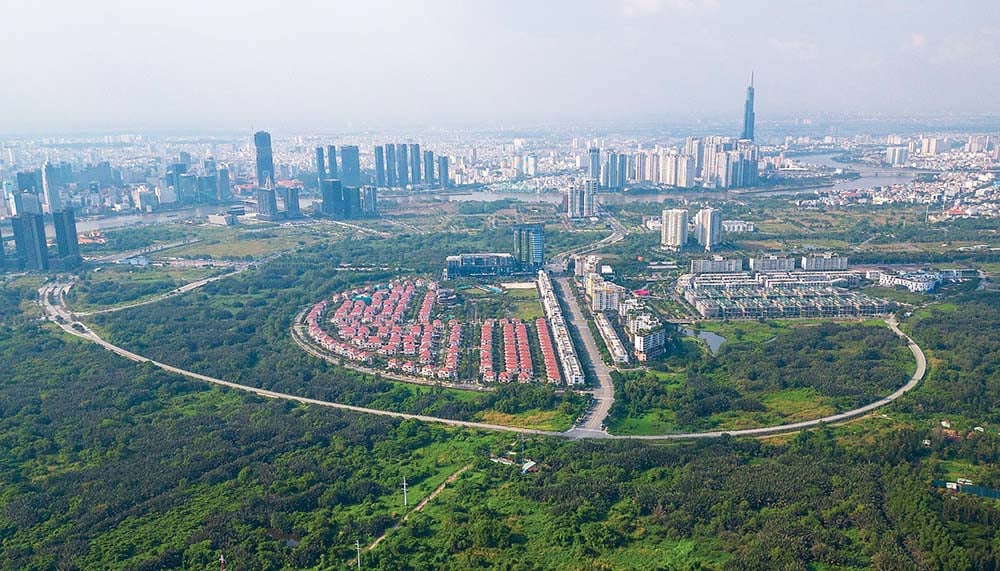 |
| Many commercial housing projects in Ho Chi Minh City cannot be transferred due to land use fee issues. |
The problem stems from issues related to land use fees.
Speaking with a reporter from Investment Newspaper, the general director of a real estate company in Ho Chi Minh City shared that his company owns several promising projects, but due to cash flow difficulties, they are forced to seek a partner to transfer a project in District 7 (Ho Chi Minh City) in order to restructure their finances. The partner is ready, but the project transfer cannot yet be completed due to legal obstacles, one of the most prominent issues being land use fees.
According to regulations, in order to transfer a project, the investor must fulfill its financial obligations to the State, including land use fees. Even if the investor is facing financial difficulties and cannot fulfill their land-related financial obligations, and even if the partner agrees to advance a sum of money to resolve this issue, the investor may still be unable to pay the land use fees for the project due to bottlenecks in the land valuation process.
The aforementioned company is not the only case. In 2024, many businesses in Ho Chi Minh City expressed interest in finding partners to transfer projects to, but so far, no deals have been successfully completed.
Information from the Ho Chi Minh City Department of Construction also shows that in 2024, no commercial housing projects in the city were transferred, although many foreign investors were eager to carry out mergers and acquisitions (M&A), but all encountered obstacles regarding legal procedures.
Proposed amendments to the regulations.
According to Mr. Le Hoang Chau, Chairman of the Ho Chi Minh City Real Estate Association (HoREA), the fact that no commercial housing projects have been transferred for an entire year shows that M&A activity is stalled, while this is a real need for many businesses to restructure investments to overcome difficulties and generate cash flow.
According to Mr. Chau, Article 39 of the Law on Real Estate Business (2023) stipulates a very strict principle: after the completion of the transfer of all or part of a real estate project, the transferee inherits the rights and obligations of the transferring investor. However, this law also stipulates that the condition for transferring a project is that the financial obligations regarding land for the project have been fulfilled, including land use fees, land lease fees, and other taxes, fees, and charges related to land (if any)...
Mr. Chau argued that such regulations are not truly consistent and not in line with reality. This is because the investor of a real estate or commercial housing project only fulfills their financial obligations, paying land use fees to the State once, except in cases where project adjustments lead to additional financial obligations.
Therefore, HoREA proposes that the Ministry of Construction consider submitting to the Prime Minister and competent authorities for consideration the addition of a regulation stating that in cases where the investor transfers all or part of a real estate project without fulfilling its financial obligations regarding land, the transferee enterprise is responsible for fulfilling these obligations on behalf of the former investor.
According to HoREA, this amendment aims to remove bottlenecks for M&A, both easing difficulties for businesses and clearing obstacles for project transfers, thereby promoting the recovery and safe, healthy, and sustainable development of the real estate market, while contributing to increased state budget revenue.
Furthermore, hundreds of currently stalled real estate projects have not yet fulfilled their financial obligations to the State. If these projects are transferred, the acquiring enterprise is usually a financially and managerially capable entity that can restart the project, or restructure and adjust it to suit market needs, thereby potentially generating additional financial obligations and increasing revenue for the state budget.
"If the above regulation is not amended, businesses can still 'circumvent' it by transferring shares or selling the business, which is essentially transferring the real estate project," Mr. Chau added.
Source: https://baodautu.vn/batdongsan/tac-chuyen-nhuong-du-an-nha-o-thuong-mai-d249825.html

















![[Photo] Prime Minister Pham Minh Chinh holds a phone call with the CEO of Russia's Rosatom Corporation.](/_next/image?url=https%3A%2F%2Fvphoto.vietnam.vn%2Fthumb%2F1200x675%2Fvietnam%2Fresource%2FIMAGE%2F2025%2F12%2F11%2F1765464552365_dsc-5295-jpg.webp&w=3840&q=75)
















































Comment (0)