

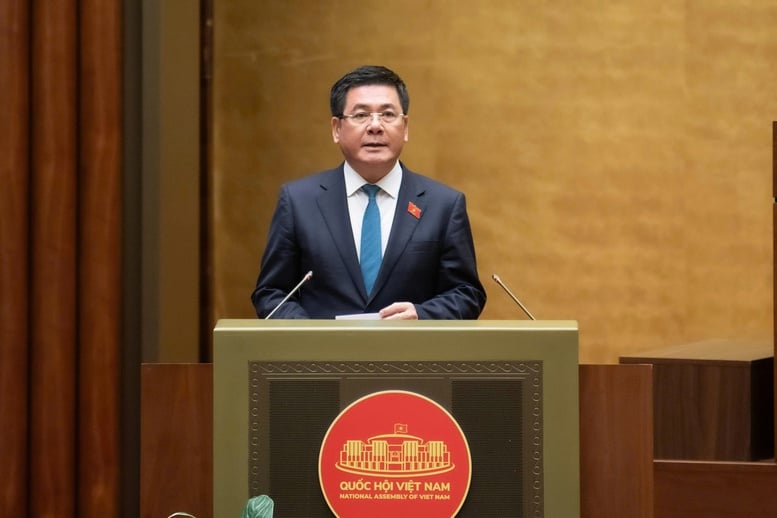
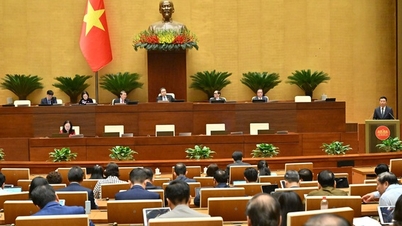
Minister of Industry and Trade Nguyen Hong Dien presented the report on the acceptance, explanation, and revision of the draft law.
On the morning of December 10th, during the working session of the 10th meeting of the 15th National Assembly , the National Assembly voted to pass the Law on E-commerce with a very high approval rate: 444 out of 446 attending delegates, accounting for 93.87%.
Before its adoption, the National Assembly heard a report from the Minister of Industry and Trade, Nguyen Hong Dien, on the acceptance, explanation, and revision of the draft law based on feedback from National Assembly deputies, the Standing Committee of the National Assembly, and relevant agencies.
Clearly define responsibilities in livestreaming sales activities.
One of the issues that has received much attention is the regulation of livestreaming sales activities. The draft law has added specific regulations on the responsibilities of each entity, including the seller, the livestreamer, and the platform owner.
The goal is to increase information transparency, establish clear legal responsibilities and create a basis for inspection, supervision and handling of violations. The law also defines social networks with e-commerce activities as a separate type of platform with a system of obligations designed to suit the nature of the activities.
This regulation does not apply rigidly as it does to e-commerce platforms, but it still ensures there are no gaps in responsibility, especially in managing business content and protecting consumers.
Identify the seller using VNeID
The law stipulates that sellers on e-commerce platforms will be identified through the national electronic identification system VNeID. This regulation supports seller tracing, limits counterfeit goods and goods infringing intellectual property rights, and helps tax authorities manage more effectively, preventing revenue losses for the state budget.
The government affirms the principle of not creating additional administrative procedures, making maximum use of existing digital infrastructure to support management without adding further burdens to businesses and citizens.
The law does not require foreign e-commerce platforms operating in Vietnam to establish a new legal entity, but must designate a legal entity in Vietnam to perform relevant obligations. This provision ensures compliance with international commitments, while helping management agencies have a clear focal point to protect consumer rights and handle violations that arise.
Creating a solid legal foundation for the development of e-commerce.
Immediately after the law is passed, the Government will implement a plan to develop guiding documents, ensuring clear and feasible regulations, avoiding overlap and not creating new administrative procedures. Post-audit work based on data and risk management will be promoted, in which the responsibilities of each entity in the entire e-commerce ecosystem will be clearly defined.
Many opinions of National Assembly deputies revolved around the issue of transaction thresholds of foreign platforms, deposit mechanisms to ensure compensation obligations to consumers or financial obligations to the State. These contents have been accepted by the drafting agency and will continue to be specified in guiding decrees. The development of laws and sub-law documents closely follows the spirit of resolutions of the Central Committee and the National Assembly, aiming to minimize procedures, simplify regulations, reduce compliance costs and not create barriers to production and business activities.
The Law on E-commerce was passed with the expectation of creating a robust, modern, and practical legal framework, contributing to the strong, transparent, and sustainable development of e-commerce in Vietnam amidst profound digital transformation.
Nhat Nam
Source: https://baochinhphu.vn/thong-qua-luat-thuong-mai-dien-tu-hoan-thien-co-che-quan-ly-bao-ve-nguoi-tieu-dung-102251210123457597.htm
![[Photo] Explore the US Navy's USS Robert Smalls warship](/_next/image?url=https%3A%2F%2Fvphoto.vietnam.vn%2Fthumb%2F1200x675%2Fvietnam%2Fresource%2FIMAGE%2F2025%2F12%2F10%2F1765341533272_11212121-8303-jpg.webp&w=3840&q=75)


![[Photo] The captivating scenery of the fragrant maple forest in Quang Tri](/_next/image?url=https%3A%2F%2Fvphoto.vietnam.vn%2Fthumb%2F1200x675%2Fvietnam%2Fresource%2FIMAGE%2F2025%2F12%2F10%2F1765353233198_lan09046-jpg.webp&w=3840&q=75)
























![[Video] The craft of making Dong Ho folk paintings has been inscribed by UNESCO on the List of Crafts in Need of Urgent Safeguarding.](https://vphoto.vietnam.vn/thumb/402x226/vietnam/resource/IMAGE/2025/12/10/1765350246533_tranh-dong-ho-734-jpg.webp)


































































Comment (0)