

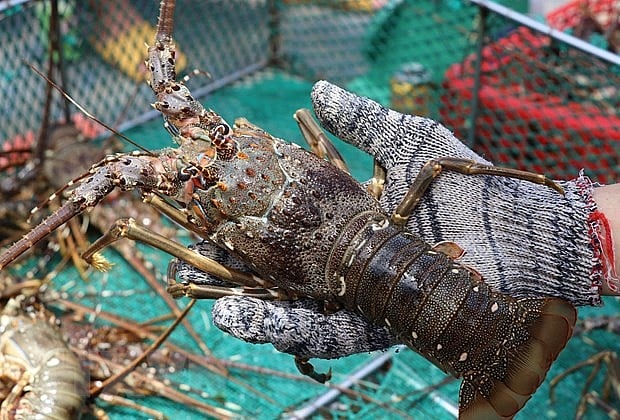
Regarding the unexplained disruption in the export of spiny lobsters to China since August 2023, the Department of Quality, Processing and Market Development has submitted a report to the leaders of the Ministry of Agriculture and Rural Development on the results of its work with the Animal and Plant Quarantine Supervision Department - General Administration of Customs of China concerning spiny lobster exports.
 |
| We have not yet received any notification from the Chinese side regarding the import of spiny lobsters from Vietnam. |
Accordingly, to address the difficulties faced by Vietnamese businesses in exporting spiny lobster to the Chinese market, at the request of the Department of Quality, Processing and Market Development (since September 2023), on November 10, 2023, the Vietnamese Trade Office in China contacted and organized an online working session between the General Administration of Customs of China (Department of Animal and Plant Quarantine Supervision; Customs offices of localities importing spiny lobster from Vietnam: Shenzhen, Guangzhou, Nanning) and the Vietnamese side (Department of Quality, Processing and Market Development, Fisheries Department, Trade Office) to exchange information on the situation of spiny lobster exports to China.
During the meeting, the Animal and Plant Quarantine Supervision Department of the General Administration of Customs of China announced the following: Regarding China's regulations on spiny lobsters, for naturally harvested spiny lobsters, in 2021, China revised the List of Endangered Species of Wild Animals Requiring Protection, and spiny lobsters were included in the Level 2 list of protected species (effective from February 1, 2021).
In May 2023, China amended its Wildlife Protection Law, which prohibits the catching, use, trading, and sale of spiny lobsters and other species on the List of Endangered Species in the Wildlife Protection System. The General Administration of Customs of China internally notified local customs agencies of this regulation for implementation.
The Chinese Ministry of Agriculture is the regulatory and management body for wild-harvested spiny lobsters, therefore, Vietnam is requested to contact this agency for specific information if needed.
For farmed spiny lobsters, the following criteria apply: they must not be caught directly from the sea and must have clear evidence of the farming process; and they must not be sourced from the wild (the broodstock must be F2 generation).
Regarding the import procedures for farmed spiny lobsters into China, Chinese importers must obtain a wildlife protection permit from the Fisheries Bureau of the Ministry of Agriculture of China. Customs clearance and food safety inspection procedures remain unchanged from before.
The requirements for packaging facilities and spiny lobster farming facilities exporting to China include registration with detailed information about the facilities. The Department of Animal and Plant Quarantine Supervision announced that it will send the new registration form to the Vietnamese side (through the Vietnamese Trade Office in China) to conduct a review and registration process for packaging facilities and spiny lobster farming facilities exporting to China.
After receiving the registration list from Vietnam, China will conduct online and/or in-person inspections of the farms and publish on the website of the General Administration of Customs of China the list of Vietnamese export packaging facilities and farms permitted to export to China.
To promote the export of live, naturally harvested Vietnamese seafood to China, the Chinese representative proposed that both sides promptly consider and sign this Protocol and would send the proposal to Vietnam through the Vietnamese Trade Office in China. The Chinese side also requested that the Department forward the proposal to the relevant Vietnamese authorities for early consideration of the import of sturgeon from China. The Department informed the representative of the Fisheries Department who participated in the meeting.
Information from the General Administration of Customs of China, and from the Vietnamese Trade Representative in China at the aforementioned meeting, indicates that the obstacle to exporting spiny lobster to China is the issue of protecting rare and endangered animals, and the procedures (for both importers and exporters) to prove that the farming process (from breeding stock) meets these requirements.
Food safety requirements and customs procedures remain unchanged.
Based on that, the Department of Quality, Processing and Market Development proposes that the Ministry's leadership direct the Department of Quality, Processing and Market Development to continue exchanging information with the Animal and Plant Quarantine Supervision Department, General Administration of Customs of China to update and inform export packaging facilities and spiny lobster farming facilities about China's regulations and registration forms for exporting live spiny lobsters to this market.
After China provided the new registration form, the Department of Fisheries directed and coordinated with localities to review, verify, and finalize the list of lobster farming facilities exporting to China that meet Vietnamese and Chinese regulations, and then forwarded it to the Department of Quality, Processing and Market Development for submission to China.
To ensure convenience for citizens and businesses, the Department of Quality, Processing and Market Development is designated as the focal point for receiving applications, registering with competent Chinese authorities, and organizing online or in-person meetings with Chinese inspection teams when requested.
The Department of Quality, Processing and Market Development, in coordination with the Department of Fisheries and the Department of Veterinary Medicine, will advise on the drafting, provide feedback, and submit to the competent authority for signing the Protocol on the control of live naturally harvested Vietnamese seafood exported to China, after receiving an official request from the China Animal and Plant Quarantine Supervision Bureau.
To date, your side has approved 46 facilities for packaging lobsters for export to China (including spiny lobsters).
Source link















![[Photo] Prime Minister Pham Minh Chinh holds a phone call with the CEO of Russia's Rosatom Corporation.](/_next/image?url=https%3A%2F%2Fvphoto.vietnam.vn%2Fthumb%2F1200x675%2Fvietnam%2Fresource%2FIMAGE%2F2025%2F12%2F11%2F1765464552365_dsc-5295-jpg.webp&w=3840&q=75)












































Comment (0)