

The Group of Seven (G7) summit concluded on the afternoon of May 21st after three days of work. Along with eight invited countries, this G7 summit discussed a range of pressing global issues.
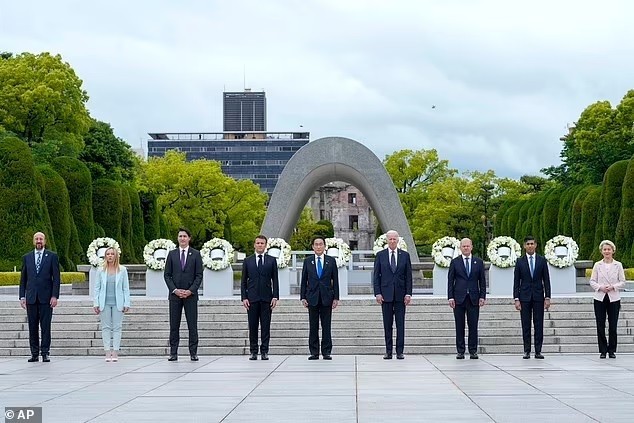 |
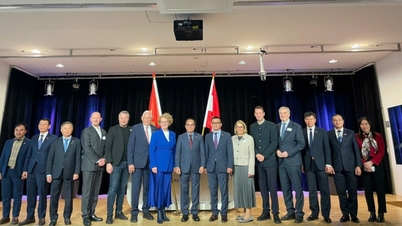
| Leaders of the seven leading industrial nations (G7) and the European Union (EU) pose for a commemorative photo at the memorial in the Hiroshima Museum, Japan, on the morning of May 19. (Source: AP) |
The issue of nuclear disarmament is considered the main topic of this G7 summit's agenda, with the message conveyed by the very choice of location – Hiroshima, the first city in the world to suffer the devastation of an atomic bomb.
G7 leaders have released the Hiroshima Vision on Nuclear Disarmament, agreeing on the importance of continuing to maintain a world free of nuclear weapons 77 years after the US dropped atomic bombs on the Japanese cities of Hiroshima and Nagasaki in August 1945.
During the security and diplomacy session, G7 leaders discussed measures to restore the nuclear disarmament process and enhance transparency of nuclear forces.
The G7 joint communiqué, released on May 20, emphasized the importance of efforts toward a world without nuclear weapons. Speaking at the closing press conference on the afternoon of May 21, Japanese Prime Minister Fumio Kishida stressed that the G7 summit was the starting point for efforts toward building a future world without nuclear weapons.
The participation of leaders from developing and emerging countries at the expanded G7 summit demonstrated the priority of host country Japan in particular, and the G7 in general, in cooperating with countries in the Southern Hemisphere to address global challenges.
G7 leaders held three expanded sessions with leaders from eight invited countries: Vietnam, Australia, South Korea, India, Indonesia, Brazil, the Cook Islands, and Comoros. Through this forum, the parties discussed global issues, including energy and food security, global health, and climate change.
Although the G7 accounted for 70% of global gross domestic product (GDP) in the 1980s, this figure has fallen to below 50% in recent years. Meanwhile, the presence of developing and emerging countries in the international community is increasing in many areas.
Therefore, experts believe that meetings with leaders of developing and emerging countries are becoming more important than ever because the G7 cannot solve international problems alone. Experts see this as an opportunity for the G7 to strengthen relations with developing and emerging countries.
Prime Minister Kishida expressed his desire to build an inclusive international network with a shared perspective on the importance of "the rule of law, resolutely opposing any attempts to use unilateral force to change the status quo."
Japan intends to strengthen relations with this group of countries with a cautious approach and offering “practical benefits” such as infrastructure development aid and food assistance. Japan plans to promote the enforcement of legal regulations through dialogue and building relationships based on trust.
During the conference discussions, G7 leaders also emphasized the importance of a free and open Indo-Pacific that is prosperous, secure, inclusive, based on the rule of law, and protects common principles including sovereignty, integration, and peaceful resolution of disputes.
In Hiroshima, the G7 countries pledged continued support for Ukraine and called on Russia to withdraw its troops from Ukraine. The G7 leaders also affirmed their commitment to strengthening sanctions against Russia, aiming to prevent Russia from acquiring essential materials for its special operations and accessing the international financial system, while also reducing international dependence on Russian energy sources.
In its relations with China, the G7 expressed a desire for a “stable and constructive” relationship. G7 leaders acknowledged the need for dialogue and cooperation with China, but also expressed deep concern about the situation in the East China Sea and the South China Sea. The G7 joint communiqué expressed strong opposition to the unilateral use of force or coercion to alter the status quo.
Regarding artificial intelligence (AI), the G7 agreed on an initiative to develop international regulations on AI. The leaders agreed with Japan's proposal to establish a mechanism to promote government-level dialogue on regulations for the AI sector.
Dubbed the Hiroshima AI Process, this initiative aims to bring together the G7 countries' views on technology regulation. The G7 summit also discussed the potential and risks of AI, including the controversial ChatGPT application. Currently, there are differences among G7 countries regarding AI regulation, and discussions in Japan have focused on how to apply AI most effectively.
Regarding supply chain issues, G7 leaders agreed to build supply chains for semiconductors and other goods to reduce dependence on a few countries. The G7 also agreed to establish a council tasked with combating “economic coercion,” such as using trade and investment restrictions to pressure other countries.
Source

















![[Photo] Prime Minister Pham Minh Chinh holds a phone call with the CEO of Russia's Rosatom Corporation.](/_next/image?url=https%3A%2F%2Fvphoto.vietnam.vn%2Fthumb%2F1200x675%2Fvietnam%2Fresource%2FIMAGE%2F2025%2F12%2F11%2F1765464552365_dsc-5295-jpg.webp&w=3840&q=75)














































Comment (0)