

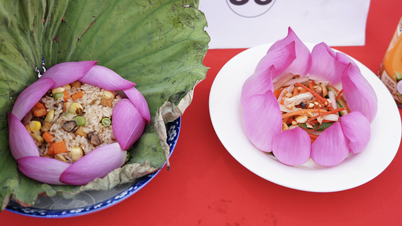
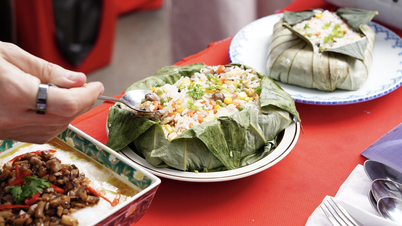
These simple yet exquisite vegetarian dishes not only showcase culinary skill but also embody a philosophy of peaceful living and virtuous conduct, serving as a testament to the rich history and Buddhist culture of this ancient capital city.

Professor Le Manh That presented a paper at the scientific conference on the Lieu Quan Zen School: History of Formation and Development in Hue in 2023.
PHOTO: GN
As mentioned, the Lieu Quan Zen school originated in Thuan Hoa, and with the support of the Nguyen lords, it flourished, and Thuan Hoa quickly became the Buddhist capital of Vietnam from the early 18th century to the mid-20th century.
At the scientific conference on the Lieu Quan Zen School: History of Formation and Development held in Hue in 2023, Professor Le Manh That affirmed that the lineage and development of the Lieu Quan Zen School have made significant contributions to the history of Vietnamese Buddhism and the nation's history, especially from the Buddhist revival period in the early 20th century to the present day.
This contribution is reflected in five main lineage branches: the branch of Venerable Tế Ân Lưu Quang, which originated in Thuận Hóa; the branch of Venerable Tế Nhơn Hữu Phi, which originated in Thuận Hóa and flourished in the South Central and Southern provinces; the branch of Venerable Tế Lập Ứng Am, which originated in Bình Định; the branch of Venerable Tế Căn Từ Chiếu, which originated in Phú Yên ; and the branch of Venerable Tế Hiển Bửu Dương, which originated in Khánh Hòa.
Venerable Thich Hai An, Rector of the Vietnam Buddhist Academy in Hue, stated that the lineage of this Zen school has been continuously continued and developed alongside the southward expansion of the country. From this Zen school, the patriarchs, high-ranking monks, lay practitioners, and Buddhists have dedicated themselves to serving the Dharma and the nation, most notably the Buddhist revival movement and the propagation of the Dharma for the benefit of all beings, contributing to the glory of the nation and Vietnamese Buddhism in modern times. To date, the Lieu Quan Zen school has spread throughout the country and even to many regions abroad, with thousands of temples and millions of monks, nuns, and Buddhist followers.
The flourishing development of the Lieu Quan Zen sect directly laid a solid foundation for the formation and popularization of the vegetarian tradition in Hue. From this brilliant development, many large temples and ancestral halls were established in Hue, and an increasing number of Buddhist followers converted and practiced the ascetic life of Buddhism. From this point, vegetarian cuisine ceased to be a foreign concept and became a familiar part of the spiritual and daily life of the people of the ancient capital.
Vegetarian dishes made from self-sufficient ingredients.
A unique aspect of the development of Hue's vegetarian cuisine, closely linked to the Lieu Quan Zen sect, is the self-sufficiency of the temples. The Lieu Quan Zen sect, originating from Mahayana Buddhism and introduced during the Nguyen dynasty, did not advocate begging but rather the establishment of a system of Buddhist temples integrated with the lives of the people. This created an important foundation: instead of relying on donations from Buddhists, the temples in Hue cultivated gardens and fields to ensure their own food supply.

Every year, a large number of monks, nuns, and Buddhist followers from all over the country gather at the Lieu Quan pagoda to perform the pagoda-cleaning ceremony and pay tribute to the Venerable Master.
PHOTO: BNL
From the founding abbots of Hue's temples to the subsequent development of temples and ancestral halls, generations of monks and nuns have lived a life of asceticism, moderation, and contentment, and have consumed vegetarian food sourced from vegetables, fruits, and rice grown in the temple's gardens and fields. With fresh, clean ingredients from these very gardens, the monks skillfully processed the vegetables and fruits into food, and thus, Hue's vegetarian temple dishes were born.
The monks' self-sufficiency in sourcing ingredients and their dedication to preparation have created vegetarian dishes that are rich in natural flavors, purity, and nutritional value. This not only ensures the purity of the meal but also reflects the Buddhist philosophy of "minimal desires and contentment" and harmony with nature.
The vegetarian dishes of Hue temples initially served the monastic life, gradually becoming known, learned, and widely popularized by Buddhists and the general public. This process has contributed to shaping the distinctive characteristics of Hue's vegetarian cuisine: simplicity, natural flavors, diversity in types and forms, along with a profound philosophy of compassion and non-violence. From the humble meals in the temples, vegetarian dishes have gradually been transformed, elevated, and spread into every aspect of life, from solemn offerings to the daily meals of each family.
It can be said that the development of the Lieu Quan Zen school, with its philosophy closely linked to the lives of the people and the self-sufficient methods of the temples, has created a solid foundation for Hue's vegetarian cuisine. It is not only a part of the culinary culture but also a testament to a lasting spiritual tradition, contributing to the unique identity of the ancient capital. (to be continued)
Source: https://thanhnien.vn/tinh-hoa-am-thuc-chay-hue-tu-chua-hue-den-doi-song-hang-ngay-185250908230956939.htm


























![[Video] The craft of making Dong Ho folk paintings has been inscribed by UNESCO on the List of Crafts in Need of Urgent Safeguarding.](https://vphoto.vietnam.vn/thumb/402x226/vietnam/resource/IMAGE/2025/12/10/1765350246533_tranh-dong-ho-734-jpg.webp)
















































Comment (0)