

Serving the people
Records about Le Quy Don mostly praise his remarkable memorization ability. For example, the "Thoai Thuc Ky Van" (Record of Retreating Food) states, "He read books very quickly, ten lines at a time; once he memorized them, he never forgot them for the rest of his life, and his hand never left the book." Many anecdotal stories about Le Quy Don's ability to read quickly and remember for a long time have emerged. For instance, the "Lich Dai Danh Hien Pho" (Record of Famous Sages of the Dynasties) recounts an incident where Le Quy Don visited the village head's house and saw a ledger recording the rice collection of the villagers. He picked it up to look through it. Later, the village head's house burned down, and the ledger was destroyed. The head, worried about not remembering the rice collection, said, "When I mentioned it to him, he said, 'I looked through it that day and remember everything. Don't worry, give me the ledger so I can read it and write it down.' Afterward, the head took the ledger to collect the rice, and all those who owed paid in full without any arguments or disputes. When the total was calculated, there was no mistake."
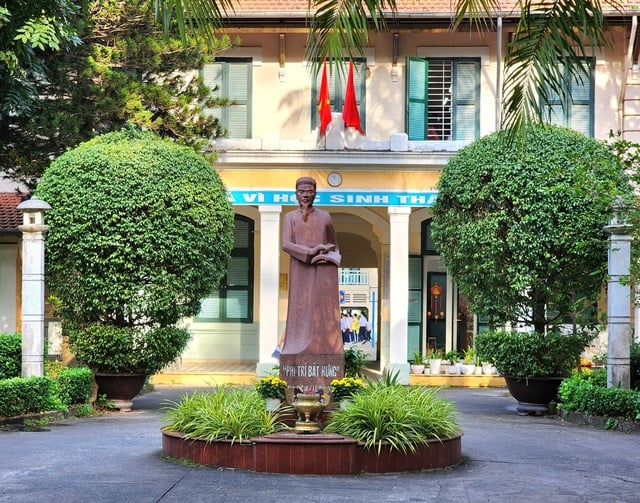
The statue of Le Quy Don is located in the grounds of Le Quy Don High School, Xuan Hoa Ward, Ho Chi Minh City.
PHOTO: TRAN DINH BA
Despite his extraordinary memory, Le Quy Don was not arrogant; on the contrary, he studied tirelessly and was ambitious. Historical records show that this scholar from Dien Ha was very diligent in reading. When asked where knowledge comes from, Le Quy Don himself believed that human talent stems from knowledge, "reading many books can reveal its source [referring to knowledge]." He is a shining example of self-study and scholarship. Thanks to this, his career flourished, as summarized in the " Customs History " when recording him: "He held power for a long time, obeyed orders to go on diplomatic missions and border patrols, and had many achievements."
With his talent and compassionate, people-caring attitude towards his officials, he was trusted by Lord Trinh. His suggestions and opinions were listened to and implemented by the Lord; for example, in the year Tan Mao (1771), he presented to the Lord four issues related to the forgery of imperial decrees by tribute students, the corruption in the selection process, the periodic inspection of public land in alluvial plains, and the thorough investigation of the exemption of taxes and corvée labor for the people. All of these issues were heeded by the Lord.
Similarly, in the year of Giap Ngo (1774), the people of Nghe An suffered from famine. Le Quy Don, faced with this tragedy, proposed to the Lord: "To retain the land and property of the prefectures that were submitted to the province for relief, to abolish the weekly tax in the district; to strictly guard the sea; to postpone the pursuit of deserters; to postpone the trial of lawsuits; to strictly instruct the Court to carefully examine the suffering of the people and report it to provide relief," as recorded in the Continuation of the Dai Viet History Chronicle . In the year of Dinh Dau (1777), he requested the Lord to reduce the number of officials in the districts and counties of Thai Nguyen province and concentrate them in one place to lessen the burden on the people. The Lord implemented this proposal...
The upright and honest official of the Censorate.
From the path of scholarly achievement, Le Quy Don entered the officialdom, holding various positions. At times, this Bang Nhan (second-highest rank in the imperial examinations) served as a scholar in the Imperial Library; at other times, he went on an embassy to China in the year Ky Mao (1759); and at still other times, he served as Tu Nghiep (Director of Education) in the year Dinh Hoi (1767)...
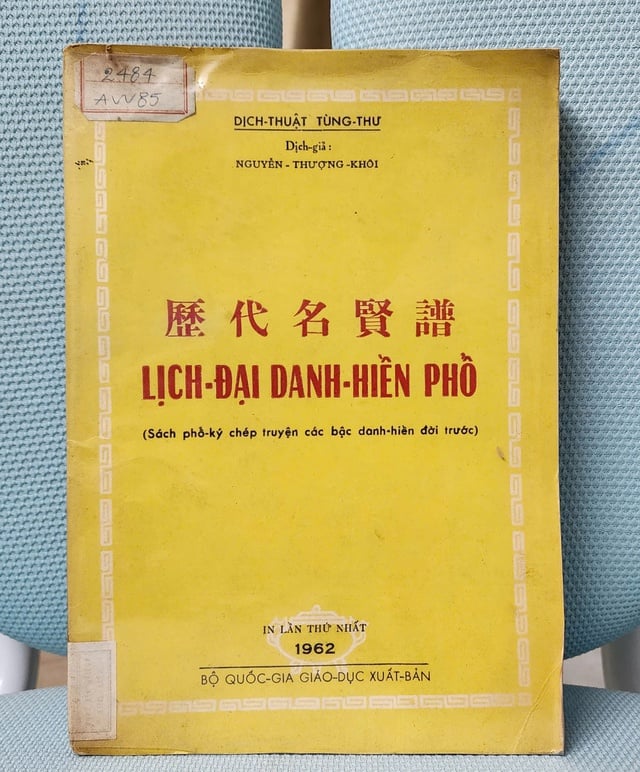
The book "Chronicle of Famous Sages Throughout History ," translated and printed in 1962, contains a record about Le Quy Don.
PHOTO: TRAN DINH BA
Throughout his various positions and roles, one of Lê Quý Đôn's highlights, as recorded in historical texts, was his time as an censor in the Censorate (or Office of Public Prosecution), where he was responsible for impeaching, remonstrating, and pointing out wrongdoings from the king to officials. Therefore, honest, resolute, and outspoken officials were needed. According to the Continuation of the Đại Việt Chronicle , in the year Kỷ Sửu (1769), Lord Trịnh appointed him to the position of Thiêm đô ngự sử (Assistant Censor). The following year, he was promoted to Phó đô ngự sử (Deputy Censor). In that same year, the same book states: "In June, Deputy Censor Lê Quý Đôn, because he repeatedly deposited bribe money from those accused into the public treasury, was specially promoted to Hữu thị lang (Right Vice-Minister) of the Ministry of Finance."
In the following year, Tân Mão (1771), the lord sent Lê Quý Đôn and Đoàn Nguyễn Thục to investigate the population and military strength of Thanh Hoa province. Upon their return, these officials requested Lord Trịnh Sâm to exempt the people from poll tax and also asked for a postponement of the payment of taxes on agricultural products, aquatic products, and public land.
Still within the scope of his responsibilities as an official, in the year of Nhâm Thìn (1772), Lê Quý Đôn, under the lord's command, went to Lạng Sơn to investigate the harassment of the people by local officials regarding the operation of postal services. After Lê Quý Đôn thoroughly investigated the matter, he "inquired about the situation regarding whether the officials were honest or corrupt, and the suffering of the people, and reported back. The Governor of Lạng Sơn, Lê Doãn Thân, was dismissed from his position for his harsh and harassing behavior." Because of these achievements, in the year of Nhâm Thìn (1772), the lord appointed Lê Quý Đôn as Imperial Censor, and then as Acting Chancellor of the National Academy. In the year of Bính Thân (1776), he was promoted to Chief Imperial Censor, demonstrating the trust the Trịnh lord placed in him as an upright and honest official. (to be continued)
Source: https://thanhnien.vn/tinh-tu-dat-viet-vi-ngon-quan-cuong-truc-185251210235210089.htm




















































































Comment (0)