

After the fall of the Tay Son dynasty, the house of the father of the Tay Son Three Heroes in Kien My village (now Block 1, Tay Son commune, Gia Lai province ; formerly Tay Son district, Binh Dinh province) was burned down. But in the hearts of the people, the memory of the Tay Son dynasty has never faded.
Right on the site of the old house, the people contributed labor and resources to build Kien My Temple, secretly worshipping the Three Heroes of Tay Son. Every year, on the 15th day of the 11th lunar month, the joint memorial ceremony is still held quietly but solemnly, as a way of preserving the spirit of the Tay Son dynasty through many vicissitudes.
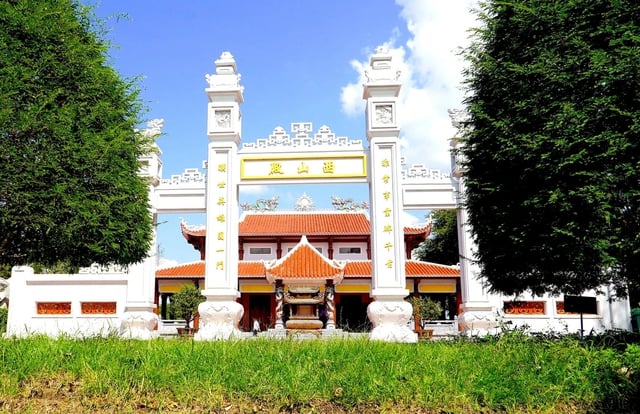
Tay Son Temple is a place of worship dedicated to the Three Heroes of Tay Son, along with other civil and military officials.
PHOTO: DUC NHAT
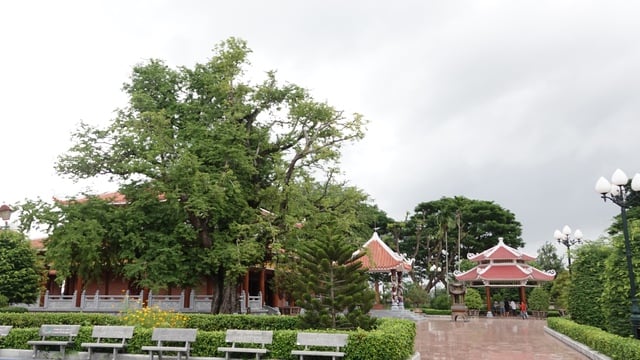
The tamarind tree and the well (a hexagonal well house) are two silent relics that have existed for over 250 years.
PHOTO: DUC NHAT
In 1946, in response to the scorched-earth resistance, the communal house was burned down. Between 1958 and 1960, the local people erected the Tay Son Temple, restored the worship practices, and maintained the annual commemoration of the Ngoc Hoi - Dong Da Victory on the 5th day of the first lunar month.
In 1979, Tay Son Palace was recognized as a national historical monument. In 2004, nine gilded ceramic statues were enshrined inside the palace, depicting the Tay Son Three Heroes and prominent civil and military officials such as Ngo Thi Nham, Tran Van Ky, Ngo Van So, Tran Quang Dieu, Bui Thi Xuan, and Vo Van Dung.
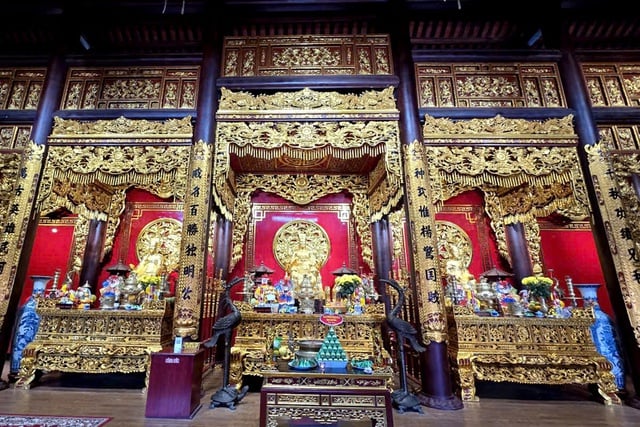
The shrine dedicated to the Three Heroes of Tay Son at the Quang Trung Museum.
PHOTO: DUC NHAT
In 2014, the Tay Son Three Heroes Temple complex was classified as a special national historical relic by the Prime Minister . Currently, the temple complex is built in the shape of the Chinese character "三" (three), with a ceremonial gate, a pavilion, and three main buildings, serving as a sacred space preserving the essence of the Tay Son dynasty.
The heritage tamarind tree - a witness to the childhood of the Three Heroes of Tay Son
Amidst that solemn setting, the ancient tamarind tree and the laterite well remain intact, bearing witness to the former home of the Tay Son Three Heroes family.
To the left of the pavilion, the ancient tamarind tree still stands, its gnarled trunk and wide canopy covering a vast expanse of sky. The people of Kien My believe that this is the tamarind tree that once sheltered the childhoods of Nguyen Nhac, Nguyen Hue, and Nguyen Lu. Under its shade, the three brothers practiced martial arts, learned horseback riding, and nurtured their great ambitions. The tamarind tree is not only an ancient tree but has become a living symbol of the enduring vitality of the Tay Son movement.
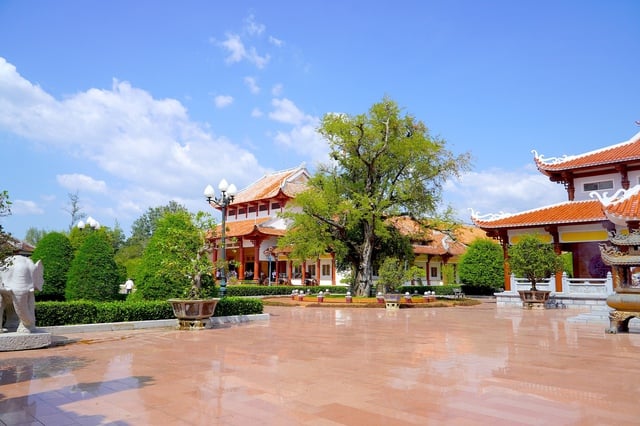
The tamarind tree, with a trunk circumference of nearly 4 meters and a canopy spreading up to 30 meters, stands next to the pavilion.
PHOTO: DUC NHAT
According to Master Nguyen Trung Thong, a specialist at the Quang Trung Museum, the tamarind tree is approximately 250 years old, with a trunk circumference of nearly 4 meters and a canopy width of up to 30 meters. In 2011, the Vietnam Association for the Protection of Nature and Environment recognized it as a heritage tree. It is also considered the "ancestral tamarind tree," a source of seedlings for many spiritual structures associated with the Tay Son dynasty.
The locals still pass down heartfelt verses dedicated to the tamarind tree, as a way of expressing gratitude to a silent witness: " The old tamarind tree, the old betel nut landing / Though not bound by love, it still welcomes and bids farewell to its beloved."
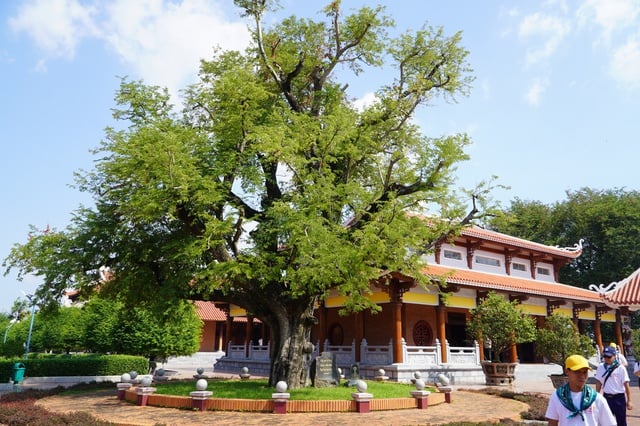
The 250-year-old tamarind tree at the Quang Trung Museum has been recognized as a heritage tree.
PHOTO: DUC NHAT
Laterite stone wells - the inexhaustible source of water for the Tay Son dynasty.
Not far from the tamarind tree is an ancient laterite stone well, constructed from red stones without mortar. The well's opening is less than 1 meter wide and 8.5 meters deep, yet it has never run dry for over 250 years.
Legend has it that after each martial arts training session, Nguyen Nhac and his brothers would often scoop up water from this spot to drink. The water was cool and sweet, and the locals considered it the "dragon vein" of the land where the Tay Son dynasty originated.
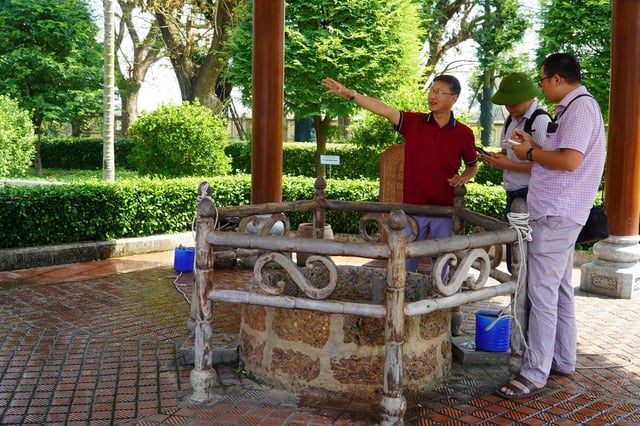
Master Nguyen Trung Thong introduces the reporter to the well of the Tay Son dynasty.
PHOTO: TRANG ANH
According to Master Nguyen Trung Thong, there are days when the museum receives 2,000 to 3,000 visitors. Each person scoops up a few liters of water to wash their face and drink for good luck, but the water source never dries up.
In 1988, a hexagonal well house was built to preserve the historical site. Its traditional roof and wooden frame surrounding the well create a solemn yet welcoming atmosphere. The well water is regularly cleaned and sanitized for visitors, but the original coolness of the underground spring remains intact.
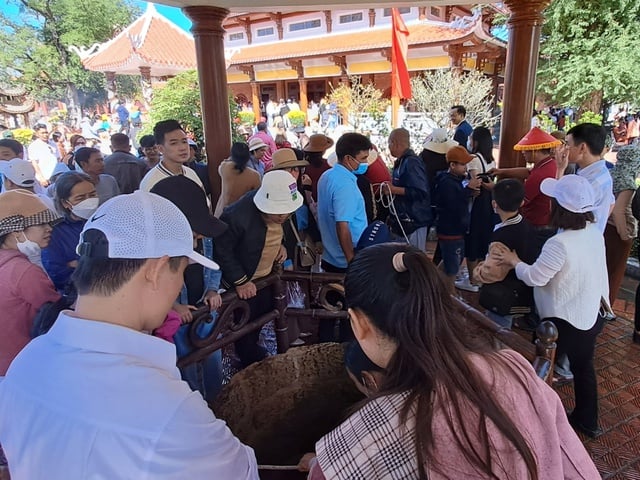
During the festival celebrating the victory at Dong Da, many people came to drink water and wash their faces at the well in the garden of the Tay Son family's house.
PHOTO: HT
According to the elders in Kien My village, the well in the garden of the old Tay Son house was constructed entirely of laterite stone, without mortar or brick walls. At that time, this was the only well in the entire village of Kien My, so the locals commonly called it the village well.
Later, Kien My acquired many new wells, but many families still preferred the cool, refreshing water from the well in Tay Son's garden. In years of prolonged drought, most wells in the village dried up, but that over two-hundred-year-old laterite stone well still retained its clear, cool water.
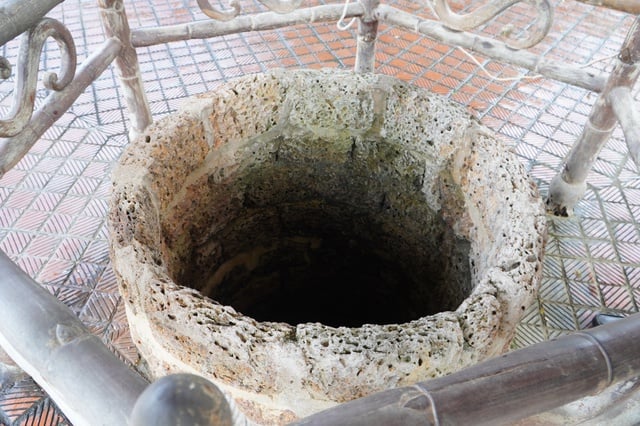
The well is only about 1 meter wide and 8.5 meters deep, but it has never run dry.
PHOTO: DUC NHAT
Locals pass down stories that the well holds a sacred aura for the Tay Son region. Many visitors often ask for a sip of the cool water to wash their faces and quench their thirst; some take the water home for their loved ones as a way of conveying their faith and seeking peace of mind. These stories are passed down through folklore as part of the spiritual and cultural life of the people in this historically significant area.
Over time, in addition to their historical value, the tamarind tree and the well have become shrouded in a veil of legend. Locals believe they carry the spiritual essence of the land that gave birth to and nurtured one of the most glorious dynasties in Vietnamese history.
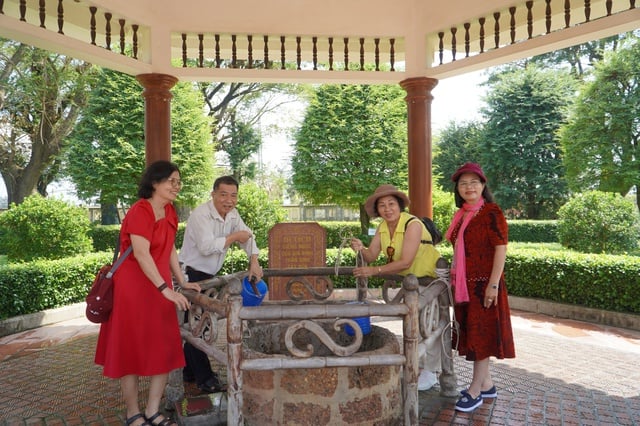
Visitors often ask for a sip of the water, as a way of receiving good fortune from the heroic spirit of the ancient heroes.
PHOTO: DUC NHAT
Mr. Nguyen Van Tan, Deputy Director in charge of the Quang Trung Museum, said that the museum is not only a place to display artifacts but also a center for research and education on the history of the Tay Son dynasty. Every activity, from inventory and preservation to restoration and festival organization, is aimed at preserving the spirit of national independence left behind by the Tay Son dynasty.
Amidst the hustle and bustle of modern life, the ancient tamarind tree and the laterite stone well quietly stand as two bridges connecting the past with the present. They are not only remnants of the former home of the three Tay Son brothers, but also symbols of the will, aspirations, and spirit that created a golden age in the nation's history – the Tay Son dynasty.
Source: https://thanhnien.vn/hao-khi-nha-tay-son-vong-ve-tu-ky-uc-cay-me-gieng-nuoc-ke-chuyen-xua-185251209163904405.htm





























































![[Infographic] Many activities at the 96th anniversary commemoration of the death of Deputy Scholar Nguyen Sinh Sac](https://vphoto.vietnam.vn/thumb/402x226/vietnam/resource/IMAGE/2025/12/11/1765441454787_infographic-nhieu-hoat-dong-tai-le-gio-lan-thu-96-cua-cu-pho-bang-nguyen-sinh-sac20251211010322.webp)












Comment (0)