

On the afternoon of February 24th, General Secretary To Lam chaired a working session with the Central Committee's Policy and Strategy Board on the growth target set for 2025 at 8% or higher, creating a solid foundation for double-digit growth in the following years, and the direction for managing assets and cryptocurrencies in Vietnam.
Eliminate at least 30% of unnecessary business regulations.
While generally agreeing with the 10 strategic solutions proposed in the report, the General Secretary noted that, both in the short and long term, the primary and overarching requirement is to mobilize all economic sectors, all businesses, and all citizens to participate in socio-economic development, actively engaging in labor and production to create material wealth and contribute to the country's growth and development. All institutions, mechanisms, and policies must aim towards and achieve this requirement.
To promote rapid and sustainable economic growth, the General Secretary requested a focus on reforms, promoting both the supply and demand sides in a manner consistent with the realities and characteristics of Vietnam's economy. Specifically, promoting supply-side factors will ensure long-term growth, with fewer negative consequences, but will have a longer time lag; promoting demand-side factors may be faster but carries more risks.
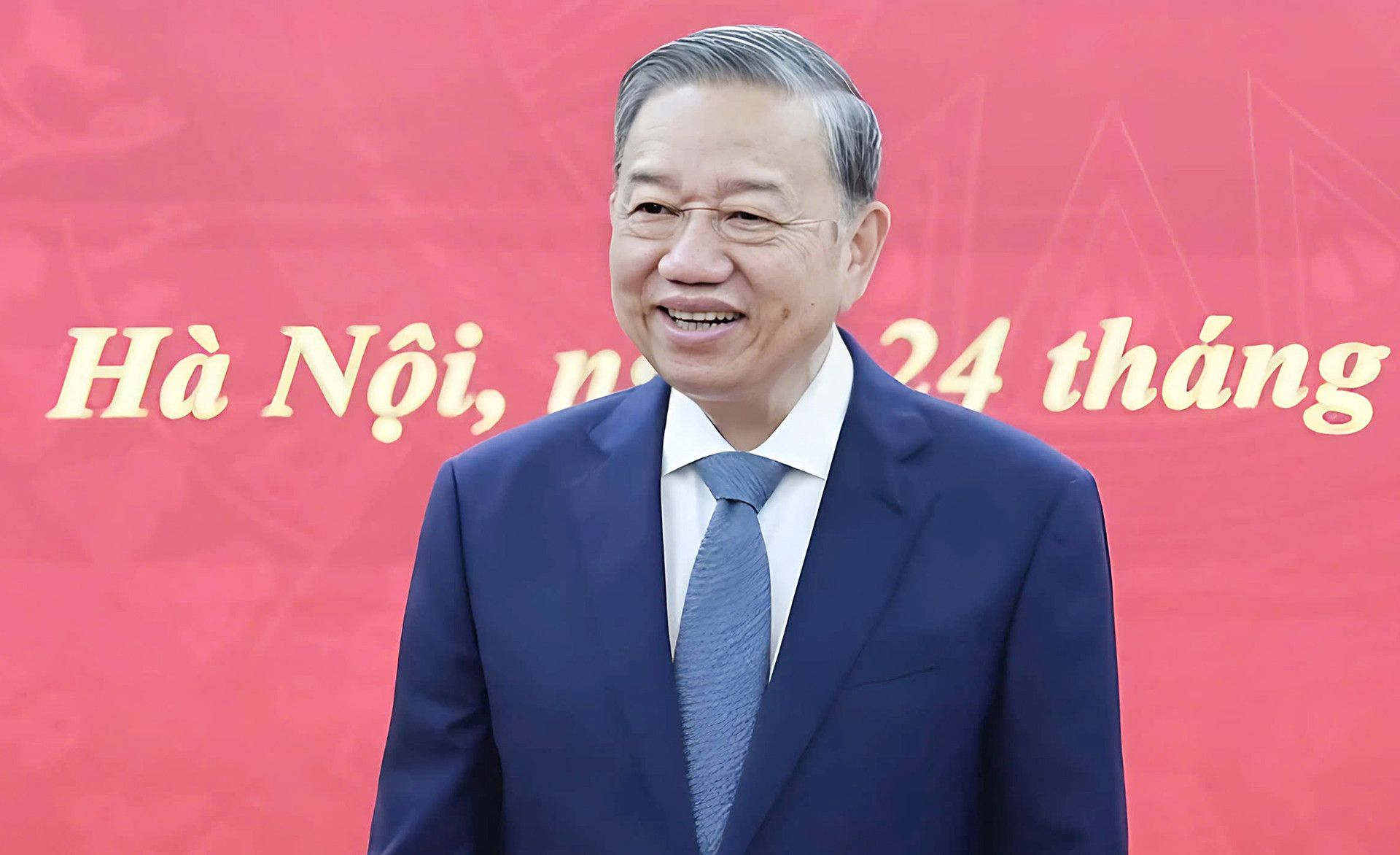
General Secretary To Lam. Photo: VNA
On the supply side, according to the General Secretary, it is necessary to continue focusing on strong institutional reforms, improving the investment and business environment, consolidating the confidence of businesses and people, striving to reduce the time for processing administrative procedures by at least 30% by 2025; reducing business costs by at least 30%, especially in the areas of customs, compliance costs, and informal costs...
At the same time, at least 30% of unnecessary business conditions will be abolished; the goal is for Vietnam's investment environment to be among the top 3 countries in ASEAN within the next 2-3 years.
The General Secretary also requested research and application of a specialized legal framework to help bring Vietnam's legal system up to speed in the development of the digital economy, innovation, and international integration, especially in financial technology, artificial intelligence (AI), platform economy, e-commerce, and special economic zones.
Along with that, there are proposals for a controlled experimental legal framework for new technology sectors; proposals for a separate legal framework for special economic zones and special technology zones, such as preferential tax mechanisms, specific mechanisms for resolving commercial disputes within the zones, etc.
Regarding land policy and the real estate market, the General Secretary emphasized the need to facilitate and promote transactions and attract investment capital into the market; to promote urban areas as a driving force for national growth based on the completion of a high-quality and synchronized infrastructure system; and to build a national digital map system for planning and land prices.
The General Secretary requested research into establishing a "National Housing Fund" to develop affordable housing in major cities. In addition, he called for the application of open financial policies for international financial center models; leveraging the effectiveness of foreign indirect investment; researching the formation of a "Duty-Free Port" model to make Vietnam a major logistics hub; and developing a "National Single Window for Investment" to enhance the attraction of foreign investors to Vietnam.
Simultaneously, promote the development of science and technology and innovation; thoroughly address air pollution in Hanoi, Ho Chi Minh City, and other major cities.
Another noteworthy point emphasized by the General Secretary was the implementation of policies to attract talented individuals to work in state agencies, units, and enterprises, as well as special policies for cadres and civil servants who achieve good results in their work; at the same time, establishing mechanisms to remove those who lack competence and integrity from the system. This further concretizes the policy of encouraging and protecting cadres who dare to think and act.
Furthermore, it is necessary to continue improving the state apparatus, establishing mechanisms and strengthening decentralization and delegation of power to local authorities. In addition, attention should be paid to improving policies to address population aging.
Managing digital currency as a type of virtual asset.
On the demand side, the General Secretary stated that the focus should be on boosting government investment in strategic and foundational national infrastructure systems, in terms of quantity, quality, and consistency; and promoting private investment by creating a favorable, transparent, safe, low-cost investment environment with easy access to credit.
This also includes promoting domestic consumption, as only by boosting domestic consumption can sustainable GDP growth be achieved; increasing net exports. It also involves boosting exports of processed agricultural, forestry, and aquatic products based on the development of an agricultural economy instead of purely agricultural production; industrializing agriculture; adjusting land use policies to facilitate land consolidation; and encouraging pilot programs for new forms of cooperation in agriculture.

General Secretary: The National Assembly and government agencies need to quickly institutionalize and specify regulations for managing digital currencies. Photo: VNA
In addition, it is also necessary to implement expansionary fiscal policy; flexible monetary policy, cautiously easing monetary policy...
Regarding the management of digital currencies, the General Secretary agreed with the proposal of the Central Policy and Strategy Committee that it is necessary to manage these currencies as a type of virtual asset to avoid negative impacts on the economy and social issues, while also contributing value to the national economy.
The National Assembly and government agencies need to promptly institutionalize and specify regulations for managing this sector. Research should be conducted on applying a controlled pilot mechanism (sandbox) to establish a "Trading Platform" for this activity.
Vietnamnet.vn
Source: https://vietnamnet.vn/tong-bi-thu-lap-quy-nha-o-quoc-gia-nghien-cuu-cang-mien-thue-2376013.html

![[Photo] Prime Minister Pham Minh Chinh attends the Conference summarizing and implementing tasks of the judicial sector.](/_next/image?url=https%3A%2F%2Fvphoto.vietnam.vn%2Fthumb%2F1200x675%2Fvietnam%2Fresource%2FIMAGE%2F2025%2F12%2F13%2F1765616082148_dsc-5565-jpg.webp&w=3840&q=75)




















































































Comment (0)