

The US, China and Japan continue to be the three largest export markets for Vietnamese agricultural, forestry and fishery products in the first 7 months of 2024.
The latest report from Ministry of Agriculture and Rural Development According to reports, in the first seven months of the year, the total trade turnover... agricultural, forestry and fishery exports Exports reached $34.27 billion, an increase of 18.8%; imports totaled $24.85 billion; resulting in a trade surplus of $9.42 billion, an increase of 60%.
In July alone, exports of agricultural, forestry, and aquatic products reached US$5.11 billion, an increase of 18.2% compared to the same period last year. Of this, major agricultural products accounted for US$2.62 billion (up 25.2%); forestry products US$1.4 billion (up 15.8%); aquatic products US$880 million (up 13.2%); and livestock products US$47.4 million (up 9.3%).
According to the Ministry of Agriculture and Rural Development, in the first seven months of the year, most product groups saw an increase, resulting in a rise in export turnover to $34.27 billion. Contributing to this result were agricultural products at $18.21 billion, up 23.4%; forestry products at $9.41 billion, up 21.1%; aquatic products at $5.29 billion, up 7.3%; and livestock products at $288 million, up 4.8%.
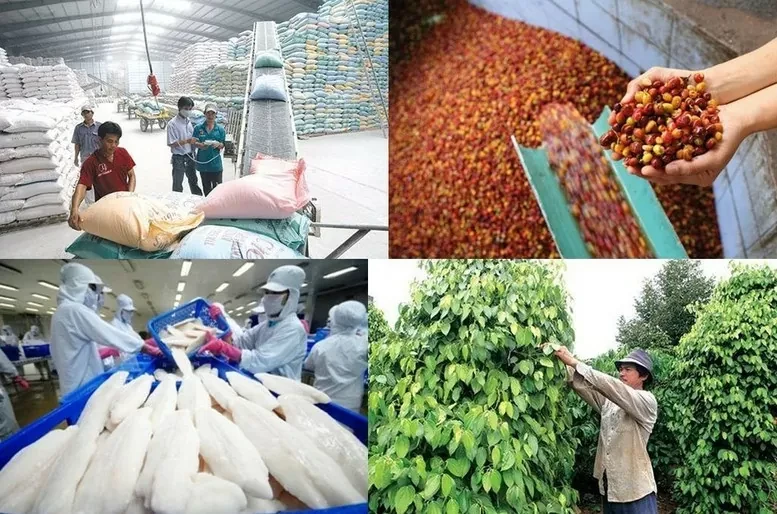
Specifically, key export items all achieved higher export values compared to the same period last year, such as: Wood and wood products at $8.7 billion, up 21.9%; coffee at $3.5 billion, up 30.9%, with a volume of 964,000 tons; rice at $3.2 billion, up 25.1%, with a volume of 5.18 million tons; cashew nuts at $2.3 billion, up 22.1%, with a volume of 424,000 tons; fruits and vegetables at $3.8 billion, up 24.3%; shrimp at $2 billion, up 7.5%; and pangasius fish at $1.02 billion, up 7.1%.
The average export prices of several commodities also increased, for example: rice at $632/ton, up 18.2%; coffee at $3,669/ton, up 51.7%; rubber at $1,555/ton, up 14.8%; pepper at $4,665/ton, up 45%; and tea at $1,728/ton, up 1.6%.
Notably, export values to all markets increased. Specifically, exports to Asia reached $16.3 billion, up 16.9%; the Americas $7.9 billion, up 20.5%; Europe $4.2 billion, up 29.6%; Africa $638 million, up 7.9%; and Oceania $476 million, up 14.2%.
In terms of markets, the US, China, and Japan continue to be the three largest export markets for Vietnamese agricultural, forestry, and aquatic products. Specifically, the US accounts for 21.1%, up 21.6%; China accounts for 20.5%, up 11.3%; and Japan accounts for 6.6%, up 4%.
As a "bright spot" in agricultural exports during the first seven months of the year, the fruit and vegetable sector is also projected to reach $7 billion this year. Mr. Dang Phuc Nguyen, General Secretary of the Vietnam Fruit and Vegetable Association, believes that Vietnamese agricultural products are increasingly high-quality and favored by many markets. In particular, durian, a key product in the fruit and vegetable group, is gaining popularity due to its low price, freshness, and fast shipping time. From July, August, September, and October, durian production will increase significantly as the Central Highlands region enters its harvest season.
Durian, dubbed the "king of fruits," is increasingly asserting its position as it becomes popular in China and many other countries.
According to the latest figures from the General Department of Customs, in the first half of this year, durian export Exports reached $1.32 billion, a 45% increase compared to the same period last year. Durian currently accounts for 65% of the total fruit exports.
Export prices for durian have also increased sharply over the past six months, fluctuating between $4.3 and $4.5 (110,000-115,000 VND/kg) depending on the market. Currently, the Monthoong variety is favored due to its high quality, small seeds, delicious aroma, and firm texture. It also has a longer shelf life compared to Ri 6 and other varieties.
Among the top 10 markets importing Vietnamese durian in the first half of the year, China led with a turnover of US$1.22 billion, accounting for 92.4%. Compared to the same period last year, durian exports to China increased by 46%. Thailand ranked second, with US$47 million, an increase of 90.5% compared to the first half of 2023.
Besides these two major markets, Japan and Cambodia have also increased their purchases of Vietnamese durian. Japan spent $2.6 million and Cambodia spent $1.6 million, representing increases of 2 and 23 times respectively compared to the same period last year.
The Vietnam Food Association believes that the demand for rice in the world market remains very high. Traditional markets such as China, the Philippines, and Indonesia have all increased their import quotas. Indonesia plans to import 5.18 million tons of rice, and recently opened a tender to purchase 320,000 tons of 5% broken rice, creating an opportunity for Vietnamese rice. The Philippines also increased its import volume from 3.8 million tons to 4.5 million tons.
In the first seven months of the year, import turnover reached US$24.85 billion, an increase of 8.2%. This included: agricultural products US$15.27 billion, up 7.6%; livestock products US$2.09 billion, up 5.4%; seafood US$1.44 billion, down 3.8%; forestry products US$1.55 billion, up 20.8%; production inputs US$4.48 billion, up 12.3%; and salt US$21.4 million, down 16.6%. |
Source

![[Photo] Closing Ceremony of the 10th Session of the 15th National Assembly](/_next/image?url=https%3A%2F%2Fvphoto.vietnam.vn%2Fthumb%2F1200x675%2Fvietnam%2Fresource%2FIMAGE%2F2025%2F12%2F11%2F1765448959967_image-1437-jpg.webp&w=3840&q=75)


![[Photo] Prime Minister Pham Minh Chinh holds a phone call with the CEO of Russia's Rosatom Corporation.](/_next/image?url=https%3A%2F%2Fvphoto.vietnam.vn%2Fthumb%2F1200x675%2Fvietnam%2Fresource%2FIMAGE%2F2025%2F12%2F11%2F1765464552365_dsc-5295-jpg.webp&w=3840&q=75)
![[Photo] Prime Minister Pham Minh Chinh holds a phone call with the CEO of Russia's Rosatom Corporation.](https://vphoto.vietnam.vn/thumb/402x226/vietnam/resource/IMAGE/2025/12/11/1765464552365_dsc-5295-jpg.webp)









































![[OFFICIAL] MISA GROUP ANNOUNCES ITS PIONEERING BRAND POSITIONING IN BUILDING AGENTIC AI FOR BUSINESSES, HOUSEHOLDS, AND THE GOVERNMENT](https://vphoto.vietnam.vn/thumb/402x226/vietnam/resource/IMAGE/2025/12/11/1765444754256_agentic-ai_postfb-scaled.png)














































Comment (0)