

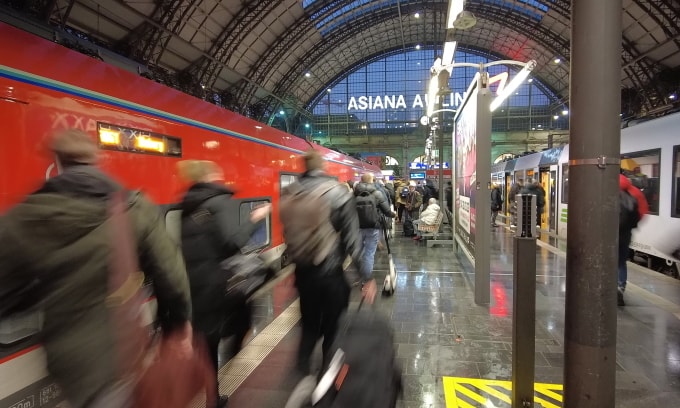
High-speed train systems in Europe
Blogger Vinh Gấu took a Christmas trip in 2022 through Germany, Austria, and Hungary, and was impressed with Europe's high-speed train system - Eurail. Through this system, travelers can easily book trains traveling through 33 countries with approximately 30,000 destinations.
Major train stations in Europe are often located right in the city center, making it convenient for travelers to get around and explore . Typically, Vinh plans his trips in detail, including departure times and locations, to secure his train seat. However, changing schedules is also easy, especially when using the Eurail Pass, which allows for free booking and seat changes on many train routes.
European high-speed trains have an average speed of around 250-300 km/h. He assessed the trains as smooth, comparable to the high-speed trains in Japan and South Korea that he had experienced.
Train stations in Europe, especially in large cities, are spacious and have many lines. Therefore, the blogger advises travelers to arrive about an hour early to have time to accurately identify the platform and train number. The stations all have detailed signage along with areas for eating, drinking, and shopping before boarding. The transportation infrastructure and connections between public transport such as buses, subways, and high-speed train stations are excellent, so Vinh Gấu had no difficulties throughout his journey.
Shinkansen system, Japan
Ngoc Trang, a tour group traveler, visited Japan in November 2023 and experienced the Shinkansen once. The high-speed train station was as spacious as a shopping mall, with amenities such as candy stores, beverage shops, and restaurants. She said the feeling on the high-speed train was like flying – fast but very smooth. Only when looking out the window and seeing the scenery whizzing by did travelers truly appreciate the train's speed.
Blogger Nguyen Son Tung (Lac) also gave a similar assessment after living in Japan for 5 years, often using the Shinkansen for work. He said he could sleep soundly even on long journeys like Tokyo to Osaka, Tokyo to Niigata, or Tokyo to Nagoya because the train was very smooth. Upon arrival, tourists can continue their journey by local train or bus, eliminating the need for air travel.
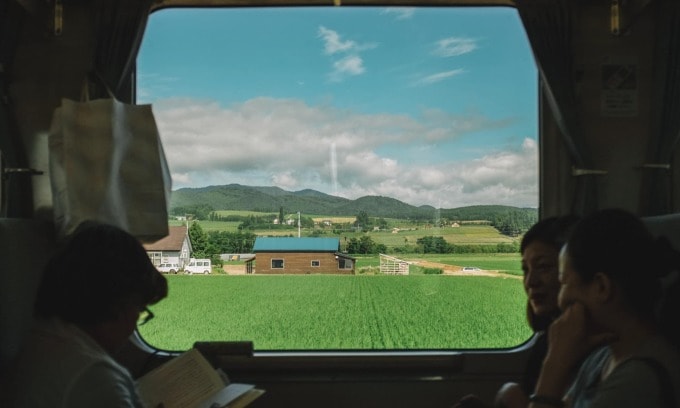
High-speed trains are usually located in the same stations as local trains, making transfers convenient. However, Son Tung notes that it's important to pay attention to the time because Japanese trains are very punctual; missing a train can result in a long wait. Although the Shinkansen can reach speeds of over 300 km/h, passengers inside don't feel a significant difference due to the speed-reducing glass; the only noticeable difference is when watching the train from the outside.
"Even the glass of water on the table barely shakes," he said.
KTX high-speed train system, South Korea
Kim Huong, a resident of Hanoi, traveled to South Korea with her family in September and chose the high-speed train to travel between Seoul and Busan. She said that while high-speed train tickets might not be cheaper than plane tickets, she chose this option because the train stations are centrally located, saving travel time. Additionally, she and her family wanted to experience the differences between high-speed train systems around the world .
"The interior of the ship is quite new, clean, and comfortable, so passengers hardly feel the high speed," she said.
Ha Thi Ha, a tourist from Hanoi, also experienced the KTX train and highly appreciated its speed and smoothness. At a price of 50,000-70,000 won (930,000-1.3 million VND) for the Seoul-Busan journey, she thought it was completely worthwhile because it saved time and avoided traffic congestion compared to buses.
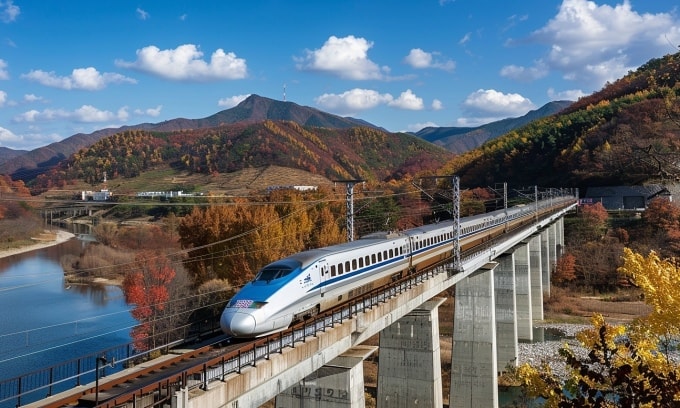
Female travelers also appreciate the spacious and comfortable seating on the train, as well as the vending machines and Wi-Fi. The restrooms are equipped with automatic doors and are gender-separated, so travelers should pay attention to the signs. Ha advises travelers wanting to experience the dormitory to carefully check the information boards at the station – they are presented in an easy-to-understand manner, similar to those at an airport.
CHR train system, China
Ngoc Cham, a representative from Top One Travel, said she has used high-speed trains in China more than 10 times on routes such as Hekou - Kunming, Hekou - Dali, and Lijiang - Kunming; she commented that "the train is as smooth as an airplane." What impressed her was that the train can reach speeds of over 200 km/h but remains smooth, and the distance between the seats is wide enough for comfortable reclining without disturbing those behind.
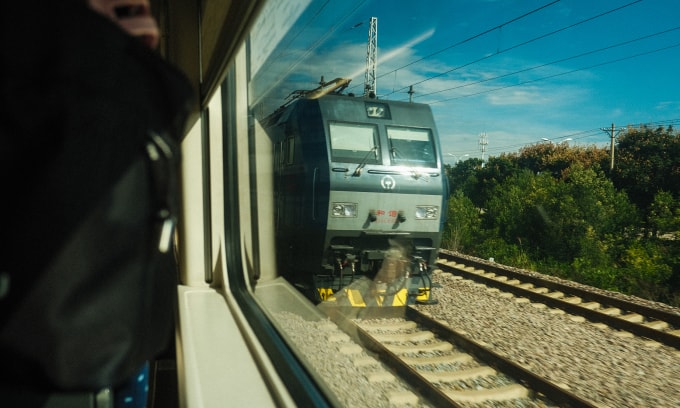
At the train station, tourists can easily find shops, food courts, or massage chairs. According to Ms. Cham, using the high-speed train saves travel time, optimizes sightseeing time, and ensures the health of tourists.
THRS train system, Taiwan
Tran Trong An, a resident of Hanoi, has visited Taiwan many times and used the high-speed train to travel from Taipei to Kaohsiung. The distance between the two points is 350 km, but the journey only takes 90 minutes. At the arrival station, he has easy access to the metro, railway, bus, taxi, and other modes of transportation.
"I wake up in the morning, take the train from Taipei, and I can still comfortably go to Taichung or Kaohsiung for breakfast and still have time for work or sightseeing," he said.
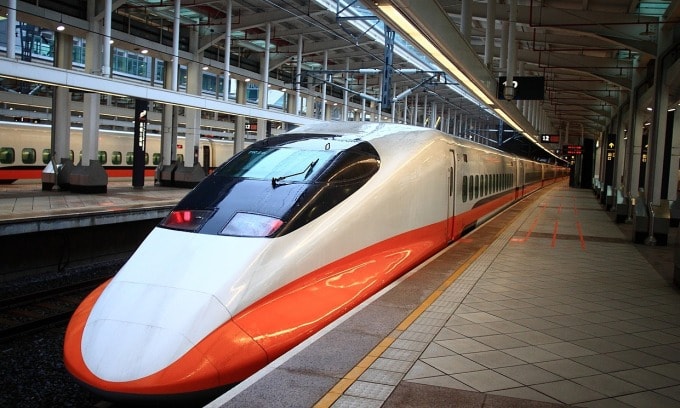
Mr. Pham Anh Vu, representing Vietnam Tourism, was also impressed with Taiwan's THSR train system. Most tour itineraries to Taiwan include at least one train journey for Vietnamese tourists to experience. The train reaches speeds of up to 300 km/h but does not experience any shaking or vibration.
Train stations in Taiwan are modernly designed and centrally located, with clear signage making it easy for travelers to find their way to the exits or connecting trains. Stations in Taipei and Kaohsiung also feature shopping areas and restaurants, creating a comfortable space while waiting for trains.
"The experience is just as good as in Europe or Japan," he said, adding that the price of around 1,000-1,500 New Taiwan Dollars (800,000-1.2 million VND) for a one-way trip from Taipei to Kaohsiung is worth it.
VN (according to VnExpress)Source: https://baohaiduong.vn/trai-nghiem-tau-cao-toc-cua-khach-viet-tren-the-gioi-395518.html
![[Photo] Prime Minister Pham Minh Chinh holds a phone call with the CEO of Russia's Rosatom Corporation.](/_next/image?url=https%3A%2F%2Fvphoto.vietnam.vn%2Fthumb%2F1200x675%2Fvietnam%2Fresource%2FIMAGE%2F2025%2F12%2F11%2F1765464552365_dsc-5295-jpg.webp&w=3840&q=75)
![[Photo] Closing Ceremony of the 10th Session of the 15th National Assembly](/_next/image?url=https%3A%2F%2Fvphoto.vietnam.vn%2Fthumb%2F1200x675%2Fvietnam%2Fresource%2FIMAGE%2F2025%2F12%2F11%2F1765448959967_image-1437-jpg.webp&w=3840&q=75)

































![[OFFICIAL] MISA GROUP ANNOUNCES ITS PIONEERING BRAND POSITIONING IN BUILDING AGENTIC AI FOR BUSINESSES, HOUSEHOLDS, AND THE GOVERNMENT](https://vphoto.vietnam.vn/thumb/402x226/vietnam/resource/IMAGE/2025/12/11/1765444754256_agentic-ai_postfb-scaled.png)












































Comment (0)