

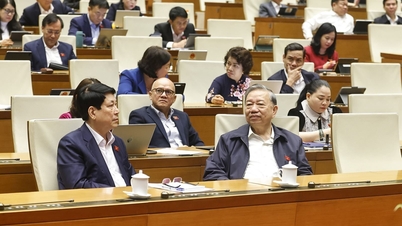
Discussing at the meeting hall this morning about the investment policy of the National Target Program on new rural areas, sustainable poverty reduction, and socio -economic development in ethnic minority and mountainous areas until 2035, many National Assembly deputies emphasized the requirement of "focusing on the right subjects, assigning to the right agencies", ensuring feasibility and effectiveness in implementation.
Only ethnic people understand the reality best.
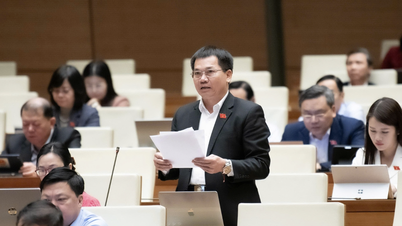
Discussing the beneficiaries and the program's host agency, delegate Pham Van Hoa ( Dong Thap delegation) said that most of the resources are focused on ethnic minorities in mountainous areas, especially poor and near-poor households.

National Assembly Delegate Pham Van Hoa. Photo: National Assembly
He clarified: "Regarding the contents of sustainable poverty reduction, new rural construction, advanced new rural construction, and modern new rural construction, the Ministry of Agriculture and Environment should be assigned; the rest should be assigned to the Ministry of Ethnic Minorities and Religions."
Explaining this proposal, the delegate emphasized: "Only those who understand ethnic minorities can clearly grasp and effectively implement it."
"This is a very important issue. We recommend that the drafting committee and the research presiding agency separate the issue clearly and not co-chair it," delegate Hoa emphasized.
Regarding the scope of subjects, delegates suggested that it is necessary to separate poor households, near-poor households from social protection subjects to calculate correctly and reduce the number of actual poor households.
Delegate Pham Van Hoa also said that many of the program's goals are being set higher than the actual capacity. According to the draft, the poverty rate in ethnic minority and mountainous areas will be reduced to 10% by 2030, while it is currently 24%.
He frankly warned: “With only 4-5 years left, it will be very difficult to achieve the target from 24% down to 10%. If the target is not met while the National Assembly has pressed the button, who will be responsible?”
Similarly, he also proposed to reconsider the target of 65% of communes achieving new rural status, equivalent to about 2,000 communes, to ensure feasibility.
Emphasizing the differences of mountainous areas, the delegate quoted the sharing of a leading expert in the field of agriculture:
“The mountainous areas do not have vast fields, nor do they have harvesters that run as straight as the storks fly. The land is scattered, the slopes are divided into small fields and plots. If we try to squeeze into the race of large-scale commodity production, the mountainous areas will always be at a lower starting point. But nature has endowed the mountainous areas with values that the plains do not have.
The mountainous areas do not need to follow the model of the plains. The production of goods in the mountainous areas is not a long line of container trucks but small, quick-made but very valuable products.
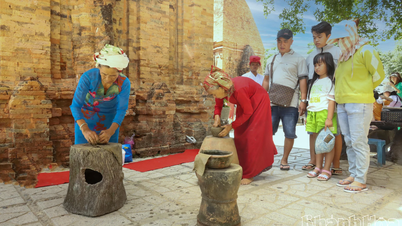
Tourists go to the mountains not only to shop but also to experience, to hear the sound of streams, to smell the smoke from the kitchen, to see the hands of ethnic women dyeing indigo, to taste corn wine; to see men carrying bundles of firewood and agricultural products to the market.
The mountains are not just goods, they are culture, the story of the community, the breath of the mountains and forests. Agricultural products associated with experiential tourism, the products become memories, identity becomes added value, indigenous knowledge becomes unique. Each village chooses a very unique product to welcome guests, sincere and truly indigenous.
With the image of people carrying "a pig and a few chickens" to the market, he asked: "Is this considered commodity production?"
According to him, if we use the plain scale to evaluate mountainous areas, it is "very unrealistic".
From that, he affirmed: "Only ethnic minorities understand the reality best to determine appropriate targets."
Where does the poor province get counterpart capital?
Resources and counterpart ratios continued to be issues raised by many delegates at the meeting. Delegate Ha Sy Huan (Thai Nguyen delegation) analyzed that, in the total State support capital of 500 trillion VND, the central budget capital only accounts for 100 trillion VND (20%), while the local budget is 400 trillion VND (80%). The delegate commented that "this structure shows that the proportion of the central budget is not commensurate with its leading role. Meanwhile, the local counterpart ratio is quite high, causing the financial burden to be concentrated mainly in the locality, creating great pressure on disadvantaged provinces, especially ethnic minority and mountainous areas with high poverty rates".
Delegate Pham Van Hoa also said that it is not feasible for localities to contribute 400 trillion VND.
He analyzed: "Where can poor mountainous provinces get the counterpart funds? We must clearly separate mountainous and delta areas. Hanoi, Ho Chi Minh City, Da Nang, Can Tho, and Hai Phong certainly have different ratios compared to mountainous provinces."
In addition, mobilizing 380,000 billion VND from enterprises is also assessed by him as "very difficult", because "over the past many years, there have been very few enterprises investing in mountainous areas, and in some provinces, there are almost none".

Delegate Do Van Yen. Photo: National Assembly
Agreeing with the request for special priority for disadvantaged areas, delegate Do Van Yen (HCMC) said that the allocation of central budget capital must be based on the principle of "prioritizing especially disadvantaged areas and ethnic minority areas".
However, to increase efficiency, he proposed adding allocation criteria based on the level of target completion and disbursement efficiency of the previous period.
According to delegate Yen: “Linking capital allocation with implementation efficiency will create strong motivation for localities, reducing the situation of slow capital disbursement or scattered investment”. He emphasized that this measure will help promote progress and improve program efficiency.
Vietnamnet.vn
Source: https://vietnamnet.vn/tran-tro-voi-khoi-bep-nuong-ngo-dai-bieu-kien-nghi-chinh-sach-dan-toc-thieu-so-2469707.html


![[Photo] 60th Anniversary of the Founding of the Vietnam Association of Photographic Artists](/_next/image?url=https%3A%2F%2Fvphoto.vietnam.vn%2Fthumb%2F1200x675%2Fvietnam%2Fresource%2FIMAGE%2F2025%2F12%2F05%2F1764935864512_a1-bnd-0841-9740-jpg.webp&w=3840&q=75)

![[Photo] Cat Ba - Green island paradise](/_next/image?url=https%3A%2F%2Fvphoto.vietnam.vn%2Fthumb%2F1200x675%2Fvietnam%2Fresource%2FIMAGE%2F2025%2F12%2F04%2F1764821844074_ndo_br_1-dcbthienduongxanh638-jpg.webp&w=3840&q=75)









































































Comment (0)