

The weakening of the economic engine, coupled with persistently high inflation and the lack of any indication that the European Central Bank (ECB) will soon ease monetary policy, is casting a dark shadow over the economic growth prospects of the Eurozone.
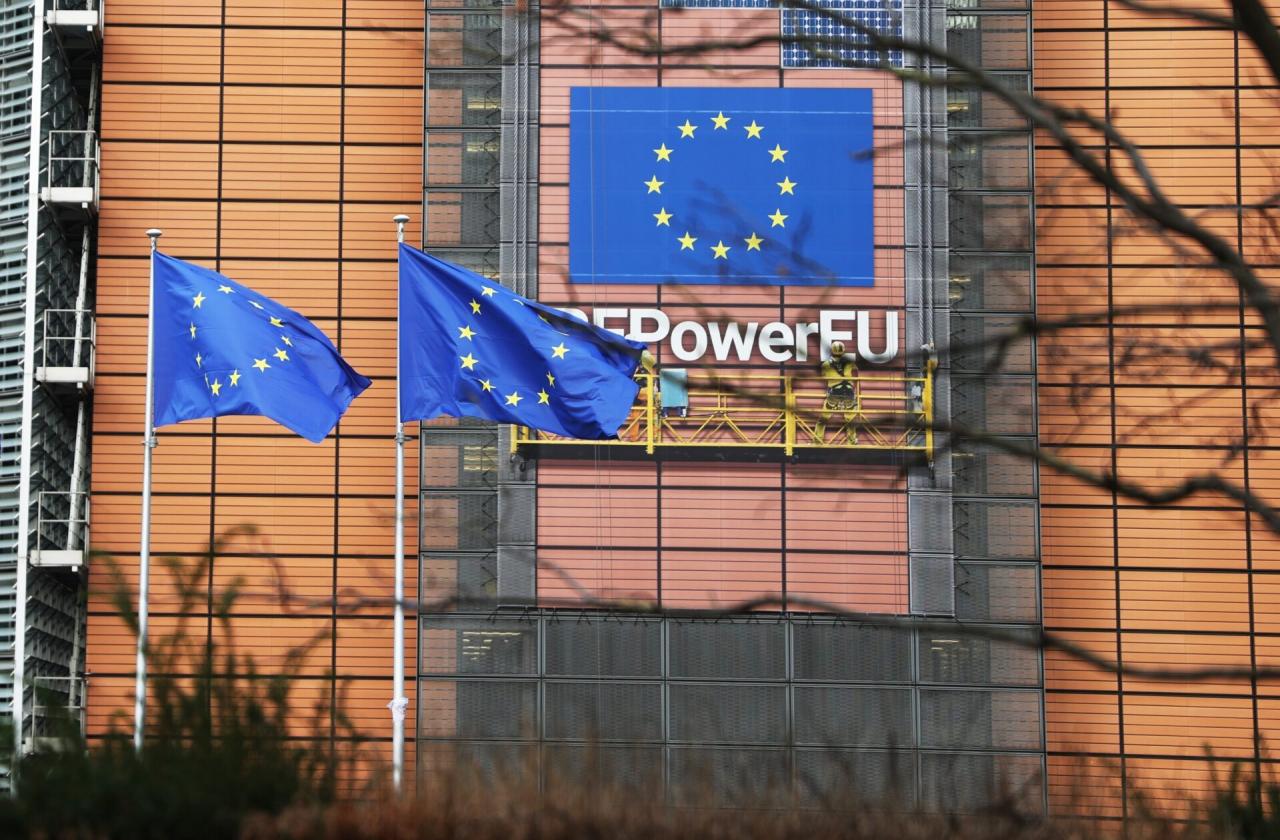
The European Commission (EC) building in Brussels, Belgium. Photo: THX/VNA
Against this backdrop, the European Commission (EC) recently lowered its Eurozone growth forecast to 0.6% in 2023, a decrease of 0.2 percentage points compared to its previous forecast, and 1.2% in 2024, a decrease of 0.1 percentage points.
The leading economic engines are still weak.
The latest statistics from the European Statistical Agency (Eurostat) show that in the third quarter of 2023, the Eurozone experienced negative economic growth of 0.1%. Prior to that, the economy of this 20-nation common currency area recorded only 0.2% growth in the second quarter of 2023. This reflects the difficulties the Eurozone is facing, including the cost of living crisis and concerns about weak demand in the global economy.
Notably, in the third quarter of 2023, Germany – Europe's largest economy – contracted by 0.1%, primarily due to the severe impact of rising energy costs, sluggish industrial production, and high interest rates. Meanwhile, France – the region's second-largest economy – grew by only 0.1%, Italy – the Eurozone's third-largest economy – remained virtually flat, and Austria recorded a 0.6% decline.
However, a positive sign for the Eurozone is that inflation in the region is showing signs of cooling down. According to Eurostat, in October 2023, the consumer price index (CPI) in the region fell from a peak of 10.6% in October 2022 to 2.9%, the lowest since July 2021. This figure is a significant decrease from 4.3% in September 2023 and lower than analysts' predictions, which expected inflation to remain above 3%.
On a Europe-wide scale (including EU member states that do not use the euro), according to Eurostat, the economic situation of all 27 EU countries is brighter, with growth of 0.1% in the third quarter of 2023.
EU Economic Commissioner Paolo Gentiloni said: “We are coming to a close on a challenging year for the EU economy, with real growth lower than expected.” “Real GDP barely grew in the first three quarters of this year and is expected to recover only slightly in the coming quarters.”
A bleak outlook
Although the Eurozone is gradually overcoming the shocks from the COVID-19 pandemic and the Russia-Ukraine military conflict, many remain concerned about the economic impact of the Hamas-Israel conflict on the region's economy. Notably, despite a decrease, inflation in the Eurozone remains high. This prevents the ECB from aggressively cutting interest rates.

A shop displays a discount sign in Brussels, Belgium. Photo: THX/VNA.
Against this backdrop, in mid-November, the EC lowered its 2023 Eurozone growth forecast to 0.6%, a decrease of 0.2 percentage points compared to its previous forecast. For 2024, the EC forecasts the region's economy will grow at 1.2%, a decrease of 0.1 percentage points compared to its previous forecast.
According to EC forecasts, Germany – the Eurozone's largest economy – will contract by 0.3% this year before experiencing a "moderate recovery" and achieving positive growth of 0.8% next year and 1.2% in 2025. France – the region's second-largest economy – will achieve growth of 1.0% this year, 1.2% next year, and 1.4% in 2025.
Both Europe and the United States are grappling with persistently high inflation. However, in contrast to the gloomy outlook in the Eurozone, the US economy is recovering strongly, with growth reaching 4.9% in the third quarter of 2023, mainly due to persistently high inflation in the Eurozone driven by high energy prices. Eurostat forecasts inflation in the Eurozone at 5.6% in 2023 and 3.2% next year.
However, given the complex and unpredictable global situation, forecasts for inflation and growth in the Eurozone are likely to shift in a more negative direction. EU Economic Commissioner Gentiloni warned that global developments could shake world energy markets – particularly the possibility of the Israel-Hamas conflict spreading to the Middle East – posing a "downside risk". He said: “Increased geopolitical tensions have added to uncertainty and risk clouding the (economic) outlook.”
Mai Huong






































































Comment (0)