

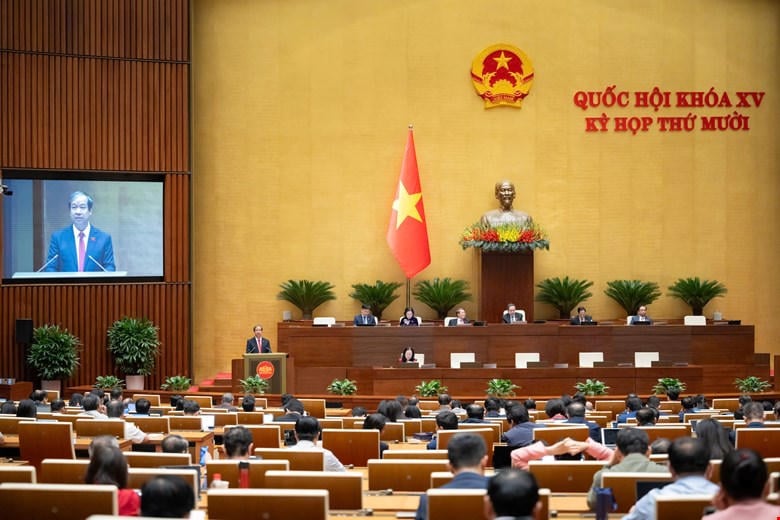
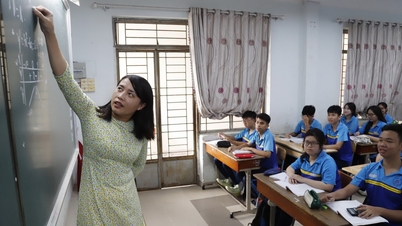
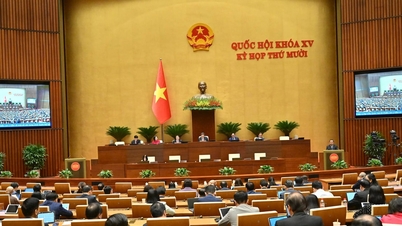
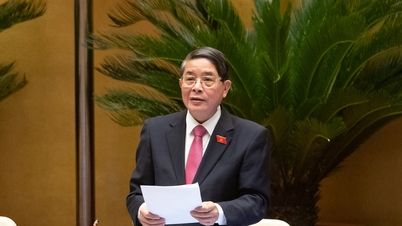
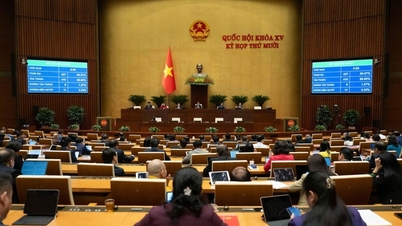
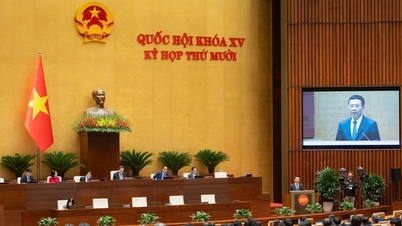
The Law amending and supplementing several articles of the Law on Education, passed by the National Assembly, will take effect from January 1, 2026, with many notable new points. One of the most anticipated regulations is that the Minister of Education and Training will decide on a set of general education textbooks to be used uniformly nationwide, and the Government will regulate the provision of free textbooks for students.
The National Textbook Review Council is established by the Minister of Education and Training for each subject and educational activity to review textbooks. The Council and its members are responsible for the content and quality of the review.
The Minister of Education and Training approves textbooks for use in general education institutions after they have been evaluated and rated as satisfactory by the National Textbook Appraisal Council; and prescribes the standards and procedures for compiling and revising general education textbooks.

The law also stipulates that diplomas of the national education system are documents in paper or numerical form issued to learners upon graduation from high school; learners who complete educational programs, training programs and meet the output standards of the corresponding level in vocational education and higher education.
Diplomas from the national education system include: high school diploma, vocational high school diploma, intermediate diploma, college diploma, bachelor's degree, master's degree, doctoral degree, and diplomas from specialized training programs in certain fields and disciplines.
Certificates of the national education system are documents in paper or digital form issued to learners to confirm their learning outcomes after training, advanced education, or professional development, or to learners who have taken examinations to obtain certificates as prescribed.
Thus, compared to current regulations, the Law amending and supplementing a number of articles of the Law on Education abolishes the issuance of junior high school graduation certificates, replacing it with the phrase "completion of junior high school program or equivalent".
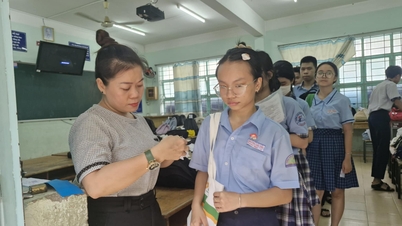
Students who have completed the primary education program and the lower secondary education program, and meet the requirements stipulated by the Minister of Education and Training, will have their academic records certified by the school principal as having "completed the lower secondary education program or equivalent".
Students who have completed the high school education program and meet the requirements stipulated by the Minister of Education and Training are eligible to take the exam. If they pass, the school principal will award them a high school diploma.
In cases where students do not take the exam or fail to meet the requirements, the school principal will issue a certificate of completion of the general education program. This certificate of completion of the general education program can be used to register for the high school graduation exam when the student wishes, or to pursue vocational education, and in specific cases as prescribed by law.
The draft also stipulates that diplomas and certificates will be issued in paper or digital form, aiming to promote the implementation of digital transformation policies in education.
For postgraduate advanced training programs in the health sector leading to degrees such as residency and specialist doctor programs, the guidance on organization, implementation, and management will be carried out by the Ministry of Health in accordance with the provisions of the draft Law on Higher Education (amended).
Source: https://daidoanket.vn/tu-nam-2026-bo-cap-bang-thcs-mien-phi-sach-giao-khoa-cho-hoc-sinh.html




















































































Comment (0)