

New pressures in the era of climate change
Around the world , traditional forecasting methods are being replaced by high-resolution numerical models, advanced data assimilation systems, and especially breakthroughs in AI and deep learning. Leading meteorological organizations such as ECMWF or JMA have applied AI to correct errors, make instant forecasts, and exploit increasingly rich open data warehouses from the World Meteorological Organization (WMO), opening a new era of data- and AI-based meteorological forecasting.
In Vietnam, the impacts of climate change are increasingly evident through the increased frequency and extremity of strong storms, localized heavy rains, flash floods, and landslides. This has caused forecasting requirements to shift from describing phenomena to predicting impacts; from qualitative forecasting to quantitative, detailed, timely, and earlier forecasting, creating great pressure for the hydrometeorological sector to accelerate technological innovation and digital transformation.
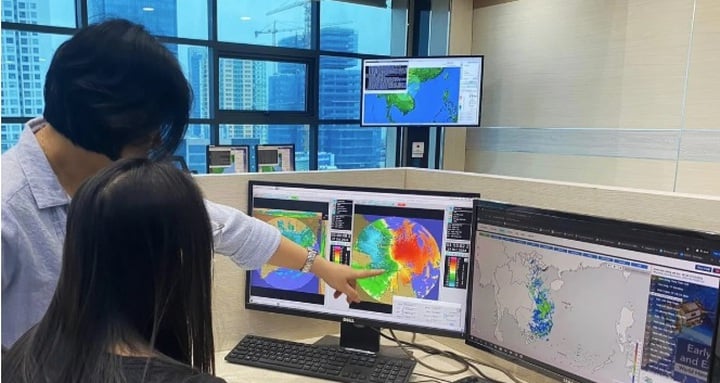
Traditional forecasting methods are being replaced by the application of AI and big data to monitor, analyze, forecast, and warn of hydrometeorology.
In recent years, the hydrometeorological sector has also faced important opportunities for modernization. The operation of the Cray XC40 supercomputer has created a major step forward in computing capacity. With a capacity of nearly 80 TFLOPS, the system helps run a 3 km resolution forecast model for the entire territory and the East Sea in just 30-40 minutes, putting Vietnam in the group of countries with strong forecasting infrastructure in the region.
Together, a network of more than 3,200 automatic rain stations, 10 weather radars and a lightning positioning system has created a continuously updated 1×1 km high-resolution data source, an important basis for forecasting models. These data have proven effective in many practical situations, such as the historic rains in the Central region in 2020 or the heavy rains in 2024.
Vietnam has also been recognized by WMO as a Regional Support Center for Severe Weather Warning (SWFP-SeA) and a Regional Flash Flood and Landslide Warning Center (SeAFFGS), expanding access to advanced technology, standardizing processes and enhancing international cooperation.
However, the challenges remain enormous. The computing infrastructure for AI and Big Data storage systems have not yet met the needs of operating deep learning models. Hydrometeorological data is scattered and lacks synchronization between ministries and sectors; some areas such as borders and islands still lack data. The cost of operating high-tech monitoring systems is high, while the socialization mechanism is limited. Human resources with knowledge of both numerical models, AI and big data analysis have not yet met the development requirements. In addition, maintaining a role in international cooperation programs requires a stable source of funding.
Breakthrough from technology and artificial intelligence
In recent years, the hydrometeorological sector has strongly implemented solutions to modernize the forecasting process. High-resolution numerical forecast models (1-3 km) have been upgraded, assimilating domestic observation data and combining international products from ECMWF, helping to shorten the forecast release time from 5-8 hours to 2-3 hours. The ensemble forecasting system with 32 short-term components and 51 medium-term components supports the construction of probability maps, impact forecasts and detailed rainfall for each commune and ward.
Since 2019, the SmartMet system has gradually replaced manual analysis, helping to visualize, edit and synchronize forecast data in real time between central and local levels, significantly shortening the time to release bulletins.
AI is beginning to play an important role in forecasting. Deep learning models are being applied in typhoon identification, ultra-short rainfall forecasting, Himawari satellite image analysis, early identification of storm center locations, and improved tropical cyclone intensity forecasting. The case of Typhoon Noru in 2022 showed that AI models integrating satellite and radar data can support early identification of storm developments when entering the East Sea, helping to increase the early warning time to 72 hours.
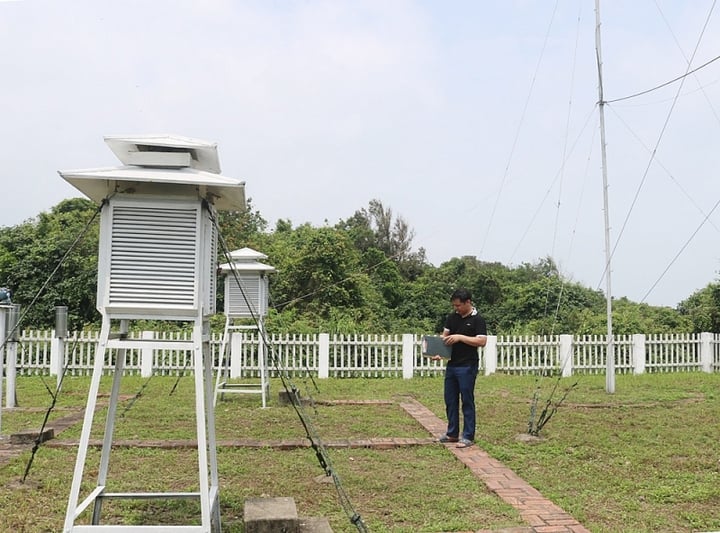
AI applications are being strongly applied to serve forecasting work.
Forecast quality has improved significantly. Storm forecasting timescales have increased from 24 hours to 3 days; early warnings have been issued 5 days in advance; storm location errors at 48-hour intervals have been halved. Heavy rain forecasts and flood warnings 2-3 days in advance have reached a reliability of about 75%; localized thunderstorm warnings have reached from 30 minutes to several hours in advance; severe cold and widespread heat forecasts have reached a reliability of 70-90%.
International cooperation continues to play an important role. Vietnam maintains professional exchanges with JMA (Japan), CMA (China) and many major meteorological agencies in data sharing, consensus assessment and human resource training. Even during the Covid-19 period, WMO training courses were maintained online, ensuring professional development for forecasters in the country and the region.
According to the Department of Hydrometeorology, Ministry of Agriculture and Environment , in the period 2025-2030, the hydrometeorology sector will develop based on three pillars: modernizing the monitoring network; improving forecasting capacity towards impact and real-time forecasting; comprehensive digital transformation. In particular, completing the automatic and synchronous monitoring network, especially in areas lacking data, is a priority task. The sector aims to increase computing capacity by 5-10 times compared to 2020; develop a hybrid model combining numerical forecasting and AI; increase the ability to warn of flash floods and landslides by 6-12 hours and warn of storms 3-5 days in advance.
Comprehensive digital transformation requires integrating 100% of data into the National Hydrometeorological Database, while building a legal mechanism to promote the socialization and commercialization of hydrometeorological services. The key factor is still people, the industry focuses on in-depth training in AI, big data, modern forecasting models and expanding international cooperation, especially with WMO and countries with advanced hydrometeorology, to receive, master and develop new generation forecasting technologies.
Source: https://mst.gov.vn/ung-dung-khoa-hoc-cong-nghe-tri-tue-nhan-tao-va-chuyen-doi-so-trong-cong-tac-du-bao-khi-tuong-thuy-van-197251201234112479.htm

![[Photo] Cat Ba - Green island paradise](/_next/image?url=https%3A%2F%2Fvphoto.vietnam.vn%2Fthumb%2F1200x675%2Fvietnam%2Fresource%2FIMAGE%2F2025%2F12%2F04%2F1764821844074_ndo_br_1-dcbthienduongxanh638-jpg.webp&w=3840&q=75)



























![[VIMC 40 days of lightning speed] Da Nang Port: Unity - Lightning speed - Breakthrough to the finish line](https://vphoto.vietnam.vn/thumb/402x226/vietnam/resource/IMAGE/2025/12/04/1764833540882_cdn_4-12-25.jpeg)































Comment (0)