

That's the memory of Mr. Do Duc Long, a former official of the Hanoi City Party Committee, which flooded back like a slow-motion film, vivid and moving, before the thematic exhibition "The Triumphal Song Resounds Forever," organized by the Hoa Lo Prison historical site to commemorate the 71st anniversary of the liberation of the capital. Each photograph, document, and artifact seemed to tell the story of a heroic Hanoi, from the days of war to the glorious moment of welcoming the victorious army and taking over the capital on October 10, 1954.
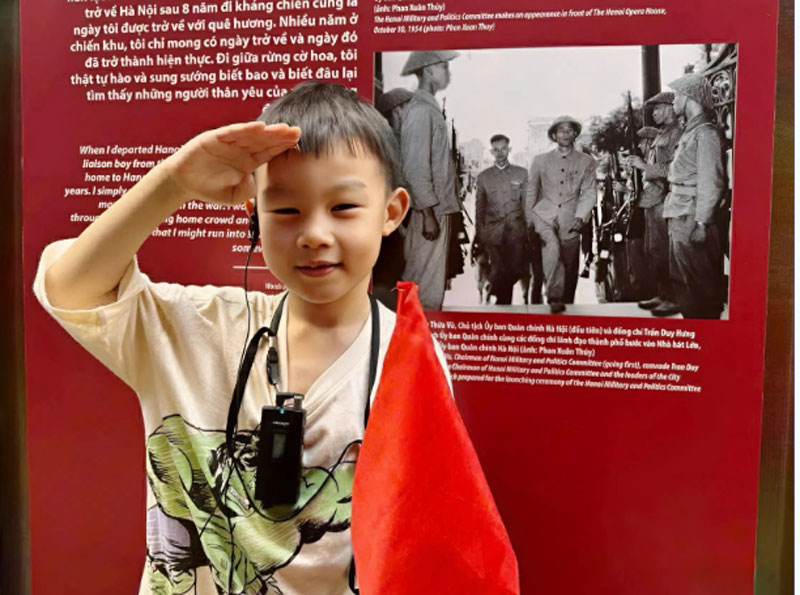 |
| Hoang Viet Quang Anh, a descendant of Lieutenant General Vuong Thua Vu's family, expressed his pride in his ancestors at the exhibition. |
At the "Unwavering Determination" exhibition, viewers journey back in time to the winter night of December 19, 1946, the moment the nationwide resistance began, through the photograph "Lang Fortress preparing to fire," captured by photographer Nguyen Ba Khoan. In these old photographs, the eyes of the soldiers of the Capital Regiment shine with unwavering faith, bearing the solemn oath, "We will die so that the Fatherland may live."
Moving on to "Hanoi - The Day of Victory," the central image is a photograph of the signing of the Geneva Accords in 1954, marking a crucial step in the struggle for national independence. Beside it, a map of the French army's 80-day assembly point evokes memories of a Hanoi temporarily divided, before the light of freedom burst forth when the capital was completely liberated. Against a backdrop of vibrant red, black-and-white photographs recreate many precious moments of that historic October: the misty Long Bien Bridge, the flag-strewn Trang Tien Street, a child waving a flag on his father's shoulder, an elderly woman with gray hair giving a bouquet of flowers to a young soldier, a map of the march to take over the capital, the footsteps of the troops through the streets...
Amidst the crowds of visitors, we encountered the relatives and family of Lieutenant General Vuong Thua Vu, Commander of the Hanoi Front. In 1941, he was captured by the French colonialists and imprisoned in Hoa Lo Prison for a period. There, he fought fiercely, earning the whispers of the French soldiers about him as a "formidable warrior"; "a master of martial arts and military tactics, proficient in all eighteen martial arts," and revered by his fellow prisoners as a "saint of martial arts." Just a few years later, this same courageous prisoner commanded the final defense of Hanoi in 1946, transforming every house and street corner into a fortified position, tenaciously holding his ground and fighting to the death for the capital. It was also Commander Vuong Thua Vu who led the victorious army back to take over Hanoi after nearly nine years of arduous resistance. He recorded this entire historical journey in his writings, imbued with a spirited and deeply moving quality.
At the Hoa Lo Prison historical site today, gazing at the faded documents and images, Mr. Hoang Viet Thang, great-grandson of Lieutenant General Vuong Thua Vu, emotionally shared: “We are extremely grateful and happy that the names and contributions of our ancestors are etched in the flow of history. Through this exhibition, we can see again the simple, resilient, and passionate image of a revolutionary soldier who dedicated his life to serving the Fatherland. This will forever be a guiding light, a reminder for the younger generation to live up to that glorious past.”
At the end of the journey, the tranquil beauty of Hanoi is captured in "The Charm of Hanoi." Against the backdrop of the song "People of Hanoi," the hand-embroidered ao dai, wooden clogs, blue-glazed ceramic teapot, and serene photographs of the old town after liberation evoke the refined culture of the people of Thang An (Hanoi) in the early morning of peace.
Source: https://www.qdnd.vn/van-hoa/doi-song/vang-khuc-khai-hoan-thu-do-912793
![[Photo] Standing Committee member of the Party Central Committee Tran Cam Tu working with the Central Inspection Committee](https://vphoto.vietnam.vn/thumb/1200x675/vietnam/resource/IMAGE/2026/05/28/1779969579668_ndo_br_bnd-2495-jpg.webp)













































































Comment (0)