

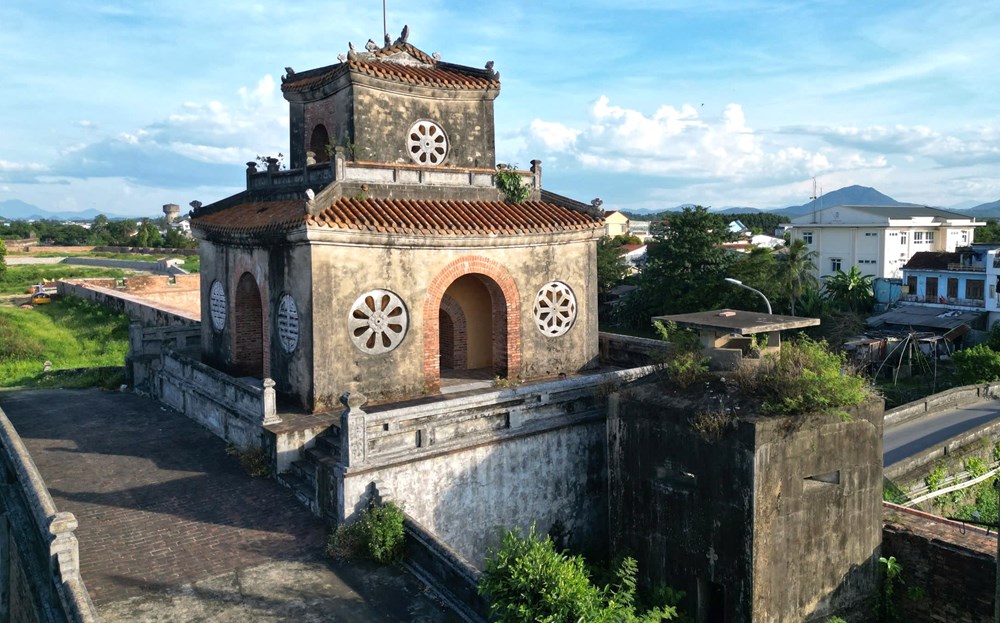
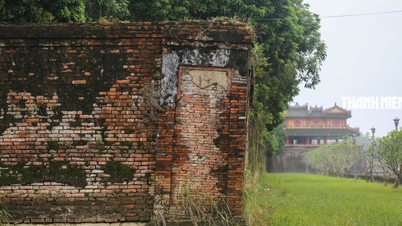
The circular bunker is located next to the watchtower of the Southwest Gate, also known as the Right Gate, leading into the Hue Citadel.
The story about dismantling the military structures in the Hue Citadel area has been discussed for many years. However, at that time, Hue City had not yet implemented the "Relocation of residents and land clearance project for Zone I of the Hue Citadel," so all opinions were merely discussions, suggestions, and projections.
One or two structures should be preserved as historical evidence.
Since the implementation of the project in 2019 and in subsequent years, approximately 5,000 households in the Thượng Thành area have been relocated and resettled. Along with the implementation of this project, the local authorities have also paid close attention to preserving and promoting the value of the Imperial Citadel relics. Specifically, the Thượng Thành area has been restored, renovated, and a pedestrian walkway is being gradually constructed around the citadel.
However, within the citadel area, 31 military structures built by the US military between 1957 and 1975 still exist. These structures are scattered in various locations, mainly on the Upper Citadel (the top of the citadel wall). Previously, some of these bunkers were used by locals as auxiliary structures, so after the residents moved away, they were abandoned and dilapidated, with some becoming gathering places for social delinquents.
Furthermore, some bunkers are located right on the pedestrian walkways of the Upper Citadel or partially overlap with the citadel walls, which is both unsightly and potentially damaging to the walls in those locations in the long term. The policy of dismantling the bunkers and underground tunnels inside the Hue Citadel is widely supported to restore the overall landscape of the historical site.
This provides a basis for developing a long-term and sustainable heritage system. However, on some forums, many opinions also suggest that some bunkers should be preserved because they are part of history and could be a "highlight" of the Hue citadel.
According to Associate Professor Dr. Do Bang, Vice President of the Vietnam Historical Science Association, history is always characterized by overlapping and continuous processes. Military structures in the Hue citadel area need to be preserved, but not all of them, as they are not characteristic of the Nguyen Dynasty citadel's historical site system.
“The citadel itself had a defensive function, as did the bunkers built later. Therefore, in my opinion, we shouldn't leave all of these bunkers intact because it would diminish the value of the entire Hue citadel system. However, we also shouldn't dismantle them all because they are also ‘historical relics.’ Instead, we should select the most characteristic and representative structure to preserve. If any historical events or battles took place there, that would be even better, as the site itself will have a story to tell,” Associate Professor Do Bang stated.
Sharing the same viewpoint, Dr. Phan Tien Dung, former Director of the Department of Culture and Sports and currently Chairman of the Hue City Historical Science Association, stated: When compiling the heritage dossier for the Hue Imperial Citadel Complex, information about the citadel area did not mention these bunkers, but only the system of ramparts under the Nguyen Dynasty. Now, we are focusing on preserving the cultural values of the Hue Imperial Citadel Complex intact, so dismantling these bunkers is reasonable. Furthermore, selecting one or two structures in certain locations to demonstrate a period of anti-American resistance here could also be acceptable.
"When constructing a pedestrian walkway on the Upper Citadel, having existing fortifications obstructing the view would make urban planning and the movement of residents and tourists somewhat difficult. Therefore, in my opinion, we should only choose one or two historically significant structures that serve as evidence of our victories to preserve, and proceed with the demolition of the rest," said Dr. Phan Tien Dung.
Ensuring the absolute safety of the heritage site must be the top priority.
Representatives from the Hue City Department of Culture and Sports also stated that, from an overall perspective, dismantling the bunkers is appropriate to ensure the longevity of the citadel. This will create more opportunities to preserve, conserve, and promote the value of the Hue citadel. In some locations on the Upper Citadel, the bunkers are wedged against the city walls, which will eventually affect the surrounding areas; over time, they will subside, causing cracks in the walls and impacting aesthetics and the landscape.
"If these structures aren't dismantled, the construction of a pedestrian walkway on the Upper Citadel later will affect the landscape and access. If we want to preserve them, we should only consider the bunkers located below, not those on top of the Upper Citadel. When dismantling them, we should also take photos and videos for future display or to tell the historical story of these structures," a leader from the Department of Culture and Sports shared.
Many experts, researchers, and members of the community have also expressed the view that when dismantling combat structures in the Hue Citadel area, safety must be ensured, appropriate construction plans must be in place, and the impact on historical relics, especially the structural system of the citadel walls, must be minimized.
“It’s important to know that the system of bunkers and underground tunnels within the Hue Citadel was built very solidly. The walls and foundations of these structures vary in thickness and depth, and more dangerously, many bunkers were built right next to the citadel walls. Therefore, the dismantling method needs to be carefully considered by all relevant parties, with the participation of many sectors and fields, and needs to be assessed and evaluated by the relevant ministries and agencies responsible for heritage management. Restoring the space and landscape of the historical site is important, but ensuring absolute safety for the heritage during the construction and dismantling process must be prioritized,” a researcher stated.
According to a decision by the Hue City People's Committee, the dismantling of 31 combat structures in the Hue Citadel area, including 26 bunkers, 2 shelters, 2 watchtowers, 1 anti-aircraft position, and 9 combat structures at the Tran Hai Citadel, Van Mieu - Vo Mieu historical sites, will have a total estimated cost of 31 billion VND.
The project was assigned to the Investment and Construction Project Management Board of Region 1, Hue City, in coordination with the City Military Command, to review the procedures. Speaking with us, a representative from the Hue City Military Command stated that, following surveys by Military Region 4, they have basically agreed to the dismantling of the bunkers in the Hue Citadel area. However, this matter still requires the approval of the Ministry of National Defense leadership, so the process is awaiting approval.
Expedite Phase 2 of the project to preserve, restore, and beautify the Hue Imperial Citadel system.
Hue City is accelerating the second phase of the project to preserve, restore, and beautify the Hue Citadel system (the project). This project is part of the key urban development program.
The People's Committee of Hue City has just directed relevant units to implement and approve compensation, support, and resettlement plans for households affected by the project before September 30, 2025. Phase 2 of the project (investment policy adjusted in December 2024), to be implemented from 2024-2025, has a total investment of over 367 billion VND, aiming to relocate approximately 744 households (264 main households, 480 secondary households) and clear 44.4 hectares of land within the scope of historical sites (16 areas) including: Ho Quyen, Voi Re, Thien Mu Pagoda, Van Mieu - Vo Mieu, Minh Mang Tomb, Thieu Tri Tomb, Duc Duc Tomb, Dong Khanh Tomb, Khai Dinh Tomb, Gia Long Tomb, Truong Co Tomb, Co Thanh Tomb, Tran Hai Citadel, Van Van Tomb, Dan Am Hon, and Quoc Tu Giam. The project also involved relocating 31 combat structures within the Hue Citadel area and 9 combat structures in the Tran Hai Citadel and Van Mieu - Vo Mieu historical sites.
By August 2025, phase 2 of the project had completed surveying the areas. Authorities issued notices of land acquisition and carried out inventory work in many project areas. Regarding the relocation of 31 combat structures (mostly bunkers) in the Hue Citadel area and 9 combat structures in the Tran Hai Citadel and Van Mieu - Vo Mieu historical sites, the Project Management Board for Investment and Construction Area 1 is coordinating with the Hue City Military Command to carry out the necessary procedures for implementation.
In phase 1 (2019-2023), Hue City has basically implemented the relocation of residents and land clearance within the Hue Imperial Citadel relic area, encompassing 11 areas with over 5,000 households in Thuong Thanh, Eo Bau, Ho Thanh Hao and Tuyen Phong Lo, Tran Binh Dai, Ho Tinh Tam, Dan Xa Tac, the roads adjacent to the City Military Command, Ho Hoc Hai, Kham Thien Giam, Xien Vo Tu, and Luc Bo at Thuong Thu Duong Bo Cong. The city has completed the construction of 10 resettlement areas with a total area of nearly 83 hectares to provide new housing for the relocated households as per regulations.
Source: https://baovanhoa.vn/doi-song/van-cho-tham-dinh-phe-duyet-160682.html


![[Image] Close-up of the newly discovered "sacred road" at My Son Sanctuary](/_next/image?url=https%3A%2F%2Fvphoto.vietnam.vn%2Fthumb%2F1200x675%2Fvietnam%2Fresource%2FIMAGE%2F2025%2F12%2F13%2F1765587881240_ndo_br_ms5-jpg.webp&w=3840&q=75)





![[Photo] Inside the Imperial Academy relic of Hue Citadel before the hundred billion dollar restoration](https://vphoto.vietnam.vn/thumb/402x226/vietnam/resource/IMAGE/2025/9/18/77fd186af68341b1a8bffd072fa896a6)







































































Comment (0)