

Vietnam is increasing its spending by billions of dollars importing key goods from the US, thereby helping to boost the domestic economy , reduce the trade surplus, and promote the comprehensive strategic partnership between Vietnam and the US.
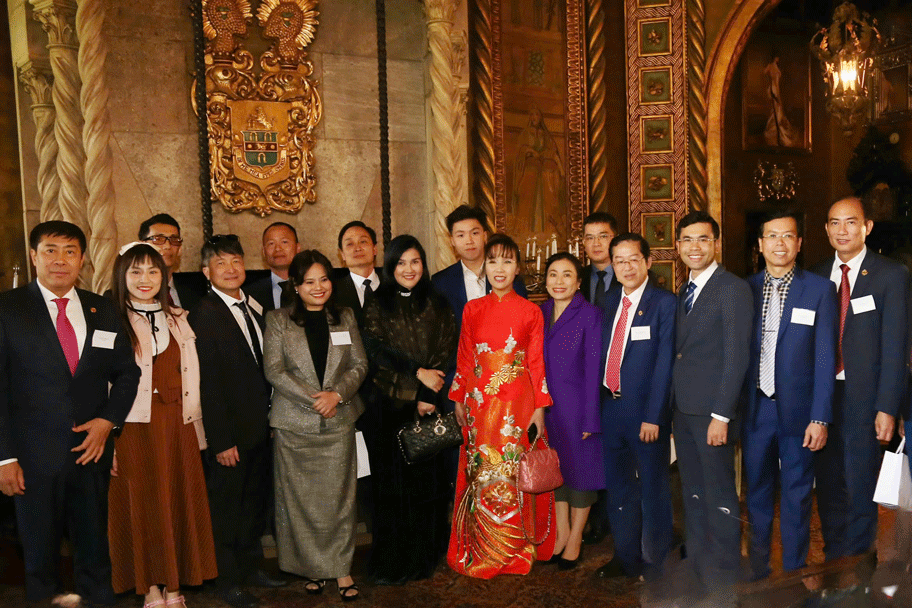
Billionaire and founder of Vietjet (VJC), Nguyen Thi Phuong Thao, recently met with strategic partners from around the world at the Mar-a-Lago estate of US President-elect Donald Trump during the "Friends of Vietnam Summit" event from January 9-11.
This is a notable event in US-Vietnam economic relations, ahead of Donald Trump's return to the White House (January 20).
VietJet's increased purchase of Boeing aircraft from the US not only strengthens trade relations between the two countries but also promotes cooperation in the aviation sector and enhances connectivity both domestically and internationally .
According to VietJet, Boeing will deliver 14 737 Max aircraft to Vietjet in 2025. In 2017, at the suggestion of President Trump, Vietjet ordered 100 aircraft, bringing the total number of 737 Max aircraft ordered by VietJet from Boeing to 200.
This is a major deal for VietJet. Estimated at around $100 million per aircraft, the total contract value could reach $20 billion. With such a large-scale purchase, the discounted price is likely to be very attractive, benefiting both VietJet and the American aircraft manufacturer Boeing.
VietJet's deals represent the largest commercial aircraft purchase and sale agreements in the history of the Vietnamese aviation industry, and also the largest in Asia, involving the B737 Max model.

Boosting purchases of American goods.
Since 2011, the United States has consistently been a key export market for Vietnam, currently accounting for nearly 30% of Vietnam's total export value. Major export items include textiles, footwear, furniture, seafood, and agricultural products.
Conversely, Vietnam is also increasing its imports of goods from the US, not only machinery for production but also agricultural products.
According to statistics from the General Department of Customs, in 2024, the whole country imported more than 15.1 billion USD worth of goods from the US, an increase of more than 9.4% compared to the more than 13.8 billion USD in 2023.
Specifically, imports of computers, electronic products and components reached nearly $4.34 billion, compared to over $3.8 billion in 2023; imports of machinery, equipment, tools and spare parts from the US reached nearly $1.1 billion, compared to nearly $919 million in 2023.
Imports of animal feed and raw materials from the US in 2024 also reached nearly $1.02 billion, a sharp increase from nearly $762 million in the previous year.
In 2024, Vietnam also imported nearly $784 million worth of plastic raw materials from the US, compared to $717 million in 2023. Imports of pharmaceuticals from the US totaled nearly $513 million, compared to $393 million. Imports of fruits and vegetables reached $544 million, compared to $332 million in 2023.
However, imports of some other items from the US decreased, such as cotton ($681 million, compared to $912 million), chemicals ($637 million, compared to $683 million)...
Trade growth from comprehensive strategic partnerships.
For many years, Vietnam has had a large trade surplus with the United States and has frequently been placed on the US government's watchlist for currency manipulation.
The US determines whether a country is manipulating its currency based on three criteria: a bilateral goods trade surplus with the US (not exceeding $15 billion); a current account surplus (not exceeding 3% of GDP); and unilateral and prolonged intervention in the foreign exchange market.
The third criterion is based on the total net amount of foreign currency purchased by the central bank over the 12 months.
If a major trading partner of the U.S. exceeds two out of three of the above criteria, the U.S. will place it on a "watch list." That country will also remain on this list for at least two subsequent reporting periods.
According to the conclusions announced in November 2024, the US continues to determine that Vietnam does not manipulate its currency. The US Treasury Department has a positive assessment of Vietnam's monetary policy.
In fact, the bilateral trade surplus between Vietnam and the United States has expanded significantly over the past six years, primarily due to growth in goods trade, led by electronics and machinery. The bilateral goods trade surplus between Vietnam and the U.S. in 2024 was $104.4 billion (Vietnam exported $119.5 billion). Vietnam ranks third among the U.S.'s major trading partners in terms of trade surplus, after China and Mexico.
When a country is accused by the US of currency manipulation, it will be barred from participating in economic contracts with the US government and may face tariffs and other trade barriers.
Increasing imports of American goods to reduce the trade surplus is seen as a solution to maintain a positive economic relationship between the two countries.
Vietnam could focus on importing goods that are crucial for national development, such as: machinery for thermal power plants (serving infrastructure), purchasing aircraft, high-tech products, etc.
When large corporations increase their use of high-quality American products and services, it helps to improve domestic economic efficiency and prospects, while also reducing the trade surplus with the United States.
The United States is a leading country in technology, especially in chip technology, aerospace technology, and renewable energy technology. Collaborating with companies like Nvidia, Apple, and SpaceX is in line with the development trends of the Vietnamese economy.
Source: https://vietnamnet.vn/viet-nam-gia-tang-nhap-hang-my-rieng-ty-phu-viet-co-thuong-vu-hang-dau-chau-a-2364422.html


































































![[Infographic] Many activities at the 96th anniversary commemoration of the death of Deputy Scholar Nguyen Sinh Sac](https://vphoto.vietnam.vn/thumb/402x226/vietnam/resource/IMAGE/2025/12/11/1765441454787_infographic-nhieu-hoat-dong-tai-le-gio-lan-thu-96-cua-cu-pho-bang-nguyen-sinh-sac20251211010322.webp)














Comment (0)