

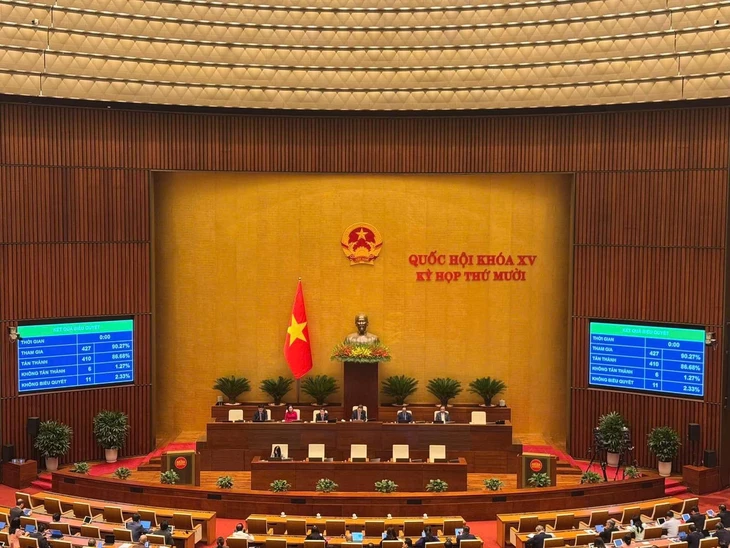
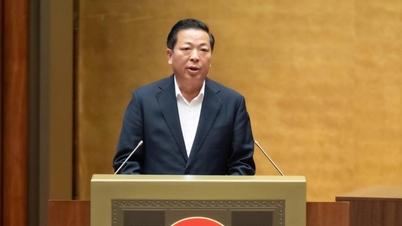
On the morning of December 11, 2025, during the final working day of the 10th session of the 15th National Assembly , with 86.68% of delegates voting in favor, the National Assembly officially passed the Resolution on the investment policy for the construction project of Gia Binh International Airport - Photo: TC
Gia Binh International Airport - the largest privately owned airport project in Vietnam's history.
The years 2025-2026 mark a historic turning point for Vietnam's aviation industry, as key national infrastructure projects enter a phase of vigorous implementation. Gia Binh International Airport (Bac Ninh) – the largest privately-owned airport project in Vietnam's history, recently approved by the National Assembly with strong consensus – will affirm Vietnam's position on the regional and global aviation map.
In particular, the presence of Masterise Group – an investor trusted and chosen by the Government and the Ministry of Public Security , with its outstanding capabilities in project management and development, along with experience in cooperating with leading global partners – will contribute to building Gia Binh International Airport to global standards, affirming its pioneering role in ushering in a new era for Vietnam's aviation infrastructure.
For the period 2026-2030, the government also aims for double-digit growth. Many believe that developing aviation infrastructure is one of the solutions to boost growth.
Infrastructure development precedes economic growth.
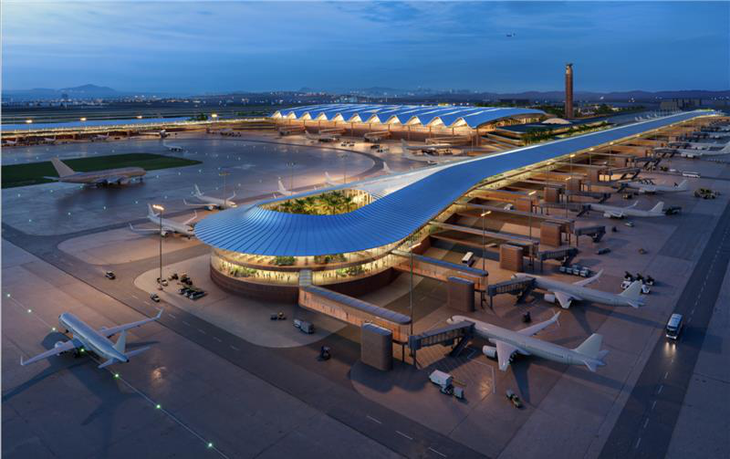
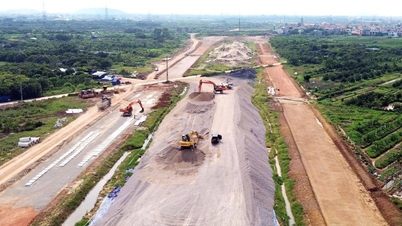
Gia Binh International Airport is seamlessly connected to the national, regional, and provincial transportation systems, including the Hanoi area, which is directly connected via expressways, urban rail, and national railways. - Photo: TC
According to the socio-economic development plan for 2026 recently approved by the National Assembly, the transportation and infrastructure sector is identified as a key investment focus, with numerous large-scale projects spanning from railways and aviation to seaports. Aviation stands out as one of the key sectors, reflecting the nation's vision of expanding connectivity in the context of deep integration.
Over the past decade, Vietnam's aviation industry has witnessed remarkable growth, making a significant contribution to promoting economic and social development, and ensuring national defense and security. The average growth rate of Vietnam's aviation industry over the past 10 years has been approximately 18%, making it the 5th fastest-growing aviation market in the world and the fastest-growing in Southeast Asia.
The rapid growth in air transport in recent years has placed significant pressure on aviation infrastructure. This issue has been recognized and addressed by authorities in the planning of the new airport system.
The National Assembly has passed a resolution on the investment plan for the construction of Gia Binh International Airport. Many believe this is a strategic and groundbreaking step, contributing to the restructuring of the aviation network in the capital region according to the "dual hub" model adopted by many major cities worldwide. Not just the airport itself, but an entire infrastructure "ecosystem" has been committed to by the investor, Masterise Group. The construction of the Gia Binh project represents a vision of a "dual hub" for the capital region. This new airport is planned according to a "twin hub" model, similar to those in London and Tokyo, strategically complementing Noi Bai Airport.
Delegate Tran Van Khai (Ninh Binh delegation) affirmed: "Bac Ninh, already a hub for the electronics industry, will now have an international air gateway right here. Manufactured goods will fly directly to the global market, and international tourists and experts will come directly to Bac Ninh, creating new investment opportunities," Mr. Khai said, emphasizing that this is a golden opportunity to restructure the economy of Bac Ninh in particular and the Northern key economic region in general, moving up to a higher value-added level in the global supply chain.
"The government's policy is not to rely entirely on the budget, but instead to create a favorable environment for private sector participation in large-scale infrastructure projects. This is an innovative and effective approach in the context of limited public funding," Mr. Khai added.
Clearly, this project has strategic significance in relieving congestion at Noi Bai Airport in the capital, while opening up new development opportunities for Bac Ninh, Bac Giang, Hai Duong, and Hung Yen provinces. With its advantageous location near high-tech industrial zones, Gia Binh International Airport is expected to become a "growth hub" for air logistics in the North.
In particular, Gia Binh is envisioned to become a next-generation smart airport, applying full-service biometrics, automated operating systems, and meeting environmental, social, and governance (ESG) criteria. The terminal is expected to integrate a range of high-end services to provide passengers with an international standard experience. This is considered a revolutionary breakthrough in the context of Vietnam's commitment to net zero by 2030.
Improve competitiveness
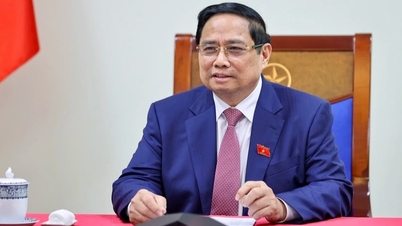
I recall that at the groundbreaking ceremony for Gia Binh International Airport in late 2024, Prime Minister Pham Minh Chinh stated: "Vietnam needs to focus on exploiting outer space, maritime space, and underwater space." In this context, exploiting outer space is not just about launching spacecraft and exploring planets; its economic significance lies in the efficient operation and maintenance of aviation infrastructure.
Prime Minister Pham Minh Chinh stated that the development of the aviation economy and the exploitation of outer space (along with the exploitation of subsurface and maritime space) is one of the new driving forces for development, contributing to promoting new productive forces and serving national development in the new era, in the context of Vietnam's "limited land and large population".
Regarding the Prime Minister's viewpoint, from a planning perspective, architect Tran Ngoc Chinh, Chairman of the Vietnam Urban Planning and Development Association, commented that adding airports to connect trade and transportation between localities is necessary. In particular, airports have great significance because they can serve dual purposes, meeting the needs of national defense as well as economic development.
Architect Tran Ngoc Chinh also affirmed: "I completely agree with the view that outer space, specifically the aviation economy, if exploited well, will bring enormous economic benefits and be an important growth driver. Looking more broadly, investing in transportation infrastructure is considered a breakthrough to create momentum for the country to enter an era of progress."
Clearly, building a sufficiently robust aviation infrastructure is a prerequisite in the overall master plan for infrastructure development. Furthermore, the private capital mobilized for Gia Binh International Airport helps reduce pressure on public investment, while also serving strategic needs related to national defense, security, and foreign relations for important events.
Previously, the draft Law on Civil Aviation of Vietnam (amended) was assessed as having strengthened mechanisms to attract investment and socialize aviation infrastructure, creating conditions to mobilize more resources for the development of this sector. National Assembly Chairman Tran Thanh Man said that this is an extremely important issue and requires groundbreaking regulations to encourage private investment and expand the public-private partnership model, especially for local and specialized airports.
Completing the aviation infrastructure system is an urgent requirement for development. It is also the "final piece" in the goal of achieving double-digit growth in 2026 and beyond. With the government's steps, the synchronized and unified connection of the aviation infrastructure system, especially through projects such as Long Thanh International Airport and Gia Binh International Airport, will not only enhance Vietnam's prestige, class, and brand but also "give wings" to economic development, improve national competitiveness, and create a launching pad for the economy to "take off."
Source: https://tuoitre.vn/cang-hang-khong-quoc-te-gia-binh-se-tao-buoc-dot-pha-don-bay-tang-truong-quoc-gia-20251211140148426.htm

![[Photo] Prime Minister Pham Minh Chinh holds a phone call with the CEO of Russia's Rosatom Corporation.](/_next/image?url=https%3A%2F%2Fvphoto.vietnam.vn%2Fthumb%2F1200x675%2Fvietnam%2Fresource%2FIMAGE%2F2025%2F12%2F11%2F1765464552365_dsc-5295-jpg.webp&w=3840&q=75)


![[Photo] Closing Ceremony of the 10th Session of the 15th National Assembly](/_next/image?url=https%3A%2F%2Fvphoto.vietnam.vn%2Fthumb%2F1200x675%2Fvietnam%2Fresource%2FIMAGE%2F2025%2F12%2F11%2F1765448959967_image-1437-jpg.webp&w=3840&q=75)


































![[OFFICIAL] MISA GROUP ANNOUNCES ITS PIONEERING BRAND POSITIONING IN BUILDING AGENTIC AI FOR BUSINESSES, HOUSEHOLDS, AND THE GOVERNMENT](https://vphoto.vietnam.vn/thumb/402x226/vietnam/resource/IMAGE/2025/12/11/1765444754256_agentic-ai_postfb-scaled.png)










































Comment (0)