

Although China has seven accredited testing centers for Yellow O, businesses absolutely must not use Yellow O in processing and packaging durian for smooth export.
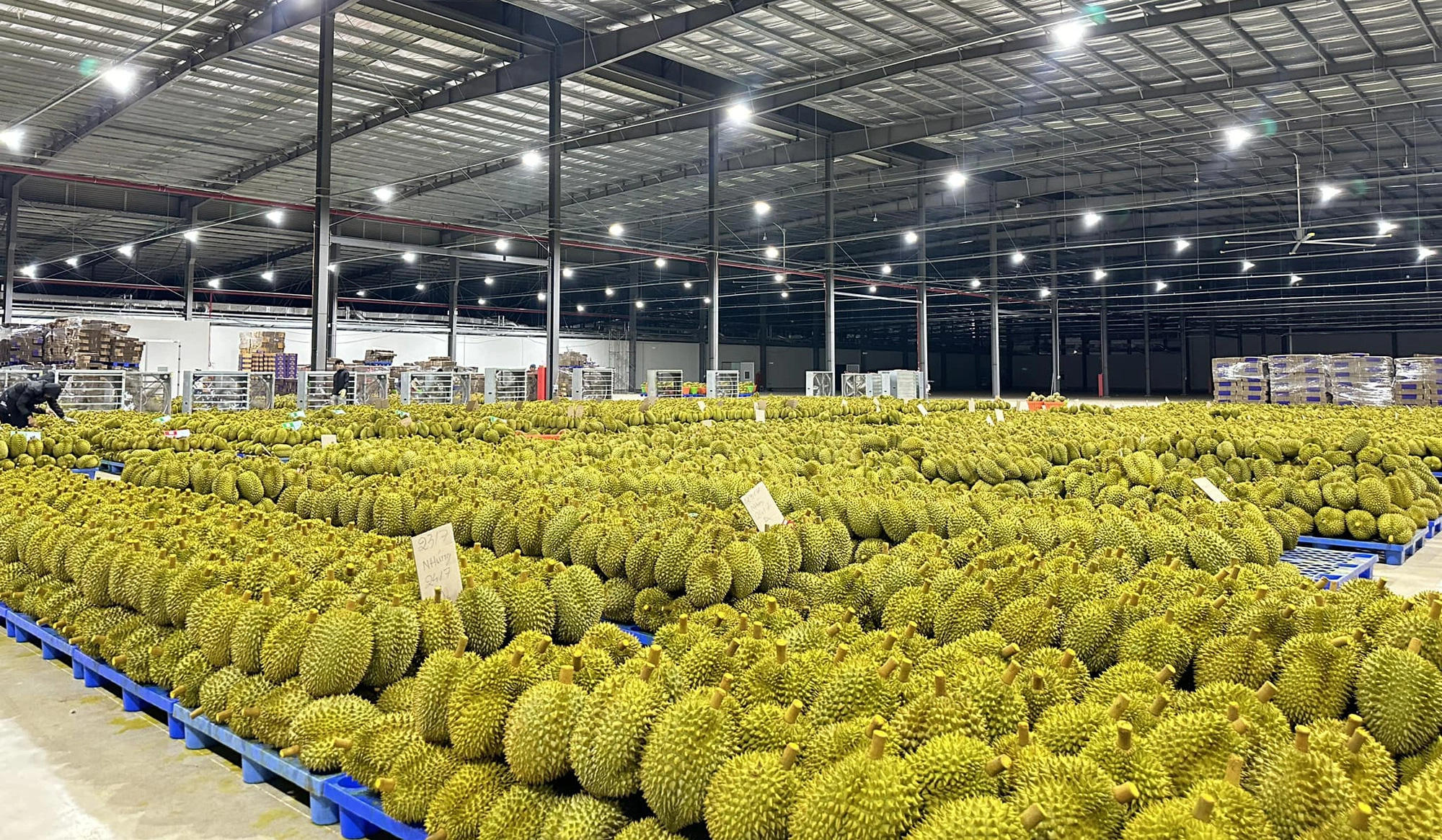
A durian packing facility in Vietnam - Photo: T.VY
Regarding the difficulties Vietnamese durian faces in exporting to China due to the Chinese requirement for a certificate of quality control for Yellow O, according to Tuoi Tre Online's investigation, after recognizing 7 qualified testing centers, Vietnam and China have agreed on a testing procedure.
It is understood that both sides have agreed to test the durian peel and flesh. Detailed information has been disseminated by the Plant Protection Department to businesses and laboratories for implementation.
What needs to be done to ensure the Chinese market accepts Vietnamese durian in the long term?
Seven testing centers recognized by China, located in Hanoi , Hai Phong, and several southern provinces, began testing on January 17th.
On average, each center can test about 100 samples per day, fully meeting the export needs of businesses, as during peak periods, Vietnam exports about 250-300 containers of durian daily.
Currently, Vietnam is finalizing procedures to request the recognition of six additional testing laboratories to meet the demand for O-gold testing from businesses.
Although your side has recognized 7 testing centers for Yellow O as qualified, you still strictly control durian shipments from Vietnam (and Thailand).
Specifically, in addition to requiring durian shipments to have certificates of cadmium residue and Yellow O (applied from 10-1), the other side also inspects 100% of shipments, only allowing them to clear customs if they meet the standards. This increases time and costs for businesses.
To facilitate durian exports at this time, a plant protection expert emphasized that relevant parties need to strengthen their responsibility to strictly comply with the requirements and standards of importing countries.
According to this person, Yellow O is often used to make durian look more attractive and appealing. However, this is a coloring agent used in industry, not for food use, not a pesticide, and not intended for plant protection purposes.
"Businesses must absolutely not use Yellow O to process or package durian," experts advise.
This official also emphasized that without a certificate verifying the quality of durian (yellow O), businesses are not allowed to export durian to China. If they intentionally export without complying with regulations, the risk of receiving further warnings from China is very high.
This could lead to China temporarily suspending durian imports from Vietnam. If this happens, it would cause significant losses to the entire industry and damage the reputation of Vietnamese agricultural products, not just a few businesses.
As reported by Tuoi Tre Online on January 9, China announced that it would apply regulations requiring Thai and Vietnamese durian shipments to have additional yellow O quality inspection certificates, starting from January 10.
At the same time, it is required that laboratories testing for O-yellow substance must be approved by the Chinese side.
This request was made after the other side discovered that a shipment of Thai durian had yellow O residue at the end of 2024.
On January 9, the Plant Protection Department ( Ministry of Agriculture and Rural Development ) coordinated with relevant agencies to send China a list of laboratories qualified to test for yellow O to request approval.
Next, on the morning of January 10, an urgent meeting was held between the Plant Protection Department and businesses and localities to announce and disseminate new regulations from the other side.
It wasn't until January 17th that China approved the list of 7 Vietnamese testing laboratories (at the same time as Thailand), so testing for Yellow O could not be conducted before January 17th. This meant that Vietnamese durian exports had to be temporarily suspended from January 10th (currently, shipments meeting the required standards have been cleared through customs).
This sudden change has left many businesses unable to adapt, especially when China has not yet approved inspection rooms, causing difficulties in exporting durian.
Many containers of durian had to be turned back for freezing or domestic consumption to minimize losses. Each container of durian is estimated to be worth up to 3 billion VND, resulting in significant losses for the business.
Source: https://tuoitre.vn/vu-sau-rieng-gap-kho-xuat-khau-sang-trung-quoc-tuyet-doi-khong-su-dung-vang-o-de-so-che-20250126090335286.htm
![[Photo] Closing Ceremony of the 10th Session of the 15th National Assembly](/_next/image?url=https%3A%2F%2Fvphoto.vietnam.vn%2Fthumb%2F1200x675%2Fvietnam%2Fresource%2FIMAGE%2F2025%2F12%2F11%2F1765448959967_image-1437-jpg.webp&w=3840&q=75)


![[Photo] Prime Minister Pham Minh Chinh holds a phone call with the CEO of Russia's Rosatom Corporation.](/_next/image?url=https%3A%2F%2Fvphoto.vietnam.vn%2Fthumb%2F1200x675%2Fvietnam%2Fresource%2FIMAGE%2F2025%2F12%2F11%2F1765464552365_dsc-5295-jpg.webp&w=3840&q=75)









































![[OFFICIAL] MISA GROUP ANNOUNCES ITS PIONEERING BRAND POSITIONING IN BUILDING AGENTIC AI FOR BUSINESSES, HOUSEHOLDS, AND THE GOVERNMENT](https://vphoto.vietnam.vn/thumb/402x226/vietnam/resource/IMAGE/2025/12/11/1765444754256_agentic-ai_postfb-scaled.png)












































Comment (0)