

Practicing yoga was the secret to Predrag Radosavljevic playing at the highest level for another five years and winning the MLS Player of the Season award at the age of 40, while Gareth Barry set a record for most appearances in Premier League history with 653 games.
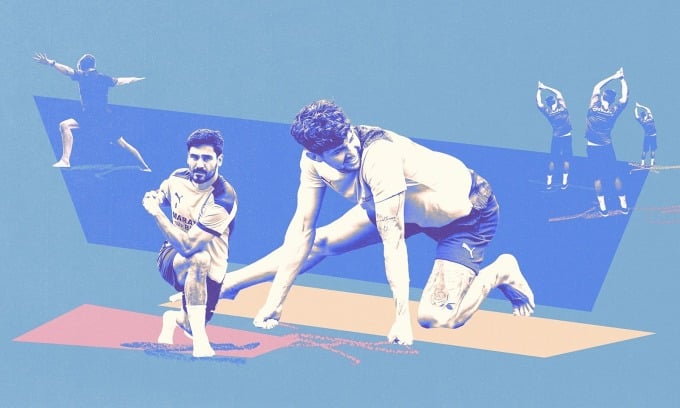
Yoga is becoming a trend in top-level European football. Photo: The Athletic
When Sharon Heidaripour's dream of playing for the Swedish women's national team was shattered by injury, yoga offered her salvation and renewed motivation. Mohamed Salah once celebrated one of the most spectacular goals of his career by mimicking one of the famous yoga poses. Cristiano Ronaldo, Lionel Messi, and even Antonio Conte are all devotees of this practice.
In modern football, as players seek more ways to enhance their physical fitness, the role of yoga is more profound than ever. The British newspaper The Athletic spoke with practitioners and instructors who believe yoga has transformed their lives both on and off the pitch.
Playing for top Swedish club Jitex BK, based just outside Gothenburg, as an energetic right winger, Sharon Heidaripour's life has been intertwined with football. From a young age, she dreamed of becoming a professional player.
This meant Heidaripour had to work hard to recover from a torn anterior cruciate ligament (ACL) in her knee and race against time to be fit for international duty at just 19 years old. "I had double training sessions and pushed myself to the limit, but then one day," she recalled. "I was taken straight to the hospital and diagnosed with an ACL, and it was terrible; football seemed to be over. I lost a part of my identity and fell into a black hole."
But yoga offered Heidaripour a way back. She moved to London, and between her time there and her return home to Gothenburg, she realized she longed to work in the football environment she still loved. If unable to play, Heidaripour would use her growing passion for the ancient Indian practice to help players develop.
After earning a degree in sports therapy from London Metropolitan University and a master's degree in football rehabilitation, Heidaripour went on to work for Premier League clubs Chelsea and Arsenal, treating academy youth players and first-team stars. She then left to start her own business, combining both of her passions: Football Yoga.
"At Arsenal, we've been able to get players back ahead of schedule," Heidaripour said. She doesn't teach yoga at the London club, but has started using some of its methods in her work. "It's mainly about injury treatment, but I feel there's a big gap between football medicine and science , and how to help players more holistically," the expert added.
Heidaripour's private yoga studio attracts clients such as Arsenal's trio Robert Pires, Santi Cazorla, and Laurent Koscielny, and is expanding. But when she tried to bring more of that into her role at the Emirates Stadium, Heidaripour was more or less met with little response.
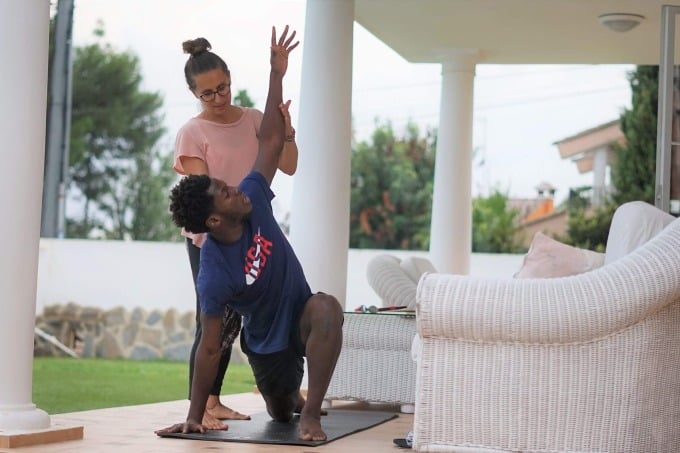
Heidaripour guides Valencia's American player Yunus Musah through a yoga pose. Photo: Sharon Heidaripour
Therefore, Heidaripour left Arsenal in 2015 to embark on a year-long self-funded study program working with players, coaches, even agents and journalists, around the world . The former Swedish player deepened her yoga studies in Mexico and even traveled to Costa Rica's top club, Deportivo Saprissa, where players return from ACL injuries in about half the usual nine months in Europe.
"It's a matter of mindset," Heidaripour said. "The sun always shines, and injured players start things with a smile and a positive mindset. Yoga really helps with that, and you need to treat the players' bodies, minds, and emotions equally."
One of the first things Heidaripour addresses when athletes perform yoga poses is breathing. "Most people don't breathe properly," she explains. "Their breaths are too shallow. Football players are no exception. Through yoga and mindfulness, you can train your breathing. Breathing from the abdomen and diaphragm actually helps activate the parasympathetic nervous system. This is the network of nerves that helps the body relax after periods of stress or danger, and helps run life-sustaining processes, such as digestion, when you feel safe and relaxed."
Upon returning to England, Heidaripour brought a new level of understanding to Premier League clients as Yoga Football began to develop. She started by helping French international Koscielny, who suffered a serious injury while playing for Arsenal just weeks before the 2018 World Cup.
"Koscielny tore his Achilles tendon in the Europa League semi-final against Atletico," she recounted. "It was May, and he wouldn't be able to play in the World Cup in Russia, a tournament where France won. So it was devastating for Koscielny and his family. But Koscielny is a strong, humble, hardworking player, and after the surgery, when he was able to control himself, we started going back to yoga after workouts."
Heidaripour said the former Arsenal center-back practices yoga two or three times a week to avoid overloading his Achilles tendon. According to her, the breathing techniques help Koscielny heal from within, mentally, because the recovery process from such an injury is long and solitary.
"Koscielny arrived at the training ground, but couldn't join his teammates," Heidaripour added. "There was sadness and a lot of disappointment, but yoga helped him calm down and get in the mindset to come back stronger. Your emotions during that time really affect how you return. Players are also human beings with normal lives, who can be affected by illness, loss of loved ones, and other issues. That inner peace is very important."
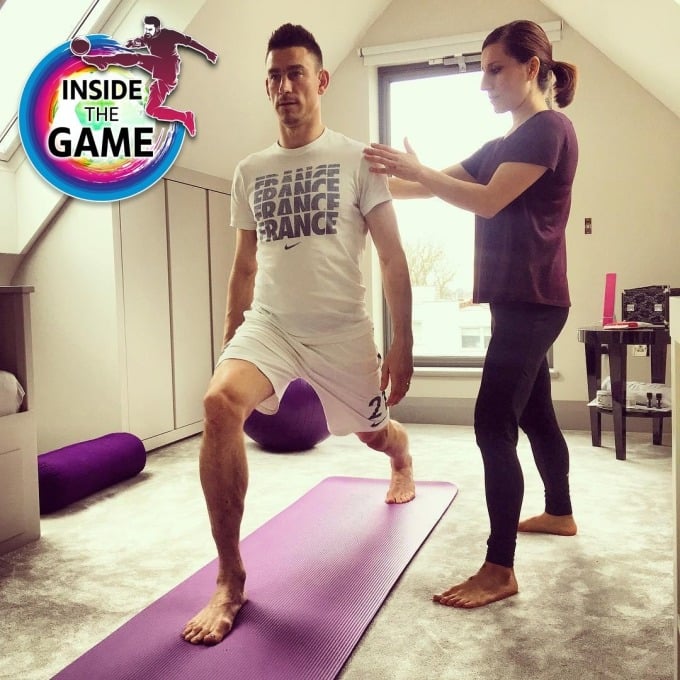
Heidaripour guides Kocielny in yoga practice. Photo: sharon_footballyoga
More than four years have passed, and Heidaripour's ambition to spread yoga remains undiminished. "I want to change the world of football," she says. "My goal is to have more academies, in Europe and America, incorporate yoga into their players' schedules. As a young football player, you might feel like you're unstoppable. As they grow up, young players can still have imbalances in their pelvis and hips. If they kick more often with one leg, that can create an imbalance, and yoga addresses that."
Heidaripour, now back in Sweden, hired a coach in England who could organize group or individual training sessions. These sessions were designed by Heidaripour, or took place via video on Zoom, which the players could follow along with the coach at the training ground or at home.
"Yoga helps prevent injuries as well as aid in rehabilitation," she continued. According to Heidaripour, when recovering from an injury, a player is usually assigned a dedicated physical therapist. But once they return to the team and resume normal training, that additional support isn't always available. Ideally, upon returning, the player should still need rehabilitation for the next 18 months to prevent recurrence of the injury. The most common feeling players experience after a yoga session is a sense of "liberation" on a psychological level. "First and foremost, my vision has always been to bring that to the academies. It can become a tool they can use when needed in life, to calm their minds. Look at how many players struggle when they're released by their clubs; it's really helpful," Heidaripour further explained.
For Radosavljevic, the former Everton and Portsmouth midfielder, practicing yoga came late in his career, when he was nearing retirement at age 38. The Serbian player was then playing in the MLS for the Kansas City Wizards, now Sporting Kansas City, where he won the MLS MVP award in 1997, but felt his body declining towards the end of the 2001 season.
"One day, I came home from training and told my wife that I'd had enough," Radosavljevic recounted. "It took me two days to recover from a heavy workout. It was September and the season ended in October. She wanted me to try yoga and I said, 'What the hell?' I scoffed at her, but decided to give it a try anyway to see where yoga could take me."
"The first time I did yoga, I wanted to cry after 20 minutes," the former Everton midfielder said, half-jokingly. "I was the only man there, and while the rest of the women were doing amazing things with their bodies, I was trembling in the corner. I wanted to leave but I was stubborn, then after the session, I showered and felt lighter. I started going three times a week and the impact on me was amazing. By pre-season, I was working out twice a day and I felt like I was 22 again."
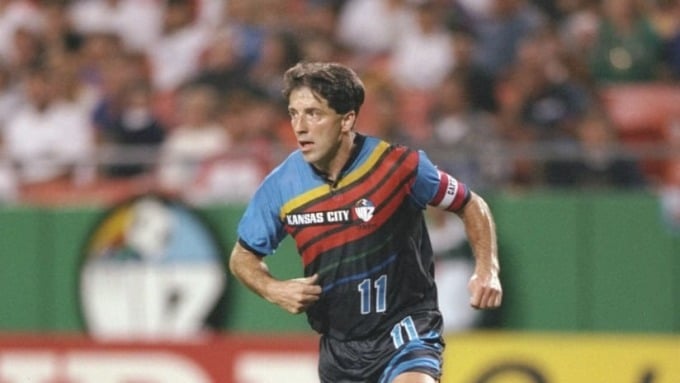
Radosavljevic in a Kansas City jersey at age 40 - when he won the MLS MVP award in 2003. Photo: MLS
Thanks to yoga, Radosavljevic played another four years in MLS and was again named MVP in 2003. "Football is about what you do off the pitch," he said. "I wish I had started yoga when I was younger. When you have that flexibility, you feel like you can do anything. I play on Saturday, rest on Sunday, do intense yoga on Monday and another session on Wednesday." However, Radosavljevic also emphasized that yoga is very difficult. Some of his teammates tried and gave up. "After a 90-minute yoga session, you sweat twice as much as when you play football. You're holding a pose for 45 seconds and, as men, we can get stiffness in our hips, so it's very painful," the legend added.
Radosavljevic, now 59 and an assistant coach for the MLS club Seattle Sounders, said that traditional soccer training helps shorten and develop muscles, while yoga helps lengthen and stretch them. "I think games will get even faster in the future if young players incorporate yoga into their training," he predicted.
Barry extended his career similarly in the Premier League. The English star started practicing yoga while at Aston Villa and maintained this habit when winning the Premier League title in the 2011-2012 season with Man City, as well as during his time playing for Everton and West Brom.
"My career started during a transitional period in sports science," Barry shared. "The choice was, 'Do what you've always done or try new things along the way,' and I would try either. Yoga certainly helped towards the end of my career, but I had been practicing since the early 2000s. At the end of my career at West Brom, I was still doing yoga once or twice a week, and they used me as an example to encourage younger players to join. Some would try it and like it, while many others would skip it. Footballers are very superstitious, and if they performed well after a yoga session, they would continue, and vice versa."
On match day, Barry will begin by stretching with yoga poses at home before joining the team. "Yoga educates you about your body and what you can achieve from it," he says. "I incorporate yoga into my routine before the game. Then, yoga sessions throughout the week give you moments of calm as you breathe and relax your mind."
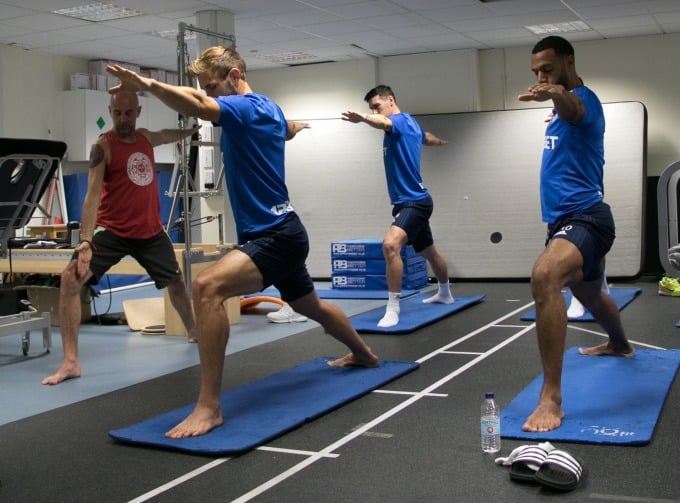
Barry (in the blue shirt - center) during a yoga session at West Bromwich Albion FC. Photo: expressandstar
Nedum Onuoha, another former Man City player, also believes in the value of yoga and similar, but more intense, pilates exercises. "Ryan Giggs, who played for Man Utd until he was 40, inspired me to train like that," he said. "The way it lasted Giggs' career was remarkable and it started a new level of preparation for players. Instead of showing up for the 10 am training session at 9:45 am and leaving at 12 pm, players started doing additional exercises, like yoga and pilates. It made you stronger and more flexible. I started at Man City and then at Sunderland."
Sheila McVitty is a teacher who has worked at a number of clubs in the northwest of England, including Everton, Wigan Athletic, Blackburn Rovers, and the Manchester United women's team. For her, the yoga revolution is happening quietly but is very important.
"I see young players in academies doing yoga at school, even before they start football training. That's great, because they understand the benefits early on and appreciate how yoga helps their health," McVitty said. "If you're a football player, you're usually doing a lot of linear training, like running. That means their hamstrings can get very tight, their quadriceps (thigh muscles) can become very prominent and that can cause problems. It's important to loosen the restrictions that come with this sport. I also work with ballet dancers and although it's very different, they're usually very flexible, you're basically still helping them overcome those restrictions. With dancers, in a way, you're trying to restrain them and improve their stability so they aren't too flexible and their joints aren't unstable. Football players sometimes need to be more flexible."
Like Radosavljevic, McVitty is familiar with the common sentiment when it comes to athletes stepping onto the yoga mat. "If I had $1 for every coach or former player who says they wish they had practiced yoga more or earlier in their career, I'd be filthy rich," she laughs.
Hong Duy (according to The Athletic )
Source link













































































Comment (0)