

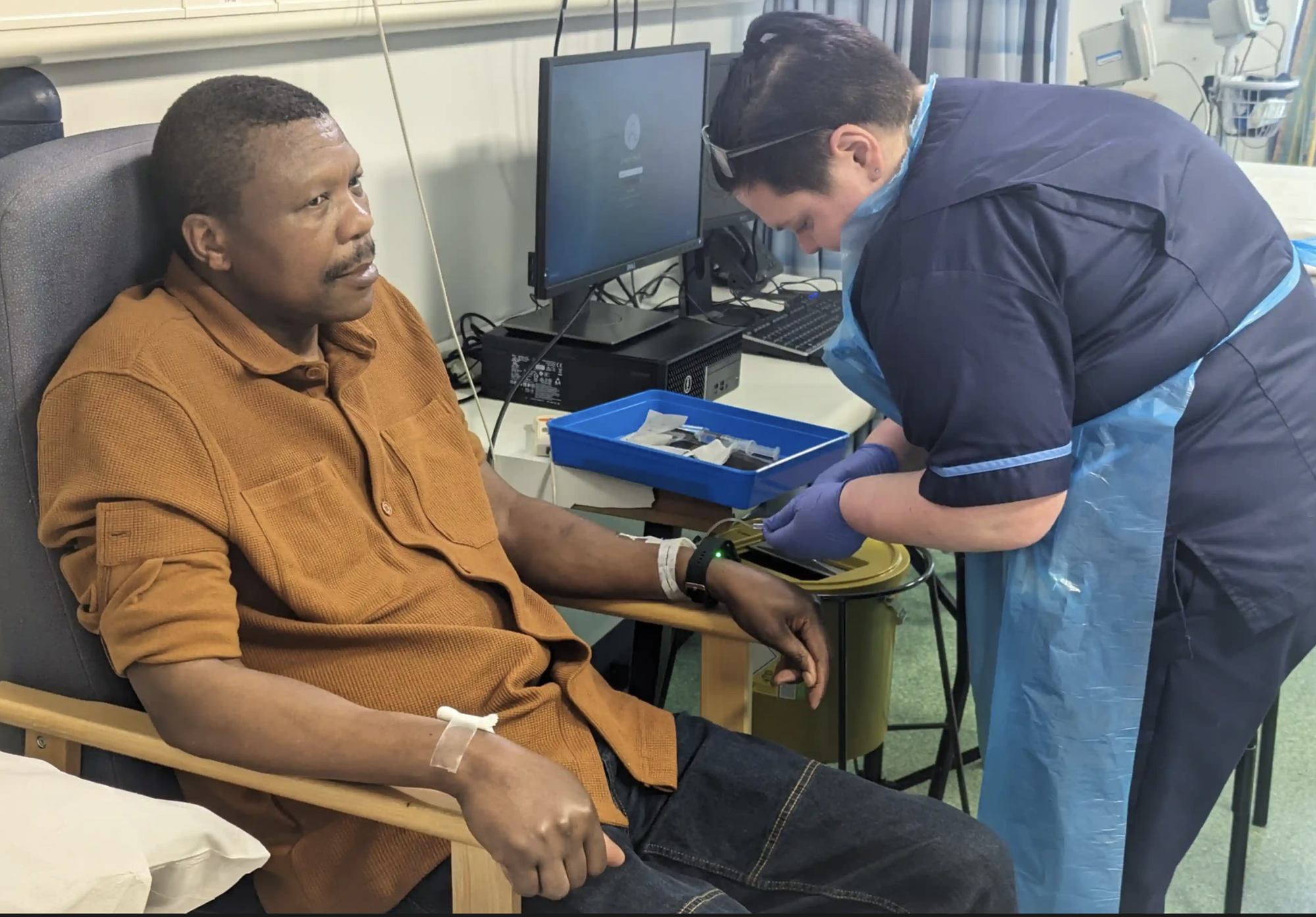
Elliot Pfebve, the first patient to participate in a clinical trial of a colorectal cancer vaccine in the UK - Photo: NHS
According to The Guardian , the UK's National Health Service (NHS) is recruiting thousands of volunteers for the world's first large-scale clinical trial of a "personalized" cancer vaccine.
Patients who meet the criteria and agree to blood tests and cancerous tissue samples will be eligible to participate in the trial.
Currently, dozens of patients have been approved, and the NHS will soon be recruiting several thousand more at 30 NHS sites across England.
Initial trials are expected to focus on colorectal, skin, lung, bladder, pancreatic, and kidney cancers... and will be expanded further in the future.
Cancer vaccines are formulated individually for each patient, after doctors take a sample of the tumor and sequence its DNA. It only takes them a few weeks to create a personalized injection tailored to that patient's specific tumor.
Once in the body, cancer vaccines work by instructing the patient's immune system to hunt down and destroy any cancerous cells, preventing the disease from returning.
The first patient to participate was Elliot Pfebve, 55, a lecturer at Coventry University. He had no symptoms but was diagnosed with colorectal cancer after a routine health checkup with his family doctor.
To test the cancer vaccine on Elliot, surgeons first removed the tumor and 30cm of his colon, then administered chemotherapy. Researchers then took samples and analyzed his tumor to identify specific mutations and develop a personalized vaccine.
Speaking about the patient's current condition, Dr. Victoria Kunene said it was too early to say whether the patient had been completely cured, but she also hoped for a miracle to happen.
"Based on the limited data we have, the vaccine and the patients' bodies are currently responding positively and showing significant effectiveness. However, we still need more data and need to continue testing on other suitable patients before drawing any conclusions," she said.
For Mr. Pfebve, participating in this trial was a truly important decision in his life, one that had significant implications for both himself and his family.
"It's wonderful that I can contribute a small part to creating a new cancer treatment, and if successful, many more patients will be able to receive treatment," Elliot shared.
NHS officials say that if these personalized vaccines are successfully developed, researched, and approved, they could become part of standard healthcare.
Can cancer vaccines eliminate all remaining cancer cells?
Last April, The Guardian reported that doctors had begun testing the world's first personalized mRNA cancer vaccine for melanoma. Experts have hailed the vaccine's potential, calling it a "game changer" in achieving a permanent cure for cancer.
Professor Peter Johnson, clinical director of oncology at NHS England, said: "We understand that even after successful surgery, cancer can sometimes return because some cancer cells remain in the body. However, using a vaccine to target those remaining cells could be a way to prevent the cancer from returning."
Source: https://tuoitre.vn/anh-thu-nghiem-vac-xin-ngua-ung-thu-theo-nhu-cau-20240603031102135.htm
























































































Comment (0)