

Contract vehicles with white license plates operate as fixed routes.
At the seminar "Contract Vehicle Management: Effective Solutions" held in Hanoi today (August 21st), Ms. Do Huong Giang - Deputy Head of the Transport Management Department of the Hanoi Department of Transport - informed that there are currently over 37,000 contract vehicles in Hanoi, of which 18,000 have fewer than 9 seats. There are 3,300 fixed-route vehicles. The number of contract vehicles is many times greater than that of fixed-route vehicles, and contract vehicles with fewer than 9 seats are more numerous than taxis.
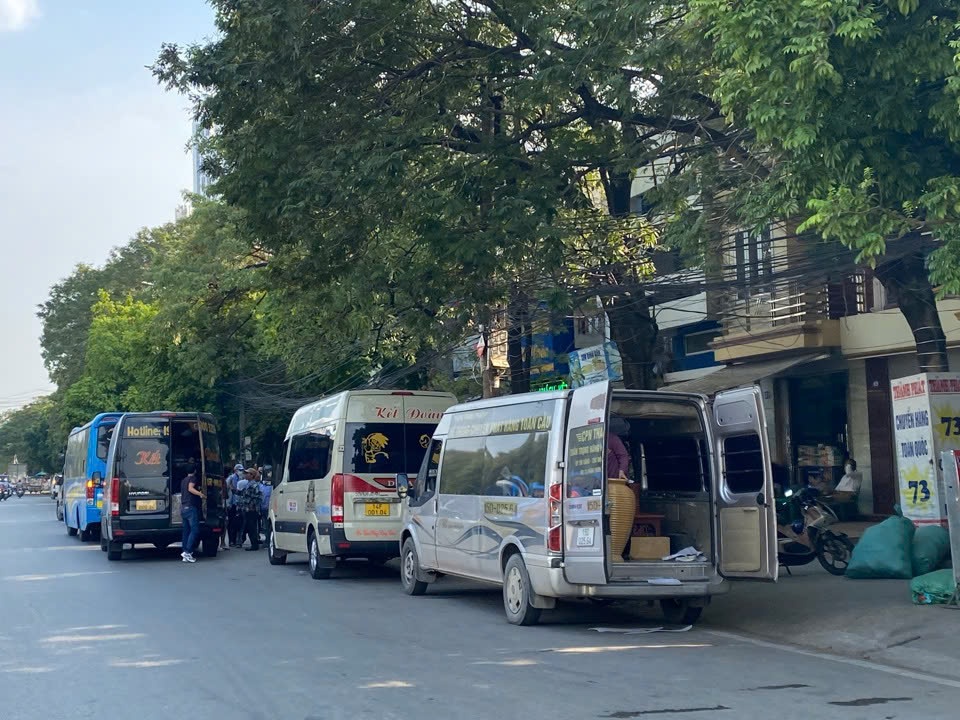
Contract vehicles operate under the guise of regular scheduled routes, picking up and dropping off passengers.
According to Ms. Giang, there are still vehicles with white license plates operating clandestinely, carrying passengers illegally, in the area, but enforcement measures are extremely difficult.
"The number of private vehicles is currently very large, hundreds of thousands, much larger than contract vehicles. Allowing them to freely connect with each other makes management difficult. Hanoi has implemented Special Project 05 to combat illegal taxis and unauthorized bus stops, but it only covers vehicles with yellow license plates and does not control vehicles with white license plates due to various civil factors," Ms. Giang said, affirming that this is a matter of great concern for the management agency.
Sharing his views on transportation business operations, Mr. Nguyen Cong Hung, Vice President of the Vietnam Transport Association, stated that a fixed-route transportation company operating at a terminal must register its schedule, routes, and times, and undergo negotiations…
The process is very complicated. Meanwhile, limousines don't need to be registered. That's why limousines have proliferated.
A small province like Phu Tho has as many as 1,000 ride-sharing services. Right next to Noi Bai Airport, there are also more than 1,000 ride-sharing services, the same number as inside the airport itself.
Mr. Nguyen Cong Hung
Sharing the same view, Mr. Nguyen Hoang Anh - Deputy Head of the Vehicle and Driver Management Department, Vietnam Road Administration, expressed that passenger buses in bus terminals are following the law by departing at fixed times, but contract buses can "break the rules" and run at will. Currently, bus companies sell tickets online, so there is no need to worry about queues causing traffic congestion. Therefore, any bus with enough passengers is allowed to depart.
According to Mr. Hoang Anh, contract vehicles transport various types of passengers such as tourists , workers, and students. Their operating range is wide and frequent, covering many routes, alleys, and time slots. This has led to contract vehicles operating like regular scheduled vehicles.
Currently, vehicles operating under contract are subject to taxation, with only the business license tax being levied. Vehicles operating on fixed routes must pay other taxes. Determining whether a vehicle is actually carrying passengers under contract requires skilled expertise. For example, if a vehicle is identified as operating under contract but the driver claims it's for repairs or transporting family members, verifying the driver's actions becomes very difficult.
Ensuring fairness among different types of businesses.
Stating that strict control over contract vehicles with white license plates is necessary to prevent the risk of taxis abandoning their roof signs and fixed-route vehicles leaving their designated stops to operate more freely, Mr. Nguyen Cong Hung - Vice Chairman of the Vietnam Transport Association - expressed: The National Assembly has tasked the Government with researching vehicles with fewer than 9 seats as a new type of service. This type of service needs a clear name in order to collect taxes.
Furthermore, according to Mr. Hung: It is necessary to clearly define the concept of contract vehicles. If they are used for picking up passengers, it is a violation. However, if they operate within bus terminals, businesses should raise any difficulties they encounter so that the local authorities can make adjustments. We propose that the local authorities establish specific regulations for businesses to comply with.
Mr. Nguyen Tien Dung, Director of Van Anh bus company, expressed that the nature of contract buses and fixed-route buses is not much different, but operating contract buses is much more efficient in terms of investment. The investment is the same, but the operating costs of contract buses are many times higher. Buses entering the terminal incur many types of taxes and fees: terminal fees, VAT on tickets, corporate income tax, etc. Businesses burdened with many taxes and fees find it difficult to lower prices to compete with contract buses. Contract buses are not dependent on schedules, there are no restrictions on customers contracting with the company, and frequent return trips allow for lower ticket prices.
"The management agency needs to be more open to fixed-route buses in some way, to make them more flexible and competitive with new types of buses. My company operates 70,000-80,000 passengers per month, and they have to go to the bus station. If they are not allowed to travel through the city center, we would need dozens of shuttle buses, incurring many additional costs," Mr. Dung suggested.
Meanwhile, Mr. Do Van Bang, Director of Minh Thanh Phat Trading and Services Co., Ltd. (Sao Viet bus company), said: "Currently, Sao Viet operates 21 buses at My Dinh bus station. We need to increase to 41 buses to meet customer demand, but developing 41 buses is not an easy task because it involves planning regulations. Passengers can't wait for us and choose other options, so businesses must also meet passenger demand. To add more contract buses, we must comply with regulations regarding business licenses, customer contracts, etc."
Therefore, Mr. Bang believes that both fixed-route and contract-based businesses need to exist to serve the needs of passengers. But what is important is that management ensures a balance of interests and equality.
From the perspective of bus station management, Mr. Nguyen Van Lap - Director of Nuoc Ngam Bus Station - expressed: The solution that needs to be discussed is parking and passenger drop-off points for contract vehicles. I think that the bus station should not only be for fixed-route buses but also for other legally operating passenger vehicles. If we do that, there will be no harm to the bus station, and the businesses operating will be more legitimate. This would harmonize the interests of other vehicles. The tax authorities will also find it easier to manage when vehicles enter the station. In addition, the parking and passenger drop-off points could be changed from just one level to multiple levels.
"State agencies need to find a harmonious balance between fixed-route buses and contract buses. For contract buses, simply regulating parking for 10-15 minutes before departure is sufficient. This way, businesses won't face issues with departure times; as long as there are enough passengers, the buses can operate," Mr. Lap proposed.
Mr. Nguyen Xuan Thuy, Deputy Director of the Transport Department, stated: "We should orient the market, not let the market orient us. We will advise on organizing traffic with contract vehicles. We can meet passenger demand, but it must be on a schedule."
Regarding the suggestion of imposing strong sanctions on businesses, such as revoking vehicle registration plates, and whether or not such measures should be implemented, Mr. Thuy stated that this will continue to be studied and included in the drafting of legal regulations. We will aim to reduce penalties for businesses while maintaining sufficient deterrence. For vehicles with fewer than eight seats that can use shared rides while taxis declare their prices, this will be implemented according to the guidelines of the Decree guiding the Law on Prices and decided by the People's Committee of the province or city.
Following directives from the Ministry of Transport, the Hanoi Department of Transport Inspectorate was the first unit to conduct inspections for violations using vehicle tracking devices. Inter-agency teams visited businesses to request that they provide vehicle tracking devices and vehicle identification numbers for monitoring purposes.
Since the beginning of the year, the Hanoi Department of Transport's inspection force has handled over 1,870 cases of violations, imposing fines totaling 6.5 billion VND, temporarily seizing 27 vehicles, revoking driving licenses in 300 cases, and revoking vehicle registration plates for dozens of vehicles.
In the coming period, the Hanoi Department of Transport will continue to strengthen inspections at businesses and conduct checks through vehicle tracking devices to handle violations.
Source: https://www.baogiaothong.vn/ban-giai-phap-quan-chat-xe-hop-dong-19224082114202369.htm


![[Photo] Prime Minister Pham Minh Chinh holds a phone call with the CEO of Russia's Rosatom Corporation.](/_next/image?url=https%3A%2F%2Fvphoto.vietnam.vn%2Fthumb%2F1200x675%2Fvietnam%2Fresource%2FIMAGE%2F2025%2F12%2F11%2F1765464552365_dsc-5295-jpg.webp&w=3840&q=75)




















































































Comment (0)