

Credit capital flowing into real estate is reaching a record high.
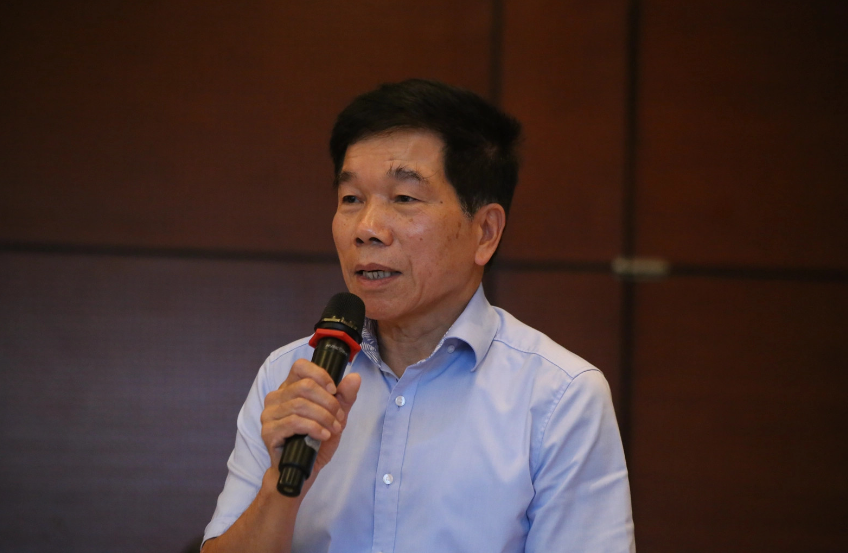
At the 2025 Real Estate Forum organized by Hanoi Radio and Television on the morning of December 4, Mr. Nguyen Quoc Hiep, Chairman of GP.Invest Company, said: The Vietnamese real estate market in recent years has had many abnormalities, with house prices increasing rapidly, especially from 2024 onwards.
If we compare the growth rate of per capita income and the growth rate of housing prices mechanically, we can see a huge difference. In the period 2024-2025, per capita income increased from 4.11 million VND/month to 8.3 million VND/month, which means doubling, corresponding to an average increase of about 6.4%/year.
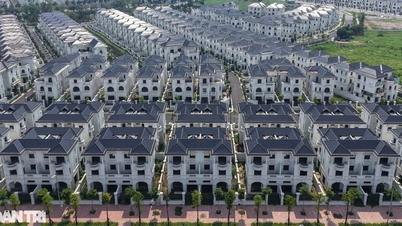
Meanwhile, the average apartment price from 2014 to 2025 increased from about 25 million VND/m2 to 75.5 million VND/m2, or 3 times, with an average growth rate of more than 12%/year. Notably, up to now, the average house price in Hanoi has even exceeded 80 million VND/m2.
According to statistics, by mid-2025, the P/I index (house price to income ratio) in Vietnam will reach 27.3, meaning the average apartment price is 27.3 times higher than the average income of a family.
“That means if you don't spend anything, it will take 27 years to save all your income to buy a house, and if you only spend 1/3 of your income to pay off the mortgage, it will take 80 years to buy an average apartment,” said Mr. Hiep.
He emphasized that the continuous increase in house prices has created favorable conditions for speculation to develop more strongly. In the context of rapid currency depreciation, many people with financial potential consider real estate as the safest channel to "keep money". Buying a house is considered to preserve the value of the property, that is the common thinking of a large part of the wealthy people today.
However, skyrocketing housing prices not only create barriers beyond the ability of buyers but also pose risks to the entire economy . Most investors currently still rely mainly on bank credit capital to implement projects.
By the end of September 2025, credit flow into real estate had increased by 19% compared to the limit, with outstanding debt of more than VND 4 million billion, accounting for 24% of total outstanding debt of the whole system, a record number.
If the market develops healthily, prices are stable and liquidity is good, real estate will be a driving force supporting socio-economic growth. On the contrary, when housing prices are pushed too high and the market loses its ability to absorb, risks will spread to the banking system and the entire economy.
“What is worrying is that in the third quarter of 2025, the real estate transaction rate decreased by 13%, with the apartment segment alone decreasing by 15%, reflecting an increase in inventory, a signal that requires extreme vigilance,” said Mr. Hiep.
Proposal to tax "super profit" land rent at 100% to cool down housing prices
In response to the question of how to develop the real estate market safely and sustainably, Mr. Hiep said that it requires the synchronous participation of both state agencies and the business community developing projects.
On the part of state agencies, the Government has recently proactively issued a series of specific mechanisms and policies to promote the development of social housing, aiming to build 1 million social houses by 2030.

Along with that, the National Assembly and the Government have also introduced many "open" policies to increase supply, such as Resolution 171 to handle and remove obstacles for many projects in localities, or Decree 98 to support the renovation of old apartments in large cities. These are all important policies, contributing to improving supply for the market.
However, Mr. Hiep emphasized that the actual implementation in localities is still slow. Administrative procedures continue to drag on, causing many projects to stagnate. Although Decree 57 and Resolution 68 have been issued, but right at the stage of converting to a two-level government model, the implementation is even more stagnant.
Therefore, according to him, it is necessary to have strong inspection and supervision from all levels of government, and at the same time, to substantially shorten administrative procedures. At the same time, the State needs to continue to supplement "open" legal mechanisms so that the real estate market has more momentum to develop.
On the business side, Mr. Hiep said that it is necessary to thoroughly understand the spirit that businesses are a component part of the real estate market, and therefore must have the responsibility to contribute to the healthy development of the market.
“Every business wants to make a profit and no one “refuses” high profits, but reality shows that when the market accepts, many businesses are willing to continuously push prices up,” Mr. Hiep revealed.
In his view, it is time to boldly consider a tax mechanism for “super profits” from land rent. This will certainly be a matter of much debate, but assuming that the profit exceeds a threshold, for example, up to 100% of the cost price, a “special” tax should be paid.
“Such a mechanism, if properly designed, could help curb price increases and help the market operate more stably,” he said.
Source: https://congluan.vn/bat-dong-san-lai-100-gia-thanh-tu-dia-to-de-xuat-ap-thue-dac-biet-10320333.html


![[Photo] Cat Ba - Green island paradise](/_next/image?url=https%3A%2F%2Fvphoto.vietnam.vn%2Fthumb%2F1200x675%2Fvietnam%2Fresource%2FIMAGE%2F2025%2F12%2F04%2F1764821844074_ndo_br_1-dcbthienduongxanh638-jpg.webp&w=3840&q=75)

















































![[VIMC 40 days of lightning speed] Da Nang Port: Unity - Lightning speed - Breakthrough to the finish line](https://vphoto.vietnam.vn/thumb/402x226/vietnam/resource/IMAGE/2025/12/04/1764833540882_cdn_4-12-25.jpeg)











































Comment (0)