

In a dusty factory, a group of Ukrainians are producing artillery that won't fire, radar that can't detect anything, and missiles that lack explosives.
The weapons were actually decoy models designed to draw fire and deplete the ammunition of the Russian army, diverting attention from where Ukraine deployed its real military equipment. The location of the factory was not disclosed.
Over the course of a year, the team's crafting skills steadily improved. Using plastic, scrap wood, foam, and metal, they were able to create replicas of real weapons, with shapes convincing enough to deceive observers using drone imagery.
At this workshop, their success hinges on how quickly the fake weapons are destroyed. "When the army comes here and says they've used up all the bait, that means we've succeeded," one person said.
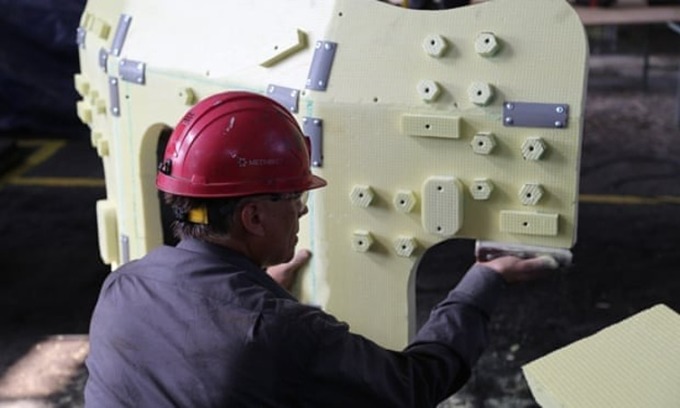
Workers manufacture decoy weapons in Ukraine. Photo: Guardian
A display case at the workshop showcasing "trophies," including engines and fragments of suicide drones, was used to lure attackers into attacking a dummy device.
For the personnel here, Russia's attack on a decoy device, while costing Moscow resources, also means one less attack on Ukraine's real weapons positions.
"These things could save the lives of our people, our comrades who are fighting. The military shared images and remnants of attacks on the decoys with us, as proof that we did a good job," said one worker.
Everyone at this manufacturing plant is an employee seconded indefinitely by the Metinvest steel company, which operates the Azovstal steel plant in Mariupol. A spokesperson said Metinvest's main shareholder is Ukraine's richest billionaire, Rinat Akhmetov, who supported the baiting scheme.
Three senior executives at the company came up with the idea of creating decoy weapons when hostilities broke out, at a time when the Ukrainian army was outclassed in weaponry and the supply of weapons from the West was only in its early stages.
"We think that if the Russian army sees a lot of equipment, they will hesitate and not dare to advance or shell an area. These decoys are psychological weapons," a senior manager said.
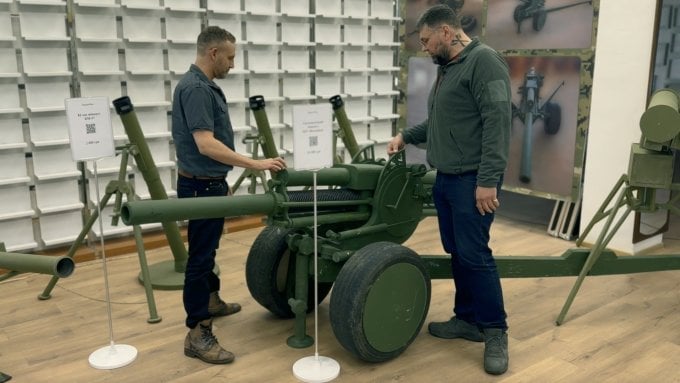
A wooden model of military equipment is displayed at a shop in Ukraine in July. Photo: Scripps News
The development team regularly updates the "production line" to produce models that closely resemble the new weapons systems recently added to Ukraine's arsenal, as well as more realistic products.
One worker said that the manufacturing process was simpler at the beginning of the conflict, when the Russian army attacked weapons they could see. Now, with both sides using decoys, soldiers can scout more carefully to determine if it's a real weapon.
The production team recently designed the dummy weapons to emit heat similar to real weapons. This makes the models more convincing even when viewed at night with thermal imaging scopes.
"We have to adapt to reality and always add new things. We evaluate the work this way: If nothing happens with the new decoy weapon prototypes, if they are not selected as targets, it proves we made a design error," the worker said.
In a coded letter sent by the Ukrainian army to the workshop, there was an order for 50 models of a type of military equipment. The Metinvest designer agreed, and the team got to work.
Initially, they would upload a series of images of the requested weapons. Then the team would calculate which inexpensive materials would still look realistic under the camouflage paint. Items such as discarded pipes, wooden crates, or old oil drums were all repurposed.
Finally, workers would meticulously create molds for each part based on the weapon's design. These model weapons would be shipped in flat layers and then assembled upon arrival at the front lines. Soldiers only needed about 20 minutes to assemble a model cannon.
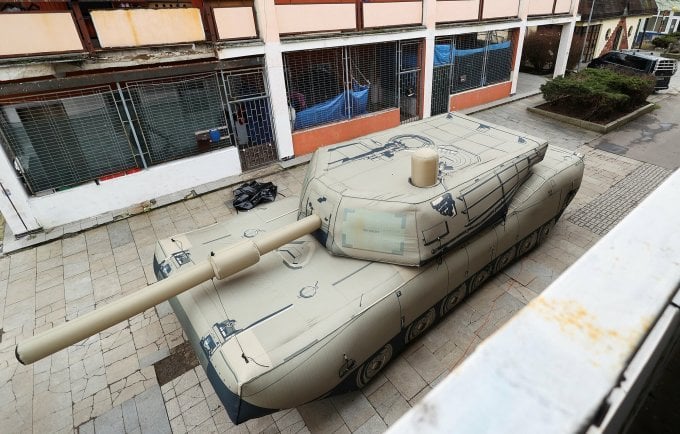
The inflatable Abrams tank, manufactured by the Czech company Inflate, was unveiled in March. Photo: Reuters
The workers at the workshop believe their invention is superior to the inflatable weapon model that Ukraine previously used as decoys. Compared to inflatable weapons, the metal-framed decoy is also easier to repair if partially damaged.
A worker said the Ukrainian army stated that inflatable decoys have problems in windy conditions or under certain weather conditions; they can be blown away and don't look realistic.
The tactic of using decoys has a long history of conflict. Dummy tanks were first deployed by the Allies and proved highly effective in World War II. At that time, the US also employed a "ghost army," using sound effects, fake radio waves, and a series of illusions to simulate large troop movements. Some of these soldiers later went on to work in film and theater.
"We're looking forward to winning and don't need to do this work anymore," said a model maker.
( By Hoang , according to The Guardian )
Source link



















































































Comment (0)