

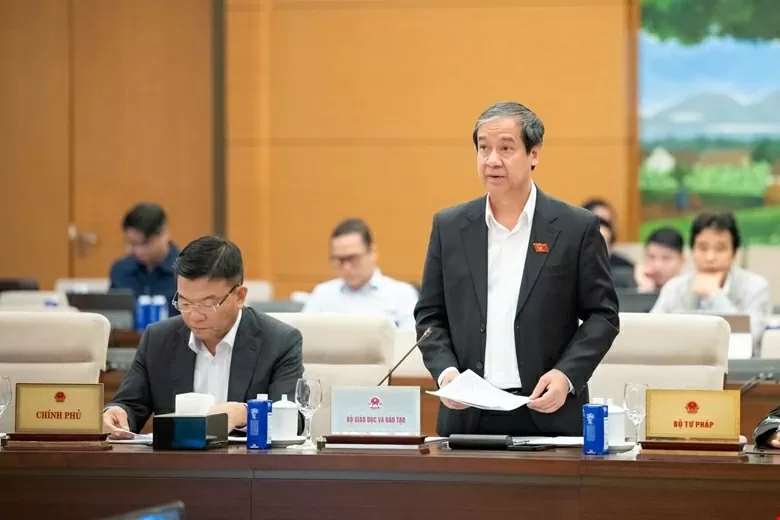
 |
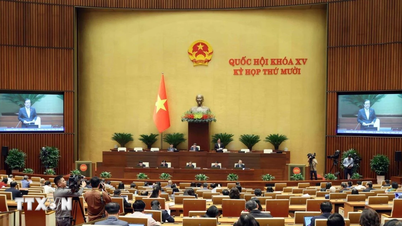
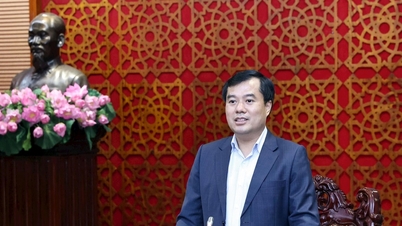
| Minister of Education and Training Nguyen Kim Son said that in the near future there will only be 3-4 pedagogical colleges left. (Source: National Assembly ) |
One of the notable new points of the revised Law on Vocational Education is that it allows qualified higher education institutions to register to provide college training in a number of professions and must comply with Government regulations.
The trend of merging pedagogical colleges into pedagogical universities
Explaining this issue at the National Assembly Standing Committee meeting on the morning of December 4, Minister of Education and Training Nguyen Kim Son said that in the planning of universities and colleges, the system of pedagogical colleges will soon have only 3-4 schools. The trend is that pedagogical colleges will merge into pedagogical universities.
The Minister added that the university of education will train preschool teachers at college level.
"In my opinion, the fact that universities can provide college-level training in a number of specialized, specialized, specialized, and special fields according to the country's human resource needs, a principle needs to be included in the law. Accordingly, universities can be allowed to organize college-level training within universities," the Minister commented.
However, the Minister of Education and Training clearly stated that in order to avoid universities "massively enrolling college-level students", which would neutralize and reduce the enrollment capacity of colleges, there needs to be a separate regulation for this content.
At the same time, the law cannot be too detailed in these contents. Therefore, Minister Nguyen Kim Son proposed that the law define a principle that "it can be opened", "who can be opened and how should be left to the Government to regulate".
Speaking at the meeting, Chairman of the Economic and Financial Committee Phan Van Mai said he agreed with the opinion of the review agency on allowing some universities to open colleges, not just in the field of pedagogy.
He emphasized that the opening of majors needs to be managed by specific criteria and standards. In addition to college training, universities with quality practice schools should also be considered for permission to implement this model.
He cited that in some specific fields such as music, training facilities such as conservatories must recruit students from a very early age, even from kindergarten or elementary school. Similarly, many other professions also need to discover and nurture talent early.
According to Mr. Phan Van Mai, if universities have potential in human resources and facilities, it is necessary to create conditions for them to prepare input talent.
"We should open up to a certain extent, manage with a system of criteria and standards to promote the effectiveness and strengths of training facilities," Mr. Mai proposed.
Residency degree is not a doctorate or master's degree
According to the Government's report explaining, accepting and revising a number of articles of the Law on Higher Education (amended), some National Assembly deputies proposed to supplement the training program and recognize degrees for training in specialties I, II and resident doctors, and at the same time recognize the training types as postgraduate training programs in the national education system.
In response to the opinions of National Assembly delegates, the draft Law on Higher Education (amended) has been revised in the direction of: "The specialized postgraduate training program in the health field, granting the degree of resident physician and specialist physician, is managed by the Ministry of Health".
To ensure the consistency of the national education system and qualifications, the Government stated that the qualifications of the residency, specialist I, and specialist II programs are not master's or doctoral degrees. These are specialized degrees related to specific medical professions, certifying professional competence managed by the Ministry of Health.
The contents related to the conditions for studying, competency standards, training programs, assessment and granting of advanced degrees will be specified in detail by the Ministry of Health in sub-law documents to ensure feasibility, quality training, and suitability to the specific characteristics of the health sector. This regulation ensures a clear division of responsibilities between the Ministry of Education and Training and the Ministry of Health in managing health sector training.
The Ministry of Health is responsible for the professional content, competency standards and practice conditions of specialized postgraduate training programs. The Ministry of Education and Training implements unified management of the system of qualifications, university, master's and doctoral degrees and quality standards in higher education.
In its role as an examining body, the Standing Committee of the Culture and Social Affairs Committee approved the addition of the content "the higher education training system has a specific post-graduate program to grant specialized degrees and residency degrees managed by the Ministry of Health". This program provides specialized training associated with professional capacity development and is not considered equivalent to a master's or doctoral degree.
The Standing Committee also agreed to supplement the regulation that the Minister of Education and Training coordinates with the Ministry of Health to issue standards for higher education institutions to conduct training in health sectors, and regulations on approving training programs at the undergraduate, master's and doctoral levels in the health sector.
The Minister of Health approves and organizes the implementation of specialized postgraduate training programs in the health field to grant degrees of resident physician and specialist physician, and at the same time regulates the threshold to ensure the quality of input for teacher training majors and majors in the health field.
Regarding the system of higher education institutions, some opinions said that the current regional university model with a two-level management mechanism increases the administrative intermediary layer, causing organizational inadequacies, so it is recommended to consider not maintaining or establishing this model. Some delegates suggested studying the restructuring of regional universities to ensure streamlined administration.
The Government explained that the assessment of the superiority of a university model needs to be viewed from many aspects, summarized and evaluated comprehensively. The Draft Law on Higher Education (amended) continues to stipulate the regional university model in Article 12 to carry out the mission of promoting regional linkages, pooling resources and supporting the socio-economic development of the region.
Source: https://baoquocte.vn/bo-truong-gddt-nguyen-kim-son-sap-toi-chi-con-3-4-truong-cao-dang-su-pham-336613.html


![[Photo] Cat Ba - Green island paradise](/_next/image?url=https%3A%2F%2Fvphoto.vietnam.vn%2Fthumb%2F1200x675%2Fvietnam%2Fresource%2FIMAGE%2F2025%2F12%2F04%2F1764821844074_ndo_br_1-dcbthienduongxanh638-jpg.webp&w=3840&q=75)



































































Comment (0)