

A unified set of textbooks but does not eliminate diversity
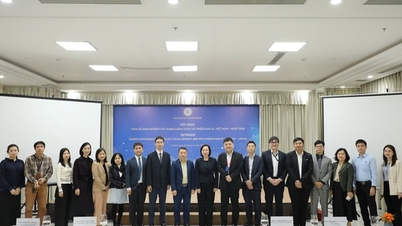
At the workshop " Education in the era of national development" organized by the Vietnam Institute of Educational Sciences today (December 5), many experts discussed major policies of the education sector in the coming time.
Prof. Dr. Le Anh Vinh, Director of the Vietnam Institute of Educational Sciences , said that in the 2024-2025 period, the education sector will carry out a series of tasks, including major reforms when implementing a two-level government, eliminating the Department of Education and Training.
In particular, according to Mr. Vinh, the industry will soon implement a policy of unifying a set of textbooks nationwide from the 2026-2027 school year, with the goal of providing free textbooks to all students by 2030.
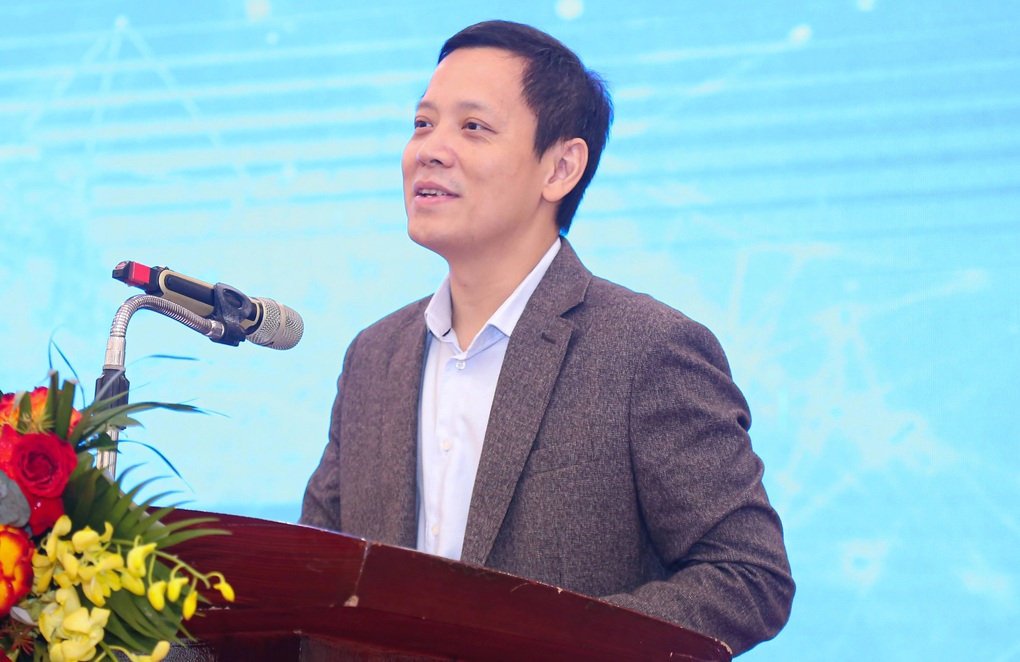
Prof. Dr. Le Anh Vinh, Director of the Vietnam Institute of Educational Sciences, organized on December 5 (Photo: My Ha).
Previously, in mid-November, the National Assembly passed a Resolution on the 2026 Socio -Economic Development Plan. According to the Resolution, the current general education program will be reviewed and completed, and a unified set of textbooks will be developed nationwide, to be used from the 2026-2027 school year.
This policy received many responses from experts and public opinion, including agreement with the policy of having a unified set of textbooks and flexibly using other sets of books to expand and enrich teaching materials.
Answering questions from delegates this morning, Dr. Pham Do Nhat Tien welcomed the policy of using one set of textbooks in the coming time. However, according to Mr. Tien, unification does not mean eliminating diversity.
He explained that a single program and a single set of textbooks would overcome existing problems due to lack of resources and large differences between regions. However, he emphasized: "Besides a unified set of textbooks, we still need many other sets of books."

Dr. Pham Do Nhat Tien (Photo: My Ha).
According to this expert, besides the unified national textbooks, there are other sets of books that have been evaluated and used effectively over time. All of them have reference value for teachers to promote professional autonomy and creativity in teaching.
Piloting AI into teaching in general education program
In addition to using a set of textbooks in the coming time, at the workshop this morning, Professor Le Anh Vinh said that among the major tasks that the education sector must carry out in the coming time is building a new preschool education program.
The new preschool education program has been evaluated in two rounds and is expected to be piloted in 2026. Accordingly, we will have a preschool education program that meets the new context.
In particular, building an artificial intelligence (AI) program to be taught in high schools is an important task that the Ministry of Education and Training has assigned to the Institute recently.
“This framework has been completed and is waiting to be officially issued, and will be piloted in early 2026,” said Mr. Le Anh Vinh.
According to the previous plan of the Ministry of Education and Training, the AI education content included in the general education program is designed according to 4 main knowledge streams, corresponding to 4 competency domains including: Human-centered thinking, AI ethics, AI techniques and applications, AI system design.
The content framework is also designed according to the level of education, corresponding to the two stages of basic education (including primary and secondary school) and career-oriented education (including high school).
At the primary level, the program helps students get acquainted with AI such as recognizing AI through visual applications, understanding that AI is created by humans and initially forming awareness of protecting personal data.
At the secondary school level, the program provides basic understanding, such as understanding the operating principles (data, algorithms), practicing using AI tools to solve learning problems and identifying the risks and biases of AI.
The purpose of career creation and orientation will be implemented at the high school level. Students learn to design simple AI systems, develop complex problem-solving thinking and career orientation in the technology field.
Source: https://dantri.com.vn/giao-duc/mot-bo-sach-giao-khoa-thong-nhat-khong-co-nghia-loai-bo-su-da-dang-20251205152040308.htm


![[Photo] 60th Anniversary of the Founding of the Vietnam Association of Photographic Artists](/_next/image?url=https%3A%2F%2Fvphoto.vietnam.vn%2Fthumb%2F1200x675%2Fvietnam%2Fresource%2FIMAGE%2F2025%2F12%2F05%2F1764935864512_a1-bnd-0841-9740-jpg.webp&w=3840&q=75)
![[Photo] National Assembly Chairman Tran Thanh Man attends the VinFuture 2025 Award Ceremony](/_next/image?url=https%3A%2F%2Fvphoto.vietnam.vn%2Fthumb%2F1200x675%2Fvietnam%2Fresource%2FIMAGE%2F2025%2F12%2F05%2F1764951162416_2628509768338816493-6995-jpg.webp&w=3840&q=75)









































































Comment (0)