

On December 4th, at its 52nd session, the Standing Committee of the National Assembly gave its opinion on the explanation, acceptance, and revision of draft laws, including: the Law on Education (amended), the Law on Higher Education (amended), the Law on Vocational Education (amended), and draft resolutions related to the field of education and training.
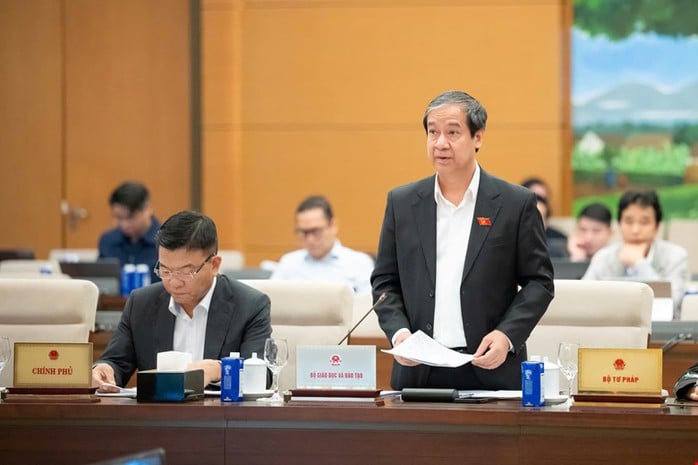
Minister of Education and Training Nguyen Kim Son speaks at the session. Photo: Pham Thang
Regulations concerning textbooks continued to be a topic of interest and discussion among National Assembly deputies at the 10th session. Deputies agreed on the principle of the State issuing a single, unified set of textbooks nationwide, to be applied from the 2026-2027 school year. However, many opinions suggested clarifying the scope of application of this set of textbooks: whether it is the only mandatory set of textbooks or merely a standard set for schools to choose from.
Regarding this issue, Minister of Education and Training Nguyen Kim Son stated that the draft law has been adjusted to incorporate the opinions of delegates, removing the provision that the Government decides on the socialization of textbooks.
Instead, the Ministry of Education and Training will decide on a unified set of textbooks nationwide. "This regulation allows flexibility between the option of compiling new textbooks or selecting and revising existing ones," the Minister said.
According to the government, at this stage, it is not feasible to immediately specify in the law whether the drafting method will be directly done by the State or through socialized means, as the specific plan is still under consideration.
An open-ended design ensures the sustainability of the law, avoiding rigid constraints while policies are still undergoing impact assessment. When given the authority, the Ministry of Education and Training can choose the option that best suits the actual conditions at each given time.
According to Minister Nguyen Kim Son, the Government has assigned the Ministry of Education and Training to develop a detailed report on the plan to organize a unified set of textbooks nationwide starting from the 2026-2027 school year.
The report must ensure openness, transparency, objectivity, and cost-effectiveness, while maximizing the advantages of currently circulating textbooks. The transition must minimize disruption to teaching and learning activities and avoid putting pressure on teachers and students.
In addition, the Ministry will study and select the strengths of various currently used textbooks to serve as a foundation for developing or choosing a unified set of textbooks, ensuring both professional quality and continuity.
Regarding the high school graduation exam, the majority of opinions suggest continuing to maintain the exam to both assess the learning outcomes of the general education program and provide reliable data for higher education institutions to use in admissions.
However, delegates argued that the process of setting exam questions, grading, and analyzing results needs improvement to accurately reflect the quality of teaching and learning and reduce unnecessary pressure on students.
Some opinions suggested abolishing the high school graduation exam and retaining only a highly differentiated university entrance exam. However, the government determined that the two exams have different objectives and cannot replace each other.
Specifically, the high school graduation exam ensures uniformity in evaluating learning outcomes and recognizing graduation nationwide; it also creates standard data for comparing the quality of education between different localities.
Meanwhile, university admissions are a highly differentiated activity and are under the autonomy of each school, which can use various methods, including the results of the high school graduation exam.
According to the government, maintaining the high school graduation exam at this stage is necessary to ensure objectivity, fairness, and discipline in the education system. The Ministry of Education and Training is tasked with continuing to improve the exam question setting and grading process, enhancing the application of technology, and reducing the burden on students.
Speaking at the session, National Assembly Chairman Tran Thanh Man reiterated the opinion of delegate Nguyen Thi Tuyet Nga (Quang Tri delegation) during the discussion session earlier that day regarding the current pressure of the 10th grade entrance exam. The National Assembly Chairman suggested a comprehensive study of the examination model, considering whether to strictly manage the entrance or exit requirements.
Source: https://nld.com.vn/bo-truong-nguyen-kim-son-noi-ve-kien-nghi-bo-thi-tot-nghiep-thpt-196251204151504809.htm




























![[Video] The craft of making Dong Ho folk paintings has been inscribed by UNESCO on the List of Crafts in Need of Urgent Safeguarding.](https://vphoto.vietnam.vn/thumb/402x226/vietnam/resource/IMAGE/2025/12/10/1765350246533_tranh-dong-ho-734-jpg.webp)












































Comment (0)