

Explaining the decision not to raise the retirement age for generals to 62, Minister of National Defense Phan Van Giang shared that the work of a military officer is very special.
Questions arise as to why the retirement age for generals is not raised to 62.
On the afternoon of October 28, the National Assembly held group discussions on the draft amendment to the Law on Officers of the Vietnam People's Army, with many opinions focusing on raising the retirement age for active-duty officers.
Regarding the regulations on retirement age for military officers at the general rank, Representative Nguyen Van Manh - Deputy Head of the National Assembly Delegation of Vinh Phuc province - stated that the draft regulations stipulate a retirement age of 60 (applicable to both men and women). The age for men remains unchanged, while the age for women is increased from 55 to 60 years compared to the old law.

Nguyen Van Manh (Deputy Head of the National Assembly Delegation of Vinh Phuc Province).
"The regulation setting the retirement age at 60 is inconsistent with the regulations in the recently amended Police Law. The police law stipulates a retirement age of 62 for male generals and 60 for female generals. The draft law is also not compatible with the Labor Law, as that law stipulates a retirement age of 62 for men and 60 for women," Mr. Mạnh said.
Representative Thach Phuoc Binh from the Tra Vinh National Assembly Delegation argued that, in reality, there are officers at the middle and high ranks who need to hold important positions but lack suitable replacements. Therefore, considering extending the service age for certain specific positions is necessary.
In many countries with developed militaries, the age of service for officers is also differentiated by rank, but is generally more flexible for higher ranks such as colonel or general if the officer is in good health and has made exceptional contributions.
Therefore, according to Mr. Binh, setting a fixed retirement age for the highest ranks may limit the utilization of the experience of veteran officers. Thus, consideration should be given to extending the retirement age by 1-2 years for certain ranks such as colonel and general, depending on specific mission requirements.
Different retirement ages should be studied for each branch of the military.
Representative Thach Phuoc Binh also suggested that the drafting committee study the possibility of different retirement ages for each branch of the military in the law, based on factors such as the specific nature of their work, health, mission requirements, and the benefits that this policy could bring to the armed forces.
Explaining the proposal, Mr. Thach Phuoc Binh cited several reasons, such as the fact that different branches of the military, including infantry, artillery, navy, air force, and special forces, all have different work characteristics and health requirements.
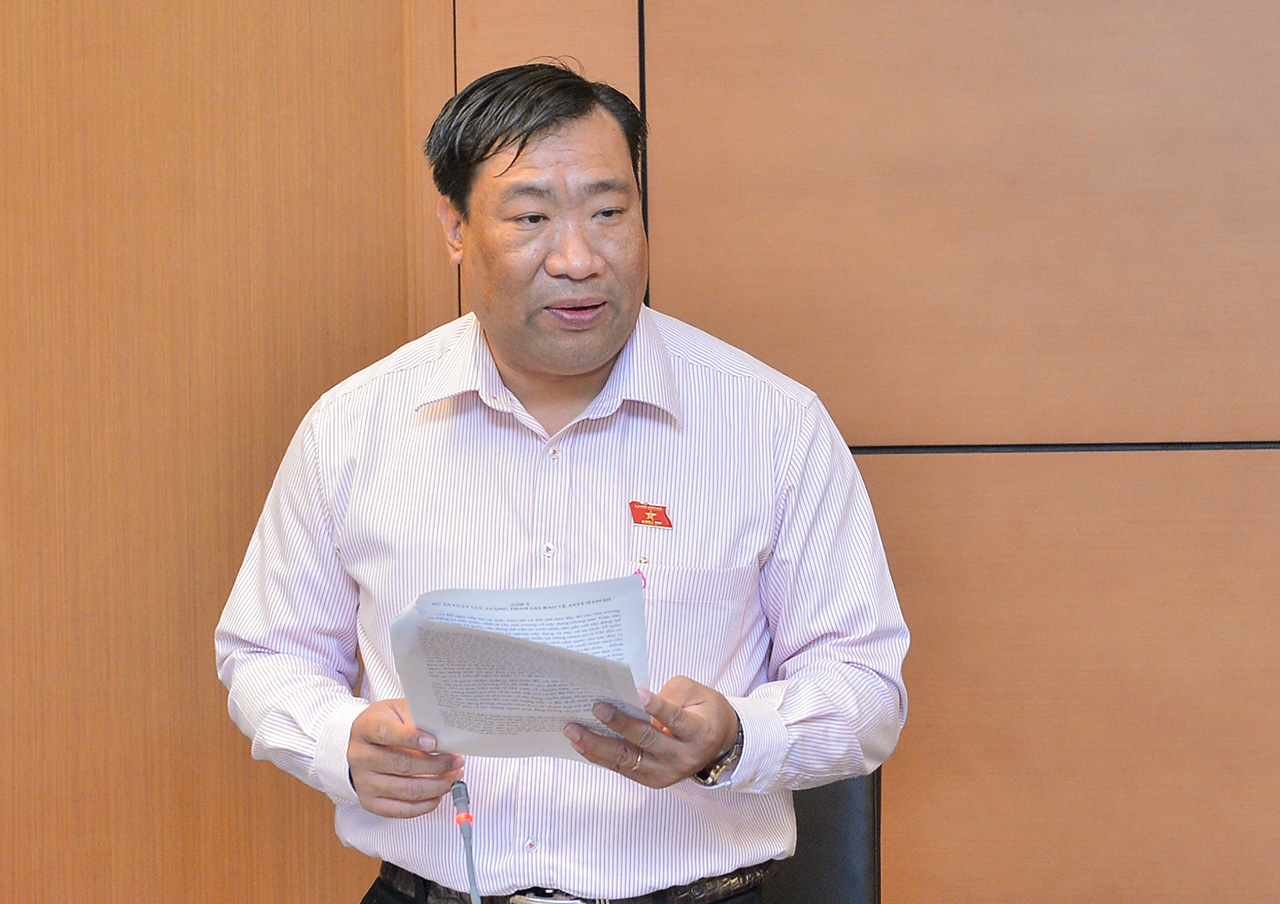
Representative Thach Phuoc Binh (Tra Vinh National Assembly delegation).
Each branch of the military has its own specific requirements and contributions. Applying a single retirement age could lead to injustice given the varying physical demands and intensity of work.
For example, air force or navy officers, who frequently work in hazardous and high-pressure environments, may find it difficult to maintain their health to the general retirement age. If the retirement age were adjusted appropriately, younger officers would have the opportunity to advance and take on greater responsibilities.
"This will create motivation for advancement and reduce the 'slow promotion' phenomenon caused by many senior officers who do not meet health requirements still holding positions, affecting the development potential of younger personnel," according to the representative from Tra Vinh.
Drawing on experiences from other countries and practical contexts, he noted that many nations with professional militaries, such as the United States and Japan, have adopted different retirement age regulations for each branch of the armed forces.
For example, the United States stipulates that officers in special forces and rapid response units have a lower retirement age because the nature of their work demands high physical fitness and quick reflexes.
Representative Binh argued that Vietnam is currently facing new demands in protecting its sovereignty, especially in its maritime and island areas. To meet long-term tasks, the military needs a force of young officers who are healthy and resilient.
Therefore, varying retirement ages will help maintain a highly combat-ready officer corps, meeting national defense needs in the new context.
The Minister of Defense explains
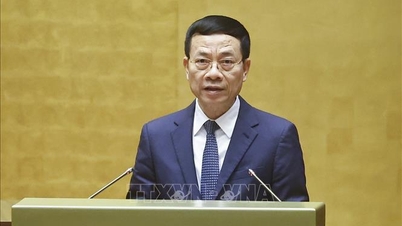
Speaking at the group meeting, Minister of National Defense Phan Van Giang clarified concerns about the proposed increase in the retirement age for officers in the draft law.
He stated that raising the retirement age would allow officers with the rank of lieutenant colonel or lower to retire with enough years of social insurance contributions to receive the maximum pension of 75%, in accordance with the Social Insurance Law.
According to this law, workers must have contributed to social insurance for 35 years for men and 30 years for women to receive the maximum pension of 75%.

Minister of National Defence Phan Van Giang speaks at the meeting.
Regarding the suggestion to separate retirement ages for male and female generals, the Minister of National Defense stated: "We have considered this repeatedly, and ideally, female military personnel should retire earlier due to the demanding nature of their work. However, to date, it is rare to have a period with three female officers holding the rank of general. Ultimately, we decided not to separate the retirement ages for men and women."
Regarding concerns about why the retirement age for generals is set at 60, instead of 62 as stipulated in the amended Police Law, the Minister of National Defense stated that the work of military officers is of a special nature, making it difficult to raise their retirement age further.
He gave the example of an officer around 40-45 years old who still has to march hundreds of kilometers with the army every year. They walk 25-27 km a day, sometimes up to 30 km. If they can't find a place to sleep, they have to keep walking for another hour; there's no way they can just walk 5-10 km and get into a car right away.
"We must train during peacetime. If we only travel by car during peacetime and don't train, we won't be able to handle the conditions when war forces us to travel on foot," according to Minister of National Defense Phan Van Giang.
Source: https://www.baogiaothong.vn/bo-truong-quoc-phong-ly-giai-de-xuat-khong-nang-tuoi-huu-cap-tuong-quan-doi-192241028180939599.htm













































































Comment (0)