

According to the new circular from the Ministry of Health , the number of drugs that must be tested for during a health examination for renewing a driver's license will increase from 4 to 5. At the same time, a 100% alcohol concentration test is no longer mandatory; it will only be required when requested by a doctor.
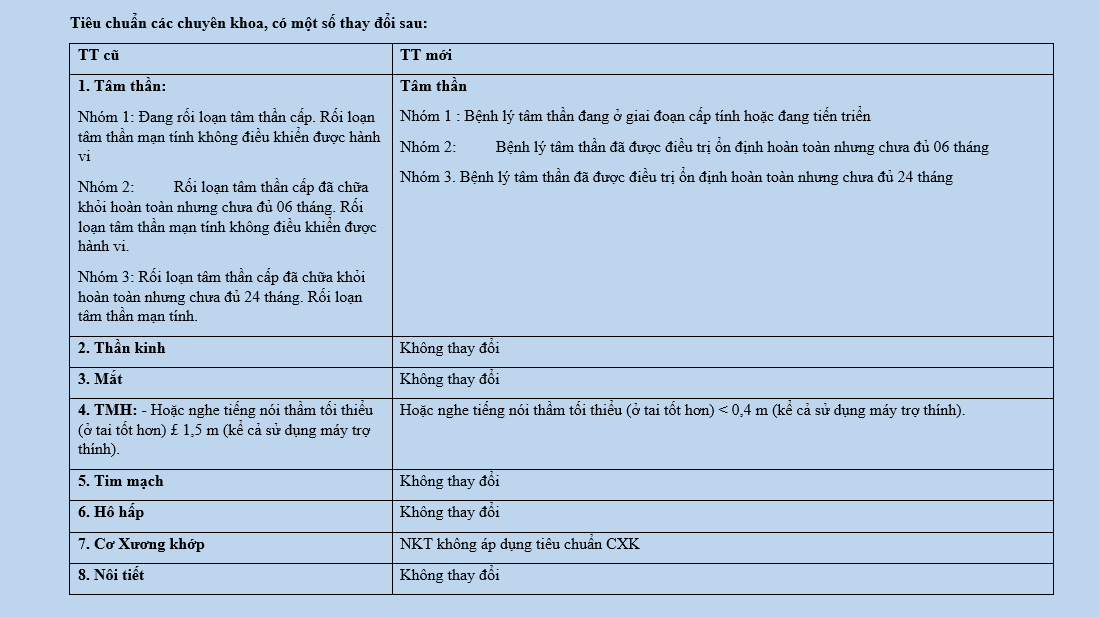
Standards for specialized fields have undergone some changes compared to the previous circular - Photo: Ministry of Health
The Ministry of Health has just issued Circular 36 regulating health standards and health examinations for drivers and operators of specialized motor vehicles; periodic health examinations for those practicing as automobile drivers; and the health database of drivers and operators of specialized motor vehicles.
Regarding the list of drug and alcohol tests required for driver's license renewal, drivers are now required to test for 5 types of drugs (previously 4). The mandatory 100% alcohol test has been removed; alcohol testing will only be performed when indicated by a doctor.
Regular health checkups for professional drivers require testing for alcohol levels and five types of drugs.
Additionally, people with disabilities applying for a Class A1 or B driver's license will not need to undergo a musculoskeletal specialist examination.
This circular also changes the standards for some specialties, such as psychiatry, and clarifies the required stabilization period before being eligible to drive.
The minimum hearing threshold in ear, nose, and throat conditions has decreased from 1.5m to 0.4m, even with hearing aids.
Maternity checkups are no longer required because they are less relevant to driver's health standards.
The validity period of health certificates has also been extended, from 6 months to 12 months from the date of signing the conclusion.
Currently, driver health examinations are conducted in accordance with the regulations in Joint Circular No. 24/2015/TTLT-BYT-BGTVT.
Circular 36 will take effect from January 1, 2025.
Driver health classification
The new circular introduces several changes, such as categorizing driver health standards into three specific groups:
Group 1: Applies to A1 and B1 driver's licenses and operators of specialized motorcycles.
Group 2: Applies to Class A and B driver's licenses.
Group 3: Applies to higher-level driver's licenses (C1, C, D1, D2, D and equivalent categories).
Previously, the old regulations grouped drivers in a way that lacked detail; for example, group 3 included drivers of vehicles with licenses A2, A3, A4, B2, and E.
Source: https://tuoitre.vn/bo-xet-nghiem-nong-do-con-tang-xet-nghiem-ma-tuy-khi-kham-suc-khoe-lai-xe-20241117152341011.htm















![[Photo] Prime Minister Pham Minh Chinh holds a phone call with the CEO of Russia's Rosatom Corporation.](/_next/image?url=https%3A%2F%2Fvphoto.vietnam.vn%2Fthumb%2F1200x675%2Fvietnam%2Fresource%2FIMAGE%2F2025%2F12%2F11%2F1765464552365_dsc-5295-jpg.webp&w=3840&q=75)













































Comment (0)