

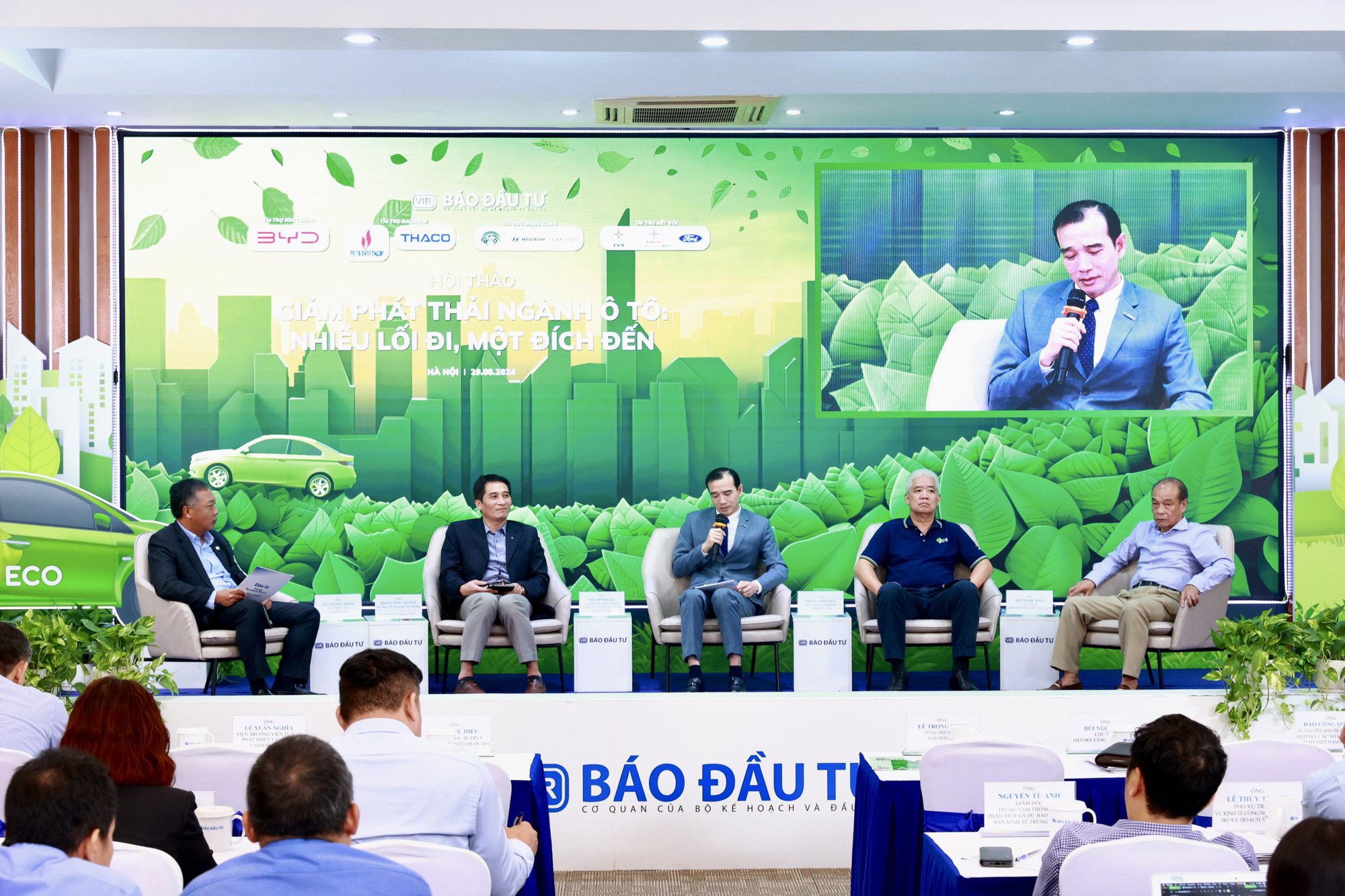
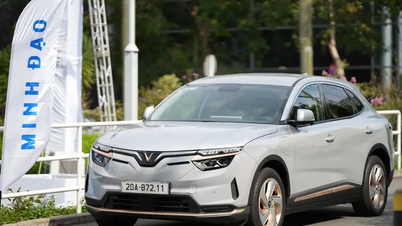
Promoting emission reduction in the automotive industry - Photo: BĐT
On August 29th, at the seminar "Reducing Emissions in the Automotive Industry: Many Paths, One Destination" organized by the Investment Newspaper, Mr. Vo Minh Luc, CEO of BYD Vietnam, stated that while policies supporting the development of electric vehicles exist, the transition and development of green transportation still face many difficulties. These include the unreasonable planning of charging stations in urban areas, which hinders investors, and the inadequate transportation infrastructure.
Policies to support the transition to green vehicles are unclear.
In particular, policies supporting the transition from traditional motor vehicles to new energy vehicles lack a clear roadmap. Therefore, for green transportation to develop, a program to transition to the use of electricity and green energy is needed.
As at BYD, Mr. Luc said that investing in charging stations faces many challenges, especially regarding land availability and legal issues. Electric vehicles are widely used in cities, but land in these areas is currently very limited. Finding land to invest in charging stations is extremely difficult.
The procedures and processes related to investing in charging stations are still unclear and complex. Regulations regarding charging stations have not been specified, creating difficulties for investors.
For example, issues related to fire safety or electrical connections are often very complex, so clear and simple procedures are needed to expedite the investment in charging stations.
From a financial perspective, Dr. Le Xuan Nghia, an economic expert, believes that the challenge in developing electric vehicles lies in securing funding. Hundreds of millions, even billions of USD in credit with low interest rates and long repayment periods are needed for a single investment.
Meanwhile, Vietnam's banking system is based on real estate lending or mortgages secured by real estate assets. The high interest rates make it difficult for industries, especially the mechanical engineering and manufacturing industries, to develop both extensively and intensively.
Support mechanisms are needed, especially in terms of capital and taxes.
Mr. Nghia analyzed that some countries in the early stages of automotive industry development often maintained large banking systems with sufficient financial resources to finance the industry, or the government guaranteed loans for businesses.
At the same time, governments are also implementing support policies that do not negatively impact the competitive environment. For example, subsidies through land prices, requiring public procurement to be for domestically produced electric vehicles, or encouraging consumers to use domestically produced electric vehicles...
Therefore, he argued that along with capital support, it is necessary to develop infrastructure, open up markets, and implement other policies such as excise tax, VAT, toll fees, and infrastructure for electric charging stations to ensure that businesses can develop charging stations in many convenient locations at low costs.
To promote the automotive industry in general and electric vehicles in particular, Mr. Dao Cong Quyet - head of the communications subcommittee of the Vietnam Automobile Manufacturers Association (VAMA) - believes that policies are needed to expand market capacity.
With the development of electrification, a suitable roadmap with incentives for each type of electrified vehicle is needed to support and encourage consumers. For example, tax and fee policies, investment in charging stations, and especially excise tax, need to be revised to provide incentives for environmentally friendly vehicles including HEV (self-charging hybrid vehicles) and PHEV (hybrid vehicles with their own charging systems).
Mr. Phan Duc Hieu, a permanent member of the National Assembly 's Economic Committee, believes that the green automotive industry has opportunities for development, but the key issue is building clear and consistent policies.
These are incentive mechanisms that need to be specific, long-term, and stable. There needs to be sustainability in investment in electric vehicle production and charging stations, setting localization targets and implementation timelines; promoting consumption through tax reductions and incentives for both investors and consumers, depending on the policy's design objectives and the automotive industry's development direction.
Source: https://tuoitre.vn/can-nguon-von-khong-lo-thao-go-chinh-sach-cho-o-to-dien-va-tram-sac-20240829152018017.htm



![[Photo] Closing Ceremony of the 10th Session of the 15th National Assembly](/_next/image?url=https%3A%2F%2Fvphoto.vietnam.vn%2Fthumb%2F1200x675%2Fvietnam%2Fresource%2FIMAGE%2F2025%2F12%2F11%2F1765448959967_image-1437-jpg.webp&w=3840&q=75)
![[Photo] Prime Minister Pham Minh Chinh holds a phone call with the CEO of Russia's Rosatom Corporation.](/_next/image?url=https%3A%2F%2Fvphoto.vietnam.vn%2Fthumb%2F1200x675%2Fvietnam%2Fresource%2FIMAGE%2F2025%2F12%2F11%2F1765464552365_dsc-5295-jpg.webp&w=3840&q=75)









































![[OFFICIAL] MISA GROUP ANNOUNCES ITS PIONEERING BRAND POSITIONING IN BUILDING AGENTIC AI FOR BUSINESSES, HOUSEHOLDS, AND THE GOVERNMENT](https://vphoto.vietnam.vn/thumb/402x226/vietnam/resource/IMAGE/2025/12/11/1765444754256_agentic-ai_postfb-scaled.png)





































Comment (0)