

 |
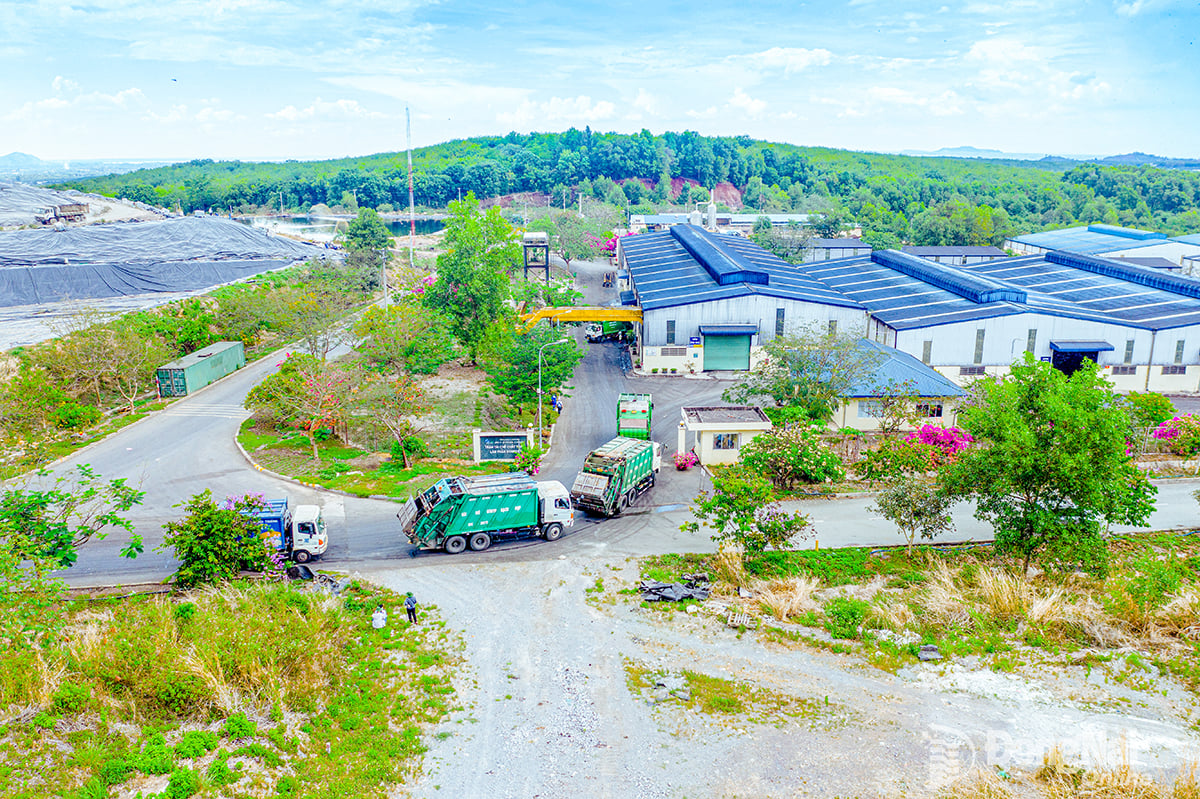
| The Quang Trung waste treatment area (Gia Kiem commune) is planned to be the site for a 7.5MW waste-to-energy project. Photo: Hoang Loc |
Developing waste-to-energy is one of the solutions to improve environmental protection, create clean electricity, and contribute to realizing the goal of a circular and sustainable economy .
Many projects have been planned.
According to the National Power Development Plan for the period 2021-2030, with a vision to 2050 (Power Plan VIII) and the Dong Nai Provincial Power Development Plan for the period 2021-2030, with a vision to 2050, the former Dong Nai province has 4 waste-to-energy projects. The largest of these is the Waste-to-Energy Plant Project in Tan An commune, with a processing capacity of 1,200 tons of waste per day and a power generation capacity of 30MW. The project received investment approval from the Provincial People's Council in 2022, with the goal of commencing construction in 2023 and completing it within approximately 3 years. In addition, the province has allocated land for the project and calculated the input waste sources, but an investor has yet to be selected.
Mr. Hoang Tuan Anh, Director of the Project Management Board of the joint venture between Le Delta Joint Stock Company and Ecotech Vietnam Technology Investment and Trading Joint Stock Company (the unit that prepared the feasibility study report), stated: The reason for the delay is that the process of preparing and adjusting the 1/500 detailed planning takes a long time; it is necessary to wait for the adjustment of the commune's construction planning to add the power generation connection line. This has led to a prolonged process of completing the environmental impact assessment report and appraising the documents.
Currently, the province generates approximately 2,600 tons of waste per day. Of this, more than 2,100 tons (about 79%) are collected and processed according to regulations, while the remainder is not collected and processed as required. In addition, the province has 22 temporary landfills with a volume exceeding 460,000 tons.
The remaining projects include: a waste-to-energy plant at the Tuc Trung Waste Treatment Area (La Nga commune), with a processing capacity of 700-1,000 tons/day and a power generation capacity of 18.5MW; the W2E Dong Nai Waste-to-Energy Plant (Long Phuoc commune), with a processing capacity of 1,500 tons of waste/day and a power generation capacity of 30MW; and a waste-to-energy plant at the Quang Trung Waste Treatment Area (Gia Kiem commune), with a processing capacity of 400-600 tons of waste/day and a power generation capacity of 7.5MW. All three projects are currently undergoing investment procedures.
In the former Binh Phuoc province, there is the Tan Hung - Hon Quan Waste-to-Energy Plant Project (Tan Hung commune), with a minimum processing capacity of 300 tons of waste per day and a power generation capacity of 7.5MW (expandable to 15MW). The project has received investment approval and is currently undergoing procedures related to land and investment.
Mr. Tran Anh Dung, General Director of Sonadezi Services Joint Stock Company, the investor of the Quang Trung Waste Treatment Plant, stated: The company's waste-to-energy project has completed all necessary planning procedures. The company has researched and worked with numerous domestic and international partners to select suitable technology; and has surveyed projects already implemented in Hanoi , Can Tho, Bac Ninh, and Binh Duong. However, the project has not yet been implemented due to four reasons. Specifically, the input waste supply needs to be stable and sufficient for the plant to operate for at least 20-25 years and for the capital recovery period. The output product, electricity, must be sold 100% after use at the plant. A unit price for waste treatment using incineration technology is needed so that the company can calculate the investment efficiency. Furthermore, the company requests preferential interest rates on loans, access to financial support programs, and international aid for the project.
"If the Provincial People's Committee supports us in resolving the four aforementioned obstacles, we can implement and complete the project within two years of its approval," Mr. Dung said.
Improving the effectiveness of environmental protection.
Waste-to-energy incineration is one of the modern technological solutions that helps process waste, create a source of clean energy, and reduce greenhouse gas emissions by reducing landfilling. For Dong Nai province, implementing these projects, in addition to the above-mentioned purposes, is also consistent with the province's orientation towards developing a circular and sustainable economy.
Mr. Tran Trong Toan, Deputy Director of the Department of Agriculture and Environment, stated that the progress of implementing waste-to-energy plant projects, including both new projects and technology conversion projects at existing treatment facilities, is slow and has not met the increasing demand for household waste treatment. According to Mr. Toan, investors need to be more proactive in coordinating with relevant departments, agencies, and localities to complete procedures related to planning, land, investment, construction, and environmental protection to implement projects between now and 2030.
Specifically, for the Tan Hung - Hon Quan Waste-to-Energy Plant Project, the Department of Agriculture and Environment will work with the Vietnam Rubber Industry Group to provide timely guidance and support in completing land-related documents and appraising environmental permit applications. For the Dinh Quan Waste-to-Energy Plant Project, the Department of Finance will guide the preparation of documents to adjust the investment policy for the pumping station and raw water supply pipeline. The Tan An Waste-to-Energy Plant Project needs to complete its feasibility study report soon to proceed with the bidding process for investor selection.
Provincial Party Committee member and Vice Chairman of the Provincial People's Committee Nguyen Thi Hoang emphasized: Waste-to-energy projects are of special significance in Dong Nai province's sustainable development strategy, contributing to the thorough treatment of household waste while creating a clean energy source and reducing pressure on the environment. Therefore, the Provincial People's Committee requests that departments, localities, and investors coordinate closely and promptly resolve obstacles to accelerate implementation progress. Upon completion, these projects will help alleviate the burden of waste treatment, improve environmental protection efficiency, and bring the province closer to the goal of building a green, sustainable, and environmentally friendly economy.
According to the Carbon Emission Reduction Plan for the period up to 2030, with a vision to 2050, issued by the Provincial People's Committee in early 2024, the environment is one of the seven priority areas for research and implementation of greenhouse gas emission reduction. The province's goal is to reduce greenhouse gas emissions by 20% by 2030, 45% by 2035, aiming for carbon neutrality by 2045 and achieving net zero emissions by 2050.
The Resolution of the First Provincial Party Congress, term 2025-2030, also sets the goal that by 2030, the rate of household solid waste collected and treated to standard will reach 97% in urban areas and 90% in rural areas. To achieve this goal, the province needs to implement a comprehensive set of solutions, including promoting the application of modern technology in waste treatment, minimizing the rate of landfilling, and ending the problem of waste accumulation due to overloaded capacity at existing treatment plants.
Hoang Loc
Source: https://baodongnai.com.vn/kinh-te/202511/cham-trien-khai-cac-du-an-dien-rac-f3422e2/

![[Photo] General Secretary and President To Lam presides over a meeting on preparations for the review of one year of operation of the three-tiered government system.](https://vphoto.vietnam.vn/thumb/1200x675/vietnam/resource/IMAGE/2026/06/02/1780391821195_a1-bnd-4595-9717-jpg.webp)












![[Image] Affirming the aspirations and new standards of the Vietnamese real estate market in the new era.](https://vphoto.vietnam.vn/thumb/1200x675/vietnam/resource/IMAGE/2026/06/03/1780441948766_giai-thuong-bat-dong-san-2026-minh-duy-6-7364-jpg.webp)













































Comment (0)