

SGGP Newspaper respectfully introduces some heartfelt opinions of researchers and leaders of educational institutions to clarify the issues raised in the effort to promote the application of AI in education and training in the coming time.
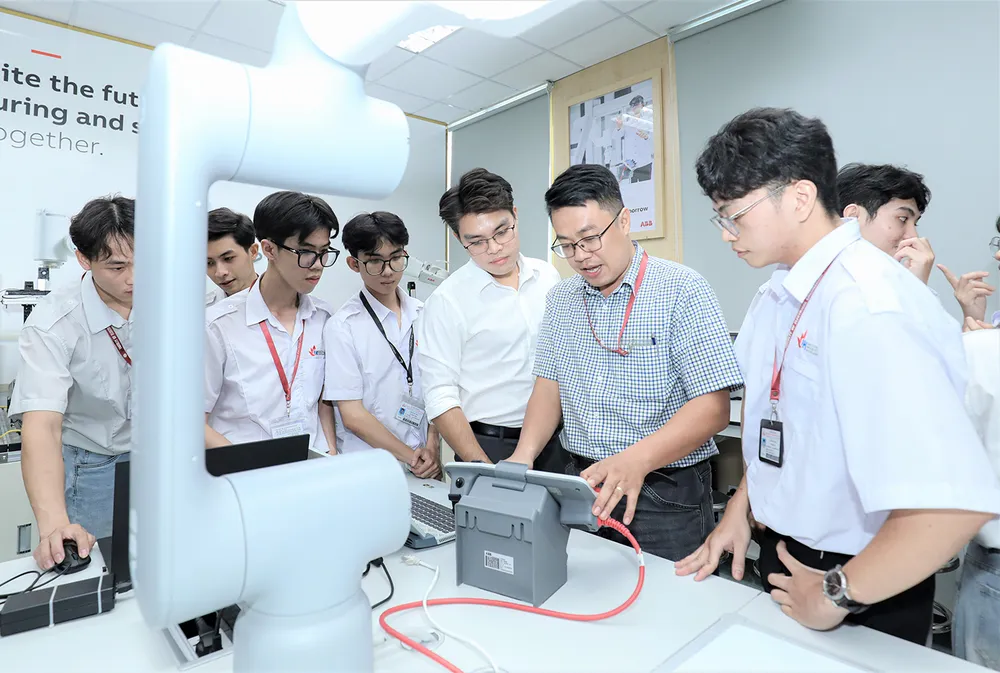
Prof. Dr. Hoang Van Kiem, Senior IT Advisor, Saigon International University:
AI is fundamentally changing the way universities teach and learn.
In the past, the teaching and learning process mainly revolved around the transmission of available knowledge. Today, with AI, knowledge becomes open, dynamic and instantaneous, students can access all global data sources and learning materials in just a few seconds. This forces lecturers to change their role from “communicator” to “trainer of thinking, emotion and creativity”.

AI supports university teaching in many forms such as: analyzing learning data to design personalized learning paths for each student; creating teaching content, exercises, experimental simulations, and real-time practice situations; helping lecturers save time on administration, grading, and assessment to focus on research and higher learning guidance.
Thanks to that, the teaching process at universities can move towards “lifelong learning with AI”: lecturers - students - intelligent systems co-create knowledge.
In scientific research, AI becomes a tool for creating and co-authoring new knowledge. AI is profoundly changing the way scientific research is conducted. Specifically, in fields ranging from medicine, engineering to social sciences, AI can analyze big data, simulate complex models, optimize hypotheses and support scientific publications. However, AI is just a tool, the researcher is still the center of creativity, integrity and scientific ethics.
Therefore, to use AI effectively in Vietnamese higher education, training institutions need to deploy AI strategically, systematically and humanely, with four key directions: building a school-level AI strategy; developing digital capacity for lecturers and students; integrating AI into training programs; ensuring integrity and human values, universities must uphold the principles of honesty, creativity and social responsibility in all AI applications, so that technology serves people, not replaces people.
AI opens up opportunities for Vietnamese higher education to shorten the gap with the world , if we know how to proactively grasp and orient correctly. Let's keep the human flame in the world of machines. When people know how to keep within themselves the light of morality, emotion and creativity, all technology, including AI, will become companions in the journey of human intellectual and spiritual evolution.
Professor, Dr. LE ANH VINH, Director of Vietnam Institute of Educational Sciences:
Technology needs to radically solve the problem of education
The results of a survey on Vietnamese students' readiness for AI conducted by the Vietnam Institute of Educational Sciences at the end of 2024 showed that more than 87% of secondary school students have knowledge about AI.
However, only 17% of students applied AI very effectively, 50% of students applied effectively, the remaining 30% felt normal or ineffective application. Among them, some difficulties students encountered when using AI include: lack of knowledge and skills about AI; lack of equipment and technology; lack of guidance from teachers...
Regarding teachers, the survey results show that 76% of teachers said they have used AI in teaching. Of these, a worrying rate is that 30.95% of teachers are uncertain about the effectiveness of use; more than 20% of teachers are not confident when applying AI in education.
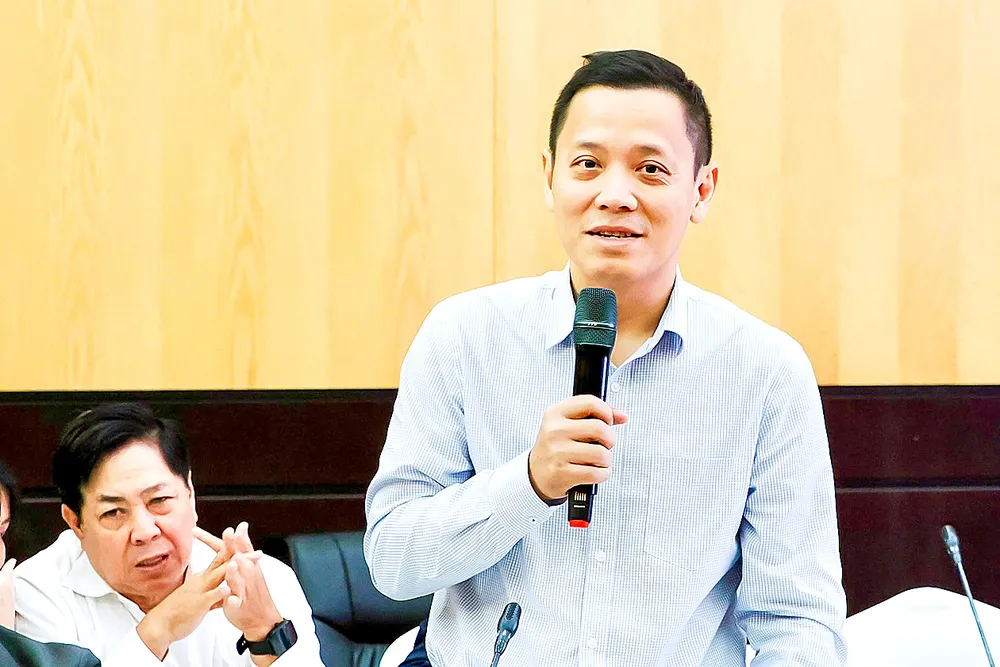
I think that current technology has not completely solved the problems of education but only solved the problems of technology. For example, teachers use AI to grade students' papers while students do not need to grade their exams by machine. Another example is that students and teachers now use AI tools to save time preparing lectures and doing homework.
However, if not used intelligently and for the right purpose, the application will not bring practical results for teaching and learning. From that reality, the implementation of AI in general education needs to be based on 3 main pillars: a consistent policy framework (ensuring ethical requirements, data security and long-term orientation); comprehensive and flexible curriculum and learning materials; human and financial resources.
In particular, policies need to prioritize building an AI competency framework for students and teachers; guiding the application of AI in teaching and investing in digital infrastructure to narrow regional gaps.
Dr. LE THI THANH MAI, former Head of Student Affairs Department (VNU-HCM):
Learners must master AI
Without a foundation of digital ethics, AI can easily slip off the learning track and become a “virtual fortune teller”. On the contrary, when properly oriented, AI will become a lever to improve knowledge, promote creativity and contribute to training a generation of brave digital citizens.

Therefore, the solution proposed in the digital environment from university lecture halls in the spirit of Resolution No. 71-NQ/TW dated August 22, 2025 of the Politburo on breakthroughs in education and training development is: Integrating digital ethics education: helping students distinguish scientific knowledge from superstition, knowing how to verify information; Strengthening psychological support: especially for health students or those under pressure to study, take exams, and find a job - so that AI does not become a "spiritual horoscope"; Training a team of teachers proficient in AI: not only for teaching but also for career orientation, relieving pressure for students, contributing to the personalization of student streaming.
AI has entered the university lecture halls. The question is no longer “to use or not to use”, but how to use it properly to become a brave and humane digital citizen. And that is also the measure for universities to self-reflect on the journey to implement Resolution 71 for the sustainable development of the country.
Mr. CAO DUC KHOA, Principal of Nguyen Du Secondary School (Ben Thanh Ward, HCMC):
Building a digital code of conduct
As the world enters a period of AI explosion, Vietnamese general education faces a new challenge: not only equipping students with knowledge but also preparing them with the ability to adapt and master AI technology.
I believe that “being ready for the AI era” is not just about investing in infrastructure, but more importantly, building human capacity – from teachers, students to the school community.

Accordingly, today's classrooms are not only blackboards, chalk and paper books. Every student can learn through online platforms, interact with virtual assistants, and look up information in just a few seconds.
AI is contributing to the formation of a generation of digital students, students who are quick, curious, and easily accessible to knowledge, but also easily caught up in the “vortex” of technology if they lack direction and easily become dependent on tools. Many students are used to using applications to look up, solve exercises, and even rewrite sample paragraphs without creative thinking.
When AI can suggest articles, presentations or analyze data, the line between “self-learning” and “copying” becomes blurred. Instead of direct communication, many students choose to “ask AI”, making the teacher-student relationship more distant. This requires a parallel between teaching with technology and teaching with emotions.
Therefore, schools need to proactively develop digital codes of conduct, guiding students to use AI for the right purpose: to support learning, not to replace learning. These rules can clearly define the scope of using AI tools in doing homework, sharing information and interacting in the online environment.
Along with that, education on "technology ethics" needs to be integrated into life skills and digital citizenship subjects, helping students understand that technology is just a means, and humans are the creative subjects.
For high schools to be truly “ready for the AI era”, I believe that there are three important factors: clear policies and directions from the education and propaganda sector, helping schools confidently innovate; the accompaniment of technology businesses, providing practical tools and solutions for schools; and the support of parents and society, so that the application of AI becomes part of the comprehensive education process, not just technology.
ACKNOWLEDGEMENTS
The seminar "Promoting the application of artificial intelligence in education and training - Benefits and challenges" took place smoothly and successfully. The Organizing Committee would like to thank the attention, companionship and support of schools and businesses, including: EMG Education Group, FPT Group, Le Bao Minh Joint Stock Company, Ho Chi Minh City University of Industry, Van Hien University, Phuong Nam Education Investment and Development Joint Stock Company, KDI Education Joint Stock Company, Ocean Consulting and Training Company Limited (Ocean Informatics), Online Mobile Services Joint Stock Company (Momo e-Wallet).
Source: https://www.sggp.org.vn/chu-dong-nam-bat-dinh-huong-dung-khi-dua-ai-vao-giao-duc-post820105.html

![[Photo] The 5th Patriotic Emulation Congress of the Central Inspection Commission](https://vphoto.vietnam.vn/thumb/1200x675/vietnam/resource/IMAGE/2025/10/27/1761566862838_ndo_br_1-1858-jpg.webp)


![[Photo] Party Committees of Central Party agencies summarize the implementation of Resolution No. 18-NQ/TW and the direction of the Party Congress](https://vphoto.vietnam.vn/thumb/1200x675/vietnam/resource/IMAGE/2025/10/27/1761545645968_ndo_br_1-jpg.webp)
![[Photo] National Assembly Chairman Tran Thanh Man receives Chairman of the House of Representatives of Uzbekistan Nuriddin Ismoilov](https://vphoto.vietnam.vn/thumb/1200x675/vietnam/resource/IMAGE/2025/10/27/1761542647910_bnd-2610-jpg.webp)






























































































Comment (0)