

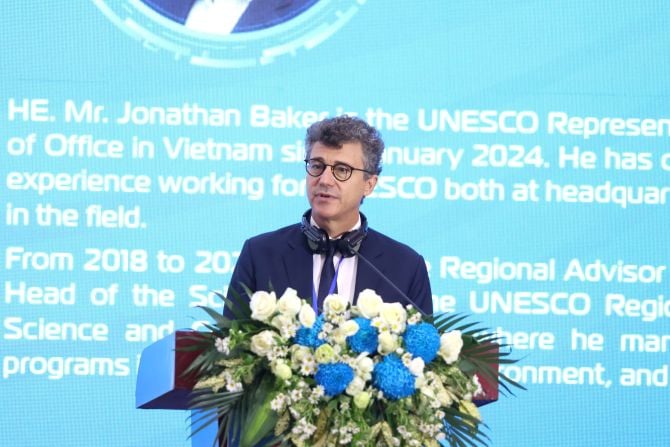
Mr. Jonathan Baker, Head of the UNESCO Representative Office in Vietnam.
Legally , Vietnam has established a clear strategic direction for AI. Resolution 57 of the Politburo identifies AI and digital transformation as key drivers of national growth. More importantly, the 2025 Law on Digital Technology Industry introduced the first dedicated legal chapter on AI, supplemented by laws on cybersecurity, data protection, and cloud computing, forming a very solid foundation. The national AI strategy, currently being revised, will reflect elements of UNESCO's recommendations on AI ethics.
In terms of education , Vietnam is integrating AI into education to transform teaching, learning, and management. More than 50 universities have implemented AI-related training programs, including 18 institutions offering full majors in artificial intelligence or data science . Vietnam has introduced a national digital competency framework for learners, adapted from UNESCO's global AI competency framework, which incorporates ethical AI.
Economically and in terms of infrastructure , Vietnam's progress in building a robust digital economy is impressive, with the digital economy now contributing 18.3% to GDP. In terms of technical infrastructure, Vietnam ranks 71st globally and 5th in Southeast Asia in the United Nations' e-Government Development Index. Internet access reaches 78% of the population and mobile network coverage reaches 99.8%, placing Vietnam in the group of countries with a "very high" e-Government Development Index.
Despite making significant progress, according to UNESCO representatives, Vietnam still has some important gaps to fill.
Regarding human resources , Vietnam faces a shortage of highly skilled AI experts, particularly in machine learning and natural language processing. Access to STEM fields remains limited for certain segments of the population, including women, ethnic minorities, and people with disabilities.
Regarding data , despite investments in data centers, there is still a need to enhance data sharing and interoperability across industries. Furthermore, continued efforts are needed to strengthen data protection, cybersecurity, and energy efficiency related to AI.
Given these strengths and weaknesses, Mr. Baker offered several recommendations for Vietnam.
The first step is to strengthen AI-related laws to better integrate ethical principles, promote diversity and equality, and ensure effective risk management.
"A national AI ethics committee needs to be established, specifically tasked with overseeing ethics and ensuring coordination," Baker emphasized.
Furthermore, Vietnam needs to raise public awareness about AI ethics and provide more AI ethics training for civil servants. It should continue to attract and develop AI talent with both ethical and technical capabilities.
Mr. Baker also called on Vietnam to establish centers of excellence and strategic technologies, while continuing to build and upgrade large-scale data centers, promoting community participation in AI, and enhancing diversity in socio-economic decision-making. He also emphasized the importance of building an innovative and ethical AI startup ecosystem by promoting private investment and supporting startups, especially those led by women and minority groups.
"UNESCO and the entire United Nations system are committed to always supporting Vietnam on its journey to developing an ethical and inclusive AI future," Mr. Baker affirmed.
Source: https://doanhnghiepvn.vn/tin-uc/khuyen-nghi-cua-unesco-danh-cho-viet-nam-trong-phat-trien-ai/20251027114344033

![[Photo] Closing Ceremony of the 10th Session of the 15th National Assembly](/_next/image?url=https%3A%2F%2Fvphoto.vietnam.vn%2Fthumb%2F1200x675%2Fvietnam%2Fresource%2FIMAGE%2F2025%2F12%2F11%2F1765448959967_image-1437-jpg.webp&w=3840&q=75)
![[Photo] Prime Minister Pham Minh Chinh holds a phone call with the CEO of Russia's Rosatom Corporation.](/_next/image?url=https%3A%2F%2Fvphoto.vietnam.vn%2Fthumb%2F1200x675%2Fvietnam%2Fresource%2FIMAGE%2F2025%2F12%2F11%2F1765464552365_dsc-5295-jpg.webp&w=3840&q=75)












































![[OFFICIAL] MISA GROUP ANNOUNCES ITS PIONEERING BRAND POSITIONING IN BUILDING AGENTIC AI FOR BUSINESSES, HOUSEHOLDS, AND THE GOVERNMENT](https://vphoto.vietnam.vn/thumb/402x226/vietnam/resource/IMAGE/2025/12/11/1765444754256_agentic-ai_postfb-scaled.png)






































Comment (0)