

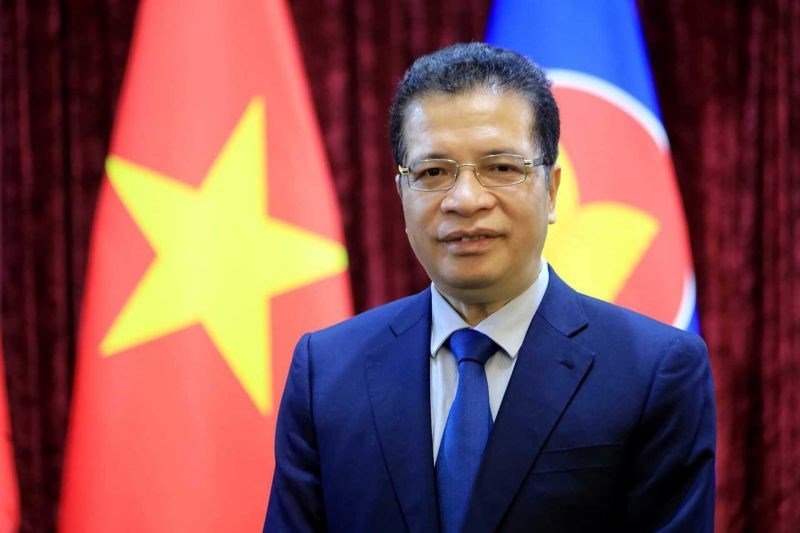
Ambassador, could you please elaborate on the importance and significance of Russian President Vladimir Putin's visit to Vietnam for the Vietnam-Russia Comprehensive Strategic Partnership, as well as for the realization of the Joint Statement on the Vision for the Comprehensive Strategic Partnership between the two countries until 2030?
At the invitation of General Secretary of the Central Committee of the Communist Party of Vietnam Nguyen Phu Trong, President of the Russian Federation V.V. Putin will pay an official visit to Vietnam from June 19 to 20, 2024. This visit is of paramount importance, as it will further deepen the comprehensive strategic partnership between Vietnam and Russia in all areas and elevate it to a higher level in the new context, especially as the two countries strive to realize the Joint Declaration on the Vision for a Comprehensive Strategic Partnership to 2030. This visit is not only an important diplomatic event but also demonstrates Russia's respect for and commitment to multifaceted cooperation with Vietnam. At the same time, the visit also shows Vietnam's active pursuit of a foreign policy based on independence, self-reliance, diversification, and multilateralism, for the benefit of the nation and contributing to peace and stability in the world. This contributes to strengthening friendship and mutual trust, creating a solid foundation for the comprehensive development of bilateral relations in the future.
During the visit, leaders of the two countries will discuss and set the direction for the comprehensive strategic partnership until 2030, further defining key areas of cooperation, from economics, trade, defense and security, energy, science and technology to education, culture, and people-to-people diplomacy . Long-term goals and specific action plans will be set out to ensure the sustainable and effective development of bilateral relations in the future. In addition, this visit is also an opportunity for both sides to sign and implement new cooperation agreements, creating momentum to promote bilateral relations.
President Putin's visit to Vietnam also sends a strong message of mutual respect between the two countries. This is a clear expression of friendship and solidarity, thereby contributing to enhancing the standing of both countries on the international stage, for the common benefit of both peoples and for peace and stability in the region and the world .
This is also an opportunity for the two countries to exchange views on regional and international issues of common concern, contributing to peace, stability, and development in the region and the world.
2024 marks the 30th anniversary of the signing of the Treaty on the Basic Principles of Friendly Relations between Vietnam and Russia and the 20th anniversary of the establishment of a strategic partnership between the two countries. Ambassador, could you please assess the highlights of bilateral relations over the past period?
Since the establishment of diplomatic relations on January 30, 1950, the relationship between Vietnam and the former Soviet Union and present-day Russia has remained strong over the years and has continued to develop and deepen in all fields.
The political relationship is highly reliable, through diverse forms and mechanisms of political cooperation such as frequent exchanges of delegations at all levels, especially at the high level, enabling leaders of both countries to exchange information and promptly direct the development of bilateral relations. Both sides have established and effectively implemented many mechanisms such as meetings of the Intergovernmental Committee, Strategic Dialogue, and annual political consultations, contributing to strengthening mutual understanding and trust, and creating a basis for promoting comprehensive cooperation between the two countries. Vietnam and Russia always support and cooperate closely in international and regional organizations such as the United Nations, ASEAN, APEC, and ARF.
Economic and trade cooperation has developed positively, with bilateral trade turnover increasing by 10-15% annually at certain periods, a result of the signing of the Free Trade Agreement between Vietnam and the Eurasian Economic Union. Despite the impact of global and regional instability, trade turnover in 2023 still reached over US$3.6 billion. Regarding investment, Russia has nearly 200 projects in Vietnam with a total capital of nearly US$1 billion. Vietnamese investment in Russia has increased sharply, from only about US$100 million in the early 2000s to US$3 billion in 2023. A key highlight in economic cooperation between the two countries is the strong development in the energy and oil and gas sectors. Both sides have cooperated effectively in oil and gas exploration and prospecting, not only on the Vietnamese continental shelf but also in the territory of the Russian Federation, with large-scale projects. Besides the Vietsovpetro joint venture, which is the flagship in oil and gas cooperation, the two sides have other joint ventures that are actively operating in both countries.
Bilateral cooperation in fields such as science and technology, culture, education, tourism, and local affairs is expanding, with scientific and technological cooperation and education and training between the two countries being strengthened and elevated to a strategic level. Russia has become an attractive destination for many Vietnamese students thanks to high-quality scholarship and training programs, with thousands of students studying in Russia each year, including key industries such as energy, oil and gas, and basic sciences.
Ambassador, what is the significance of cultural factors in the Vietnam-Russia friendship? How has cultural cooperation been promoted within the overall framework of cooperation between the two countries?
Throughout the history of cooperation, cultural exchanges have contributed significantly to building strong and close ties between the people of the two countries. Culture helps us better understand each other's customs, traditions, and lifestyles. Through activities such as cultural festivals, exhibitions, and artistic and musical events, the people of both countries have the opportunity to access, explore, and appreciate each other's precious cultural heritage. This not only deepens the friendship between the two nations but also contributes to building a solid foundation for the comprehensive strategic partnership between Vietnam and Russia.
Over the years, cultural cooperation between Vietnam and Russia has been strongly promoted. Numerous cultural exchange programs have been organized regularly, creating opportunities for artists, researchers, and people from both countries to meet, exchange ideas, and learn from each other.
Russia is the world's fourth-largest market in terms of purchasing power. Despite facing numerous challenges, thanks to the determination and efforts of businesses from both countries, trade turnover in 2023 still reached an impressive figure. How does the Ambassador assess the potential for economic cooperation between the two countries in the coming period, particularly in new potential areas of cooperation?
In 2012, Vietnam and the Russian Federation established a Comprehensive Strategic Partnership. In 2015, Vietnam and the Eurasian Economic Union signed a Free Trade Agreement (VN-EAEU FTA), facilitating the development of economic, trade, and investment cooperation between the two countries. After the VN-EAEU FTA came into effect in October 2016, bilateral trade between Vietnam and Russia developed rapidly, reaching a turnover of US$5.5 billion in 2021, a 90% increase compared to 2016.
However, since the outbreak of the Russia-Ukraine conflict, the complex political and economic situation in the world has negatively impacted economic and trade cooperation between the two countries. With the joint efforts of relevant agencies and the business communities of both countries, difficulties in transportation and payment have been gradually resolved, and import and export activities between Vietnam and Russia have shown a clear recovery. In 2023, bilateral trade increased by 3.6% compared to 2022. In the first five months of 2024, the value of goods imported and exported between the two countries reached approximately US$2 billion, an increase of 52% compared to the same period in 2023. Many of Vietnam's strong export product groups, such as agricultural products, seafood, textiles, and machinery, continue to maintain high export growth rates to the Russian market. Conversely, we also increased imports of essential goods such as coal, fertilizers, chemicals, and food to serve production and business needs, meeting domestic demand and exporting abroad.
Regarding investment, as of the end of May 2024, the Russian Federation had 186 projects in Vietnam with a total investment capital of approximately US$1 billion; meanwhile, Vietnam had about 25 investment projects in Russia with a total investment capital of approximately US$3 billion. Cooperation in the traditional oil and gas sector continues to be maintained and strengthened, with two prominent enterprises, Vietsovpetro and Rusvietpetro, continuing to operate effectively. Investment cooperation in other sectors such as food processing, automobile manufacturing and assembly, etc., is also gradually developing.
Over the past period, Vietnam and Russia have also gradually resumed cooperation in many other areas that were interrupted after the Covid-19 pandemic. Since the beginning of 2024, the two sides have reopened direct flights between Moscow and Ho Chi Minh City with a frequency of three flights per week. Currently, Russia and Vietnam have relaxed visa regulations for each other's citizens. Since August 2023, Vietnamese citizens have been able to apply for e-visas to Russia with a simple and convenient process; meanwhile, from August 15, 2023, Russian tourists can stay in Vietnam for up to 45 days visa-free. These are favorable conditions for businesses in both countries to recover and promote tourism and trade cooperation in the coming time.
We suggest that businesses from both countries further strengthen trade promotion activities, participate in specialized trade fairs and exhibitions in Russia and Vietnam to explore markets, find customers, and establish business and investment relationships.
For generations, the people of Vietnam and the people of the former Soviet Union and present-day Russia have always shared a special and rare bond. Therefore, how should people-to-people exchanges be promoted to "keep the flame" of Vietnam-Russia friendship alive?
The friendly relations and cooperation between Vietnam and the former Soviet Union, and Russia today, have always been continuously strengthened and nurtured by successive generations of leaders and people of both countries.
To keep the flame of Vietnam-Russia friendship alive, promoting people-to-people exchanges is essential. First and foremost, cultural exchange programs should be strengthened. Intergenerational exchanges, especially between the younger generations of both countries, should be organized more frequently and on a larger scale, creating a space for people of all ages to meet, interact, learn from each other, and understand one another. This will enhance awareness of the importance of Vietnam-Russia friendship and contribute to consolidating and deepening the friendship between the two nations and peoples. Regarding educational cooperation, the Soviet Union previously helped Vietnam train nearly 40,000 skilled cadres and experts in various fields. Currently, Russia continues to support Vietnam in human resource training. Since 2019, Russia has increased the number of scholarships for Vietnam to approximately 1,000 per year. There are currently over 5,000 Vietnamese students studying in Russia. In addition, organizing people-to-people exchanges through workshops, forums, and social cooperation programs is also essential.
According to the Ambassador, what needs to be done to promote and strengthen cooperation in areas such as education and training, and science and technology?
First, it must be affirmed that cooperation in science, technology, and education and training between the two countries in recent years has been very effective, increasingly diverse, substantive, and forms an important foundation of the comprehensive strategic partnership between the two countries.
Regarding scientific and technological cooperation, it can be seen that this field not only contributes to socio-economic development but also creates conditions for improving the capacity and efficiency of research and training institutions, enhancing professional skills, and forming a network of reliable partnerships between scientific and technological agencies of the two countries.
To develop scientific and technological cooperation with the Russian Federation in the future, both sides should focus on implementing joint research cooperation programs and projects in areas where Russia has strengths and Vietnam has needs, such as: life sciences, energy technology, space technology, rational use of environmental resources; basic research, Fintech, artificial intelligence, biomedical fields, etc.
Both countries need to have policies and allocate adequate financial resources to invest in joint research cooperation programs and projects, while also strengthening exchanges of delegations and scientific personnel, and connecting cooperation networks between research and training institutions.
Regarding human resource training in the Russian Federation under the Agreement, we need to prioritize sending students to train in engineering, applied sciences, and financial technology; and coordinate with relevant ministries to increase the number of scholarships for medical and cultural/artistic fields. Annually, the Russian government grants 1000 scholarships to Vietnamese citizens to study in Russia. To attract Vietnamese citizens to study in Russia, it is necessary to promote awareness of Russian education and universities in localities across Vietnam, and expand the target group for scholarship applications to increase opportunities for Vietnamese students nationwide.
Thank you very much, Ambassador!
Source: https://kinhtedothi.vn/dai-su-chuyen-tham-viet-nam-cua-tong-thong-nga-gop-phan-dinh-huong-quan-he.html














![[Photo] Prime Minister Pham Minh Chinh holds a phone call with the CEO of Russia's Rosatom Corporation.](/_next/image?url=https%3A%2F%2Fvphoto.vietnam.vn%2Fthumb%2F1200x675%2Fvietnam%2Fresource%2FIMAGE%2F2025%2F12%2F11%2F1765464552365_dsc-5295-jpg.webp&w=3840&q=75)









































Comment (0)