

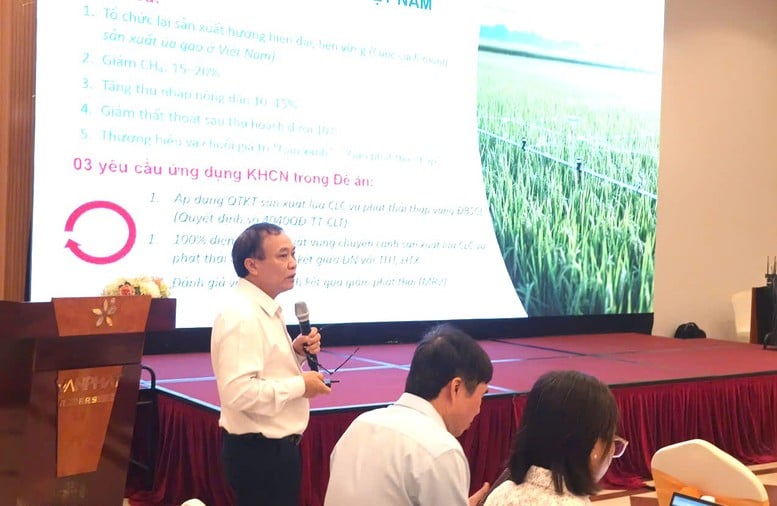
Director of the Department of Cooperative Economics and Rural Development, Le Duc Thinh, speaks at the Conference - Photo: VGP/LS
Three transformations of Vietnamese rice
Speaking online from Japan, Mr. Hagiwara Hideki , Deputy Director of the Department of Environment, Export and International Cooperation, emphasized the strong cooperative relationship between the two countries in the agricultural sector. From rice varieties to planting techniques, from preservation to personnel training, to high-tech agricultural projects according to JGAP and GlobalGAP standards, Vietnam and Japan have together built a foundation to elevate the rice industry.
Looking back at the development of rice cultivation, experts believe that Vietnamese rice has undergone three significant revolutions. The first, in the 1960s and 1970s, saw Vietnam begin applying biotechnology to breeding; short-duration, lodging-resistant, drought-tolerant, and high-yielding rice varieties were gradually bred to replace traditional long-duration varieties. The import and testing of IRRI varieties, along with the use of chemical fertilizers, laid the foundation for modern agriculture.
The second revolution came after Resolution 10/1988 , when peasant households were granted autonomy. This institutional change unleashed a surge in production capacity, transforming Vietnam in just a few years: from food shortages to rice exports in 1989, ushering in a period of rapid and sustainable growth.
The third revolution in Vietnamese rice production, beginning in 2023, is defined as the Green-Digital Revolution, linked to the Sustainable Development Project for 1 million hectares of high-quality, low-emission rice in the Mekong Delta region for the period 2023-2030 . The goal is not only to increase productivity but also to "green" the value chain, reduce greenhouse gas emissions, and increase the value of Vietnamese rice in a global context prioritizing sustainable agriculture.
Green rice ecosystem – digital: A new foundation for the Mekong Delta
At the conference, Mr. Le Duc Thinh , Director of the Department of Cooperative Economics and Rural Development, affirmed that this FDI cooperation with Japan aims to build a modern rice production ecosystem. According to him, this ecosystem includes organizing farmers according to the cooperative model, linking the rice value chain to reduce emissions, digital transformation, and participation in the carbon market. The ultimate goal is to create a closed value chain from seeds, production, harvesting, processing to consumption – an advanced model that many countries are pursuing.
After two years of implementing the project, the rice industry has achieved many remarkable results. Pilot projects at 11 locations covering 543.5 hectares and involving 355 households showed an average yield increase of 5.12 quintals/hectare , cost reductions ranging from 1.7 to 4.9 million VND/hectare , and price reductions from 326 to 1,052 VND/kg of paddy rice . The alternating wet and dry irrigation technique allowed for 2-3 water withdrawals per crop , while simultaneously reducing CO₂ emissions by 3.7 tons/hectare/crop . To date, 354,800 hectares have been certified for sustainable production in six provinces of the Mekong Delta, including 7,493 hectares under VietGAP certification, 246 hectares under organic certification, and 5,659 hectares under food safety certification. Several green rice supply chains of Trung An and Tan Long enterprises have begun to form and operate effectively.
Nevertheless, the conference emphasized that initial success is only the foundation for the long road ahead. In the coming period, the rice industry must accelerate the application of technology in all stages: from soil care, irrigation, and straw management; to deep processing and logistics to reduce losses; to digital transformation of the entire chain, international standard traceability, building a shared digital platform, and applying IoT, robotics, and Big Data in agricultural management.

In the coming period, the rice industry must accelerate the application of technology in all stages: from soil care, irrigation and straw management; to deep processing and logistics to reduce losses - Photo: VGP/LS
Many challenges face Vietnamese rice.
Besides the great opportunities presented by the green and digital production model, the conference also highlighted the existing challenges facing the rice industry. First and foremost is the increasingly severe effects of climate change. Unseasonal rains, erratic water availability, and unpredictable tidal surges are disrupting the planting schedules of farmers in the Mekong Delta. Many areas are forced to change their farming models, switching to intercropping or choosing other, more suitable crops.
The second challenge is the technology gap. While equipment, machinery, and digital applications are developing rapidly, the direct workforce in agriculture has limited access to them, largely consisting of older workers with limited exposure to new technologies. Therefore, technology transfer faces many obstacles, affecting the progress of green and digital transformation.
Furthermore, the global rice market is increasingly volatile. Consumption demand can change abruptly due to social, political, or income factors in importing countries. The Vietnamese rice industry faces greater pressure to maintain quality, stabilize production, and ensure competitiveness in terms of value.
Vietnamese rice grains in a new outlook.
Delegates at the conference shared the expectation that the third revolution would create a historical turning point for Vietnamese rice. If the first revolution focused on increasing productivity, and the second on empowering producers, then the third is a comprehensive reconstruction to bring Vietnamese rice deeper into the high-end and sustainable market.
Collaborating with Japan, a country with a high-tech agricultural sector, is seen as a golden opportunity to learn about green production models, increase transparency, and raise quality standards. Pilot models that have proven effective are building confidence among businesses and farmers as they expand their operations.
Vietnamese rice, therefore, carries new expectations: not only meeting food needs but also becoming a green, responsible product with a clearer place in the global supply chain.
Le Son
Source: https://baochinhphu.vn/cuoc-cach-mang-lan-thu-3-cua-lua-gao-viet-nam-hat-gao-xanh-cho-tuong-lai-10225121214350531.htm










![[Photo] Prime Minister Pham Minh Chinh holds a phone call with the CEO of Russia's Rosatom Corporation.](/_next/image?url=https%3A%2F%2Fvphoto.vietnam.vn%2Fthumb%2F1200x675%2Fvietnam%2Fresource%2FIMAGE%2F2025%2F12%2F11%2F1765464552365_dsc-5295-jpg.webp&w=3840&q=75)














































Comment (0)