

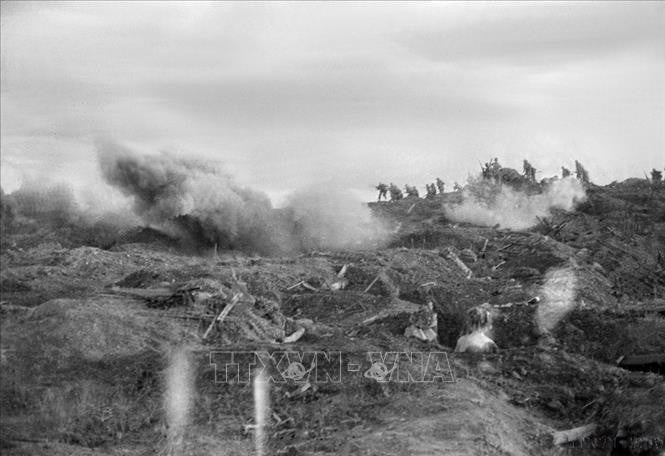
The second offensive was the most important, longest and fiercest of the Campaign.
The second offensive was the most important, longest, and fiercest phase of the campaign because the central sector was the strongest, situated in the middle of the Muong Thanh plain, and protected by a very advantageous system of high ground to the east.
Following the victory in the first phase, we concluded that, although our forces had annihilated a significant portion of the enemy's troops, their strength remained considerable. Therefore, our operational strategy remained "attack surely, advance surely."
On March 30, 1954, the second phase of the offensive began.
On March 31, 1954, our troops continued their offensive on Hill A1.
March 31, 1954: The battle on hill A1 was in a fierce stalemate.
- On the enemy side:
In his memoir " Dien Bien Phu - A Historical Rendezvous," General Vo Nguyen Giap, Commander-in-Chief, clearly shows the chaos and anxiety of the enemy: at dawn on March 31, De Castries met with Langler, Padis, and Bigia to discuss how to deal with the situation. Langler proposed concentrating the entire 2nd Airborne Group, including the 1st and 8th Parachute Battalions, a part of the 5th Parachute Battalion, along with the 3rd Foreign Legion Battalion and tanks from Hong Cum to launch a counterattack. All artillery and tank forces of the fortified complex would be mobilized for the counterattack.
De Castries also urgently requested that Hanoi send reinforcements.
On the morning of March 31st, Navarre hastily flew from Saigon to Hanoi. At 7:45, Cogny arrived to meet Navarre and reported on the situation at Dien Bien Phu, which he had learned about since midnight. Navarre became furious and reprimanded him. Cogny argued back fiercely. Nevertheless, the two men had to sit down together to discuss how to resolve De Castries' request.
Colonels Nicot, commander of the air transport force, and Sauvagnac, commander of the airborne reinforcement force, both realized it was impossible to drop paratroopers into Muong Thanh during the day.
With nothing left to wait for, Bigia decided to assemble all of Muong Thanh's mobile forces, including its battered battalions, to launch a counterattack.
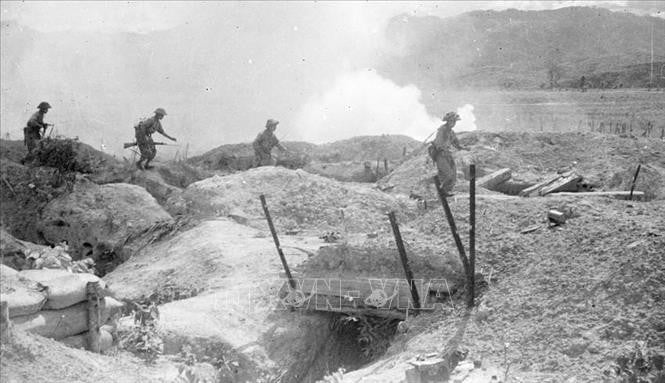
The 8th Airborne Assault Unit took advantage of the artillery smoke to climb to high point D1.
- At Hill D1, on our side, the situation was the opposite. The memoir "Dien Bien Phu - A Historical Rendezvous" shows the determination and unwavering fighting spirit of our officers and soldiers, even at the cost of their lives: After 25 minutes, the enemy recaptured almost all of Hill D1, cornering our defending company. The situation became critical. Soldier Tran Ngoc Boi, the leader of a three-person team, shouted: "Better to die than abandon the battlefield!" Timely words from soldiers on the battlefield often provide strength. The soldiers rose up, using firepower and bayonets to repel the enemy's counterattacks. We used artillery to block them and sent reinforcements. Our two companies turned the tide of battle.
After 1 hour of fighting, the surviving enemy soldiers fled back to Muong Thanh. Bigia not only failed to recapture Dominic 2 but also had to abandon Dominic 6 (D3) and withdraw the artillery position at Dominic 5 (210), knowing that these high points could not hold if Dominic 2 was lost.
Still according to the memoir "Dien Bien Phu - Historic Rendezvous", at hill C1:
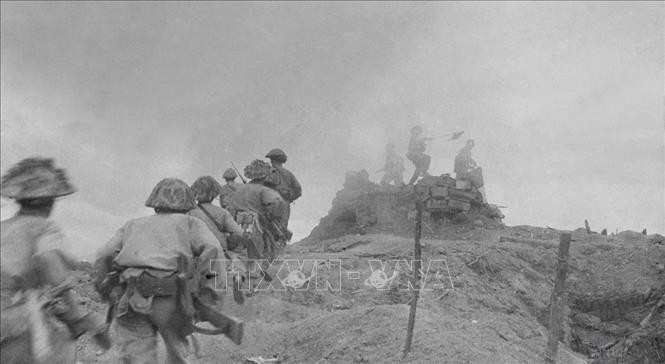
- Enemy: At 1:30 PM, Bigia directly commanded the 6th and 5th paratrooper battalions to advance towards C1.
This time the enemy was larger, supported by air force and artillery, and tanks cleared the way. They captured the Flagpole Hill, putting the defending soldiers at a disadvantage.
- Our side: Company 273 of Regiment 102 has been on the hilltop since morning, along with the rest of Company 35 of Regiment 98, repelling numerous enemy counterattacks from C2 attempting to push our troops off the hill.
The soldiers tied white parachute fabric to the muzzles of their guns to serve as a reference point for the artillery. While our artillery fired relentlessly, the regiment sent a reinforcement unit along the newly dug trench on Hill D, and together with the defenders, repelled the enemy from the Flagpole, restoring the battle lines.
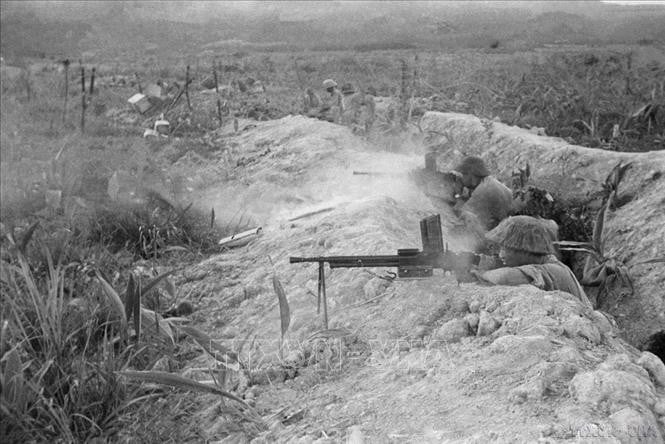
On March 31st, our troops repelled seven counterattacks by two paratrooper battalions. Soldier Vu Van Kiem, using a recoilless rifle, was awarded the First Class Soldier's Medal.
At 4:00 p.m. the same day, Bigia was forced to order a retreat.
The enemy counterattacks on March 31 were a complete failure.
- At hill A1:
By about 4 a.m., we had occupied two-thirds of the stronghold. However, the enemy, relying on the remaining part and fortified bunkers, continued to resist fiercely.
Early in the morning of March 31, 1954, the enemy deployed the 6th Colonial Parachute Battalion to counterattack. The battle at Hill A1 was fierce and protracted. By the afternoon of March 31, 1954, the enemy had recaptured two-thirds of the Hill A1 stronghold, leaving us with only one-third in the northeast.
In light of this situation, the Front Command decided to replace the forces, continue the offensive on A1, and simultaneously instructed forces on both the East and West sides to work together to disperse the enemy's troops.
[Source: VNA; Book: General Vo Nguyen Giap: Dien Bien Phu: 50 Years Later, People's Army Publishing House, Hanoi, 2004, pp. 122, 123; General Vo Nguyen Giap: Complete Collection of Memoirs, People's Army Publishing House, Hanoi, 2010, pp. 1029, 1030, 1031].
Source


![[Photo] Closing Ceremony of the 10th Session of the 15th National Assembly](/_next/image?url=https%3A%2F%2Fvphoto.vietnam.vn%2Fthumb%2F1200x675%2Fvietnam%2Fresource%2FIMAGE%2F2025%2F12%2F11%2F1765448959967_image-1437-jpg.webp&w=3840&q=75)
![[Photo] Prime Minister Pham Minh Chinh holds a phone call with the CEO of Russia's Rosatom Corporation.](/_next/image?url=https%3A%2F%2Fvphoto.vietnam.vn%2Fthumb%2F1200x675%2Fvietnam%2Fresource%2FIMAGE%2F2025%2F12%2F11%2F1765464552365_dsc-5295-jpg.webp&w=3840&q=75)

































![[OFFICIAL] MISA GROUP ANNOUNCES ITS PIONEERING BRAND POSITIONING IN BUILDING AGENTIC AI FOR BUSINESSES, HOUSEHOLDS, AND THE GOVERNMENT](https://vphoto.vietnam.vn/thumb/402x226/vietnam/resource/IMAGE/2025/12/11/1765444754256_agentic-ai_postfb-scaled.png)
































Comment (0)