

In that context, the Da Nang Forest Protection Management Board (FPMB) - a unit under the city's Department of Agriculture and Environment - has proactively improved its organization, not allowing forest protection work to be interrupted, and at the same time implementing many strong solutions in the direction of professionalism - technology - closely following reality.
CAND Newspaper reporter had an interview with Mr. Vo Hung Nhan, Director of Da Nang Forest Protection and Development Board about the strategy of forest protection and development in the new period.
+ Reporter: The implementation of the two-level local government model, along with the entire RPH area being assigned to the Management Board, has created what opportunities and challenges for forest protection work, sir?
- Mr. Vo Hung Nhan: This change brings both pressure and great motivation. The fact that the forest is assigned to the Management Board under a unified focal point helps us to be more proactive in coordinating human resources, resources and forestry techniques. The management line of the province (Department of Agriculture and Environment) - Management Board - commune/ward becomes concise, reducing intermediary steps, allowing the Board to focus entirely on in-depth expertise in forest management and protection.
However, the absence of an intermediate management level at the district level requires the Board to improve its autonomy, reorganize its apparatus, increase its presence at the grassroots level, and strengthen coordination with commune/ward authorities - a force that is not specialized in forestry - to have more support in forest protection work.
+ Reporter: To ensure the effectiveness and efficiency in the work of managing and protecting forests on a large scale, how has the Board reorganized its apparatus and forces at the grassroots level to adapt to the new mechanism?
- Mr. Vo Hung Nhan: This is a breakthrough that we have prepared very carefully. We implement the motto "Forest coverage - permanent presence", establishing 10 Forest Management Stations spread across key areas, ensuring 24/7 staff. Each Station is equipped with enough personnel and equipment to work independently and proactively patrol, inspect and coordinate with other sectors.
Under each Station, we organize into smaller Working Groups, in charge of a specific forest area, working directly with the village/residential group and the contracting community.
Each Station is organized into Teams/Posts in charge of specific forest areas, working directly with the contracting community, closely following the residents to help grasp the violation situation early - from afar.
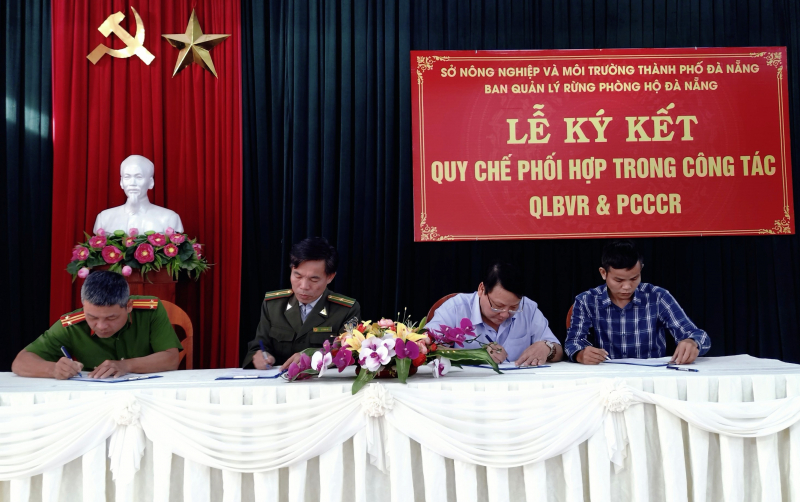
The Stations are also the direct focal point for coordination with the Commune/Ward People's Committee, local Forest Rangers and local Police in patrolling, controlling and recording violations. This coordination is specified in the signed Inter-sectoral Coordination Regulations.
+ Reporter: In addition to reorganizing the apparatus, what key solutions does the Da Nang Forest Protection Department have to improve the quality of forest protection, especially in the context of increasingly severe forest fire risks and climate change?
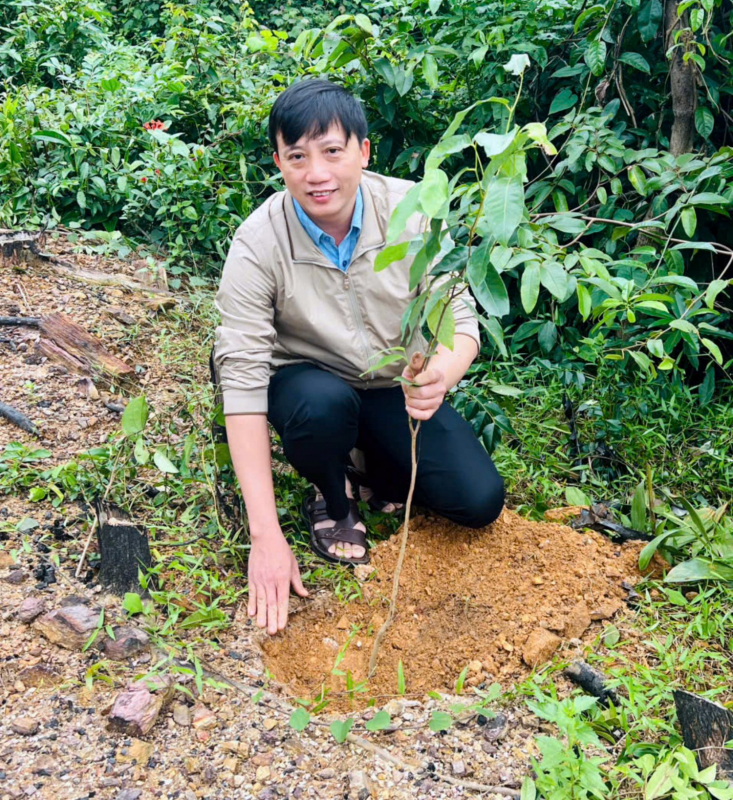
- Mr. Vo Hung Nhan: We always identify that protection must go hand in hand with development. Therefore, we focus on two main pillars. First, focus on improving forest quality through implementing programs and projects to plant additional native trees with high protection capacity and multi-purpose trees, prioritizing implementation in poor and vulnerable forest areas to strengthen the ability to protect against landslides and flash floods. The goal is to create a sustainable, diverse, multi-purpose protective forest ecosystem with high environmental protection capacity.
Second, focus on management, supervision, investment, and application of high technology in forest protection and forest fire prevention and fighting: applying advanced forestry management software, applying artificial intelligence, investing in early warning systems using thermal sensors and unmanned aerial vehicles (Flycam/Drone), and camera traps. At the same time, build solid fire prevention works such as reservoirs and firebreaks according to technical standards. Forces at 10 stations are trained in fire prevention and fighting to ensure skills, requirements, and readiness to respond as quickly as possible when an incident occurs.
+ Reporter: With this new management mechanism, what is the biggest goal that the Da Nang Forest Protection Department is aiming for in the coming years to ensure security and promote the value of the city's "green lung", sir?
- Mr. Vo Hung Nhan: Our core goal in the coming period is to build an effective and efficient QLBVR system, based on the participation of people, the community and the professionalism of the apparatus.
Regarding management: ensure 100% of forest area is strictly managed, no deforestation or illegal encroachment occurs, maintain a system of 10 Stations operating stably and professionally.
Regarding value: Continue to promote the economic and ecological value of protective forests through coordination with the commune government to develop livelihoods for people such as: growing medicinal herbs, non-timber forest products under the forest canopy, responsible ecotourism, planting multi-purpose trees, contracting forest protection according to the policy of payment for forest environmental services, carbon credits, etc. Thereby, forests are not only assets that need to be protected but also become a stable source of income, thereby promoting the community to voluntarily participate in protection. We are determined to maintain the title of Da Nang - a green, safe and sustainable city. Mr. Nhan affirmed.
+ Reporter: Thank you for this interview!
Source: https://cand.com.vn/doi-song/da-nang-tang-cuong-su-dung-cong-nghe-va-luc-luong-chuyen-trach-bao-ve-rung-i789903/
![[Photo] Cat Ba - Green island paradise](/_next/image?url=https%3A%2F%2Fvphoto.vietnam.vn%2Fthumb%2F1200x675%2Fvietnam%2Fresource%2FIMAGE%2F2025%2F12%2F04%2F1764821844074_ndo_br_1-dcbthienduongxanh638-jpg.webp&w=3840&q=75)

































![[VIMC 40 days of lightning speed] Da Nang Port: Unity - Lightning speed - Breakthrough to the finish line](https://vphoto.vietnam.vn/thumb/402x226/vietnam/resource/IMAGE/2025/12/04/1764833540882_cdn_4-12-25.jpeg)






































Comment (0)