

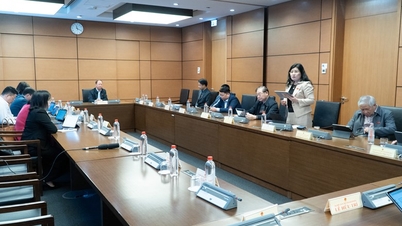
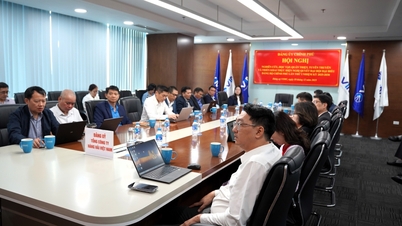
Attending the discussion session at Group 6 were National Assembly delegates from the National Assembly delegations of Lang Son, Dong Nai provinces and Hue city. Delegate Trieu Quang Huy, Head of the National Assembly delegation of Lang Son province, chaired the group discussion session.
Removing difficulties arising for people and businesses
Contributing opinions to the draft Law on amending and supplementing a number of articles of the Law on Value Added Tax, National Assembly deputies in group 6 highly agreed on the necessity of promulgating the law to create a synchronous legal corridor, and at the same time proposed that the amendment must be close to reality, avoiding creating additional procedural burdens and costs for the agricultural and fishery sectors and small-scale producers.
 |
| Delegate Huynh Thanh Chung, National Assembly Delegation of Dong Nai province, speaks at the group discussion session. Photo: Contributor |
Speaking at the group discussion, delegate Huynh Thanh Chung, National Assembly Delegation of Dong Nai province, expressed his agreement on the necessity of promulgating the Law on Value Added Tax (amended), but the delegate emphasized that when implementing it, the Government and the Ministry of Finance need to have a specific plan to remove difficulties arising for people and businesses in the agricultural production sector.
"In reality, agricultural production activities are currently very scattered and small-scale, so tracing goods from the beginning will be very difficult," said the delegate.
Delegate Huynh Thanh Chung further analyzed that farmers who grow timber in their home gardens are not intensive farmers but only extensive farmers. The products of the Southwest region from inland aquaculture are also extensive farmers, even "just a few kilos of fish, a few kilos of shrimp, a few cubic meters of planted forest wood, or agricultural products harvested from home gardens". Therefore, if we have to prepare documents and procedures through the tax authorities for such small outputs, it will create a burden, making it very difficult for farmers to implement.
Delegate Huynh Thanh Chung emphasized that this issue was raised in the previous session and is now being raised again in this session, showing that this is a problem that needs a radical solution.
Delegate Huynh Thanh Chung also pointed out that it is necessary to clarify the contradiction between imported goods and domestically produced goods based on the general principle in the overall solution to solve the problem, not just focusing on the "problem" of increasing revenue. Because up to now, the consistent policy of the Party and State is to exempt and reduce taxes for agriculture, thereby protecting farmers and encouraging agricultural production.
"From President Ho Chi Minh's Testament to current policies, all efforts have been made to exempt and reduce agricultural taxes, from agricultural land tax to income tax from agricultural products," the delegate emphasized.
Carefully assess the impact of tax policy
Based on that reality, delegate Huynh Thanh Chung suggested that the Government carefully calculate the impact of tax policies on domestic enterprises and producers.
The delegate cited that currently about 70% of the population in our country are farmers, so tax policy needs to create a favorable environment and healthy competition for domestic agriculture.
In particular, the Ministry of Finance needs to evaluate and clearly quantify the cost of the tax collection apparatus in the agricultural sector. "If tax is collected, will the cost of organizing the apparatus to "manage the collection" be larger and more complicated than the amount collected? If the entire exemption is granted, what will be the national interest and the interest of the economy?" - the delegate raised the question.
 |
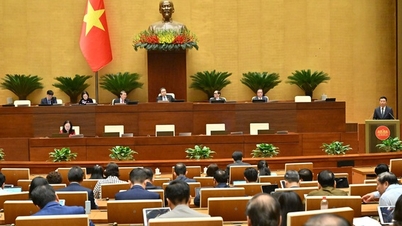
| Scene of the discussion session at Group 6 on the morning of December 8. Photo: Contributor |
Therefore, according to delegate Huynh Thanh Chung, to ensure transparency and efficiency, two clear options should be considered: either subjecting all subjects to tax, or exempting them completely. After that, the Government must report specifically to the National Assembly with quantitative data, instead of just qualitative assessment, including imports into the country.
"Tax exemption or collection to benefit the economy must be for the national interest, the interest of the people" - the delegate emphasized.
“The Draft Law amends and supplements Clause 1, Article 5 of the current Law in the direction of stipulating: Enterprises, cooperatives, and cooperative unions that purchase unprocessed crops, planted forests, livestock, and aquaculture products that have only undergone normal preliminary processing and sell them to other enterprises, cooperatives, and cooperative unions are not required to calculate VAT.
At the same time, add Clause 3a after Clause 3, Article 14, stipulating that input VAT of goods and services not subject to VAT can be fully deducted.
Minister of Finance Nguyen Van Thang presented a report on the draft Law amending and supplementing a number of articles of the Law on Value Added Tax at the 10th Session of the 15th National Assembly on the morning of December 8.
Ha Le (summary)
Source: https://baodongnai.com.vn/tin-moi/202512/dai-bieu-quoc-hoi-tinh-dong-nai-huynh-thanh-chung-can-co-ke-hach-c-the-de-thao-go-kho-khan-trong-linh-vuc-san-xuat-nong-nghiep-69f2b93/


![[Photo] Explore the US Navy's USS Robert Smalls warship](/_next/image?url=https%3A%2F%2Fvphoto.vietnam.vn%2Fthumb%2F1200x675%2Fvietnam%2Fresource%2FIMAGE%2F2025%2F12%2F10%2F1765341533272_11212121-8303-jpg.webp&w=3840&q=75)
![[Photo] The captivating scenery of the fragrant maple forest in Quang Tri](/_next/image?url=https%3A%2F%2Fvphoto.vietnam.vn%2Fthumb%2F1200x675%2Fvietnam%2Fresource%2FIMAGE%2F2025%2F12%2F10%2F1765353233198_lan09046-jpg.webp&w=3840&q=75)





















![[Video] The craft of making Dong Ho folk paintings has been inscribed by UNESCO on the List of Crafts in Need of Urgent Safeguarding.](https://vphoto.vietnam.vn/thumb/402x226/vietnam/resource/IMAGE/2025/12/10/1765350246533_tranh-dong-ho-734-jpg.webp)




















































Comment (0)