

Speaking at the opening of the 13th Conference of the 13th Party Central Committee (October 6, 2025), General Secretary To Lam emphasized that the introduction of personnel to join the 14th Party Central Committee is a "particularly important" task, "the key of the key", and is the decisive factor for the success of the 14th Party Congress and the country's development in the coming period; absolutely do not let in people who seek positions, power, opportunism, or factions.
If personnel work is the “key of the keys”, then staff evaluation is the first important step of personnel work. Any link in the personnel work process requires high accuracy, but errors in staff evaluation are like building a house without a standard foundation right from the beginning, which is “building a house on sand.”
Personnel work includes many stages: assessment; planning; training, fostering; rotation, transfer; arrangement, use (appointment, reappointment, election, nomination, designation, assignment, dismissal...); management; reward, discipline of cadres; implementation of preferential policies; inspection, supervision; internal political protection; settlement of complaints and denunciations about cadres; organization improvement, improvement of quality of cadres doing personnel work.
These links combine to form a unified entity, closely related to each other, and affect each other.
Staff assessment is the first step in staff work and has a decisive meaning in detecting, selecting, training, fostering, arranging, using, promoting, rewarding, disciplining and implementing regimes and policies for staff.
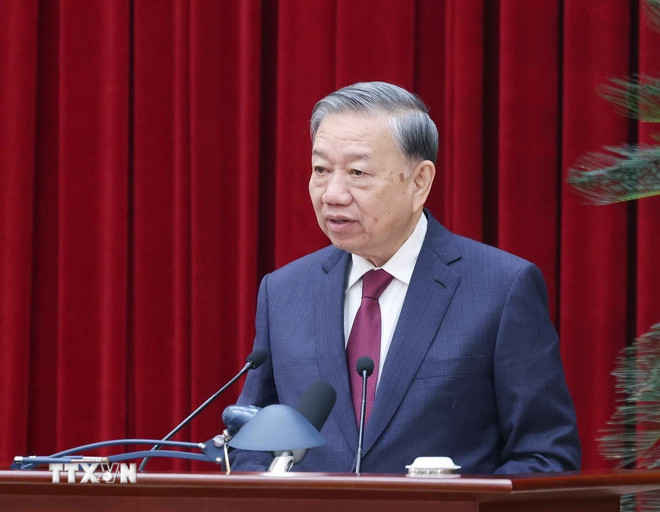
Correctly evaluating cadres is the basis for properly arranging and using cadres, which is beneficial for the unit and locality, and in general will increase the Party's prestige and the people's trust.
Wrongly evaluating cadres is the opposite. Evaluating cadres is not an easy task, it is very sensitive because it is an evaluation of people, requiring objective, comprehensive, and multi-dimensional views.
Meanwhile, when individuals or groups evaluate cadres, they are still "mortal people," not "those from above looking down" to grasp everything, still influenced by "love makes perfect, hate makes distorted," "seeing red thinks ripe."
Evaluating cadres requires a “discerning eye,” as the late General Secretary Nguyen Phu Trong said at the meeting of the 14th Party Congress Personnel Subcommittee on March 13, 2024, which means being able to see through the essence of things through the colorful layers of paint, such as reports that “ring like bells.”
If in a unit or locality there are many hot spots and many complaints, but 100% of the Party cells are clean and strong; 90-95% of Party members complete their tasks well, then these beautiful numbers are a manifestation of the disease of achievement, in the current saying, "virtual living."
Without a "discerning eye", one cannot see that the phenomenon of "uniform unity" is just as dangerous as taking advantage of criticism and self-criticism to bring each other down and strengthen personal and group interests.
"Silence is golden", flattery, avoidance, and following the leader's will are the diseases of "consensus" and "formal democracy."
“Without a discerning eye,” one can “see a chicken as a pheasant” – nominate and appoint the wrong person. However, in contrast to this is the hesitant and perfectionist attitude in evaluating cadres, especially young party members, which means not nurturing but waiting for the “fruit to ripen on its own,” missing out on people with potential.
Evaluating cadres is a process, not a one-day or two-day job. It is not rigid but must be placed in the movement of the social context and the movement of the cadres themselves because revolutionary tasks are always moving and changing.
President Ho Chi Minh's viewpoint on evaluating cadres is to stand on the "dynamic" and "development" viewpoint. He reminded: "In the world, everything changes. People's thoughts also change. Therefore, the way of considering cadres should not be fixed, because it must also change. A cadre may not have made mistakes in the past, but it is not certain that he will not make mistakes in the future. The past, present and future of a person are not always the same" (quoted from Modifying Working Style, Ho Chi Minh Complete Works, volume 5, National Political Publishing House, Hanoi - 1995, p.278).
Our Party has issued many guiding documents on cadre evaluation. Resolution No. 03-NQ/TW, dated June 18, 1997 of the 8th Central Executive Committee on Cadre Strategy in the period of promoting industrialization and modernization of the country sets out the direction: "Having viewpoints and methods for evaluating and using cadres in an objective, scientific, and impartial manner;" "Cadre evaluation must be done annually, before the end of the term or job transfer, based on cadre standards, actual work efficiency, taking into account the environment, working conditions, and the level of trust of the people."
Conclusion No. 37-KL/TW dated February 2, 2009 of the 9th Central Conference, Session X on "Continuing to promote the implementation of the Cadre Strategy from now to 2020" requires Party committees and organizations at all levels to innovate their thinking and working methods, effectively overcome weaknesses in each stage of cadre work, in which, first of all, it is necessary to: "Innovate the work of cadre assessment, build new standards for cadre titles and specific assessment criteria for each title and each cadre group".
The 12th Congress (from January 20 to 28, 2016) emphasized: "Continue to promulgate and implement regulations, rules, and mechanisms in personnel work, ensuring unity, synchronization, and tightness between stages and interconnection between levels; including regulations on correct and objective assessment of cadres, to have a basis for using and arranging cadres, preventing and repelling the situation of buying positions, buying age, and buying degrees."
However, according to the Party's 13th Congress Document, in the process of cadre work, "cadre assessment is still a weak link. Although there have been many innovations, there are still many cases that do not reflect the true nature."
If the evaluation of cadres does not reflect the true nature, the civil servant team, even though streamlined and compact, will still find it difficult to be strong and work effectively. In order to limit the imposition and bias of competent persons in the evaluation of cadres and civil servants, the Politburo issued Regulation No. 142-QD/TW dated April 23, 2024 on piloting the delegation of power and responsibility to leaders in personnel work, regulating the pilot introduction of election personnel, appointment of deputy heads of heads; election of additional members of the Standing Committee of the Party Committee at the same level; appointment and dismissal of subordinate heads directly under the management authority; to be applied on a pilot basis to Party Committees, Party organizations, agencies and units from district level and above.
This is a new point in personnel work because the leader must be responsible for his/her decisions even after transferring jobs or retiring in the following cases: introducing cadres for election and appointment without impartiality and objectivity; not ensuring standards, conditions, political qualities, ethics, lifestyle, working capacity; dismissing cadres without ensuring the basis and procedures according to regulations.
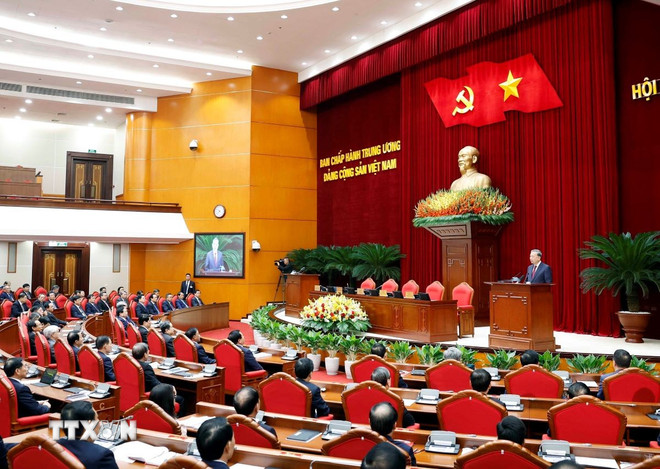
Thus, the Party attaches importance to both "pre-inspection" and "post-inspection" in the evaluation of cadres in particular and personnel work in general, avoiding the situation of "correct procedures but still not suitable personnel."
Following Regulation No. 142-QD/TW, dated October 8, 2025, the Politburo issued Regulation No. 377-QD/TW on "Decentralization of cadre management and planning, appointment, nomination, temporary suspension, removal from office, resignation, and dismissal of cadres."
One of the important purposes and requirements of the above document is to "regularly, objectively, impartially and accurately evaluate cadres" to ensure "the planning, selection and placement of the right cadres."
Regulation 377 is considered a "comprehensive handbook" on cadre assessment because it contains very specific provisions on the responsibilities of the Central Executive Committee, the Politburo, the Secretariat, Party committees, Party organizations and heads of agencies and units in cadre management; determines detailed processes and procedures for planning, appointing, reappointing, recommending candidates, re-electing, temporarily suspending work, removing from office, resigning, dismissing, as well as regulations on disciplining cadres.
“Handbook 377” is expected to minimize the limitations in the Party’s personnel work, including the evaluation of cadres, avoiding the repetition of unwanted figures as reported by the Central Internal Affairs Commission: In 2024, more than 700 party organizations and 24,000 party members were disciplined for violations. The Central Executive Committee, the Politburo, the Secretariat, and the Central Inspection Commission disciplined 68 cadres under the Central management.
Regulation 377 is also considered the basis for "choosing the right person for the right job", especially high-ranking personnel participating in the Politburo, the Secretariat, and the country's leaders - a prerequisite to turn the vision and aspirations of the entire nation into reality, according to General Secretary To Lam at the opening session of the 14th Conference of the 13th Party Central Committee on November 5, 2025./.
Source: https://www.vietnamplus.vn/danh-gia-can-bo-theo-cam-nang-377-tranh-xay-nha-tren-cat-post1080918.vnp



















![[Photo] Parade to celebrate the 50th anniversary of Laos' National Day](/_next/image?url=https%3A%2F%2Fvphoto.vietnam.vn%2Fthumb%2F1200x675%2Fvietnam%2Fresource%2FIMAGE%2F2025%2F12%2F02%2F1764691918289_ndo_br_0-jpg.webp&w=3840&q=75)
















![[VIMC 40 days of lightning speed] Hai Phong Port determined to break through, reaching the target of 2 million TEUs by 2025](https://vphoto.vietnam.vn/thumb/402x226/vietnam/resource/IMAGE/2025/12/04/1764816441820_chp_4-12-25.jpeg)











































Comment (0)