

In Hanoi , the sandbars and alluvial plains along the Red River have been proposed as a multi-functional cultural and ecological park, but implementation is hampered by dike and flood control planning.
At the workshop on the construction project of the Bai Giua Cultural Park on November 24th, architect Nguyen Ba Nguyen, Deputy Director of the Hanoi Department of Planning and Architecture, stated that according to the general plan and the zoning plan for the Red River urban area, the Bai Giua area and the alluvial plains along the river are oriented towards the construction of landscaped green parks, cultural parks, urban squares, and structures that symbolize the capital city.
The sandbar (or mid-river sandbar) and riverside areas of the Red River, formed by years of alluvial deposits, create a vast green space in the heart of the capital city, covering approximately 300 hectares. In recent years, the area of the sandbar has changed little with the rise and fall of floodwaters because the Red River's water level rarely rises significantly. This area falls under the administrative boundaries of four districts: Tay Ho, Hoan Kiem, Long Bien, and Ba Dinh.
Hanoi needs to be granted special policies.
According to Mr. Nguyen, the city will first study and develop a detailed plan for the central area to become a multi-functional cultural park, plan transportation routes connecting the inner city and the northern part of the city in the future (according to the general plan for the capital city currently under construction), and construct service facilities to serve the organization of major cultural and artistic events.
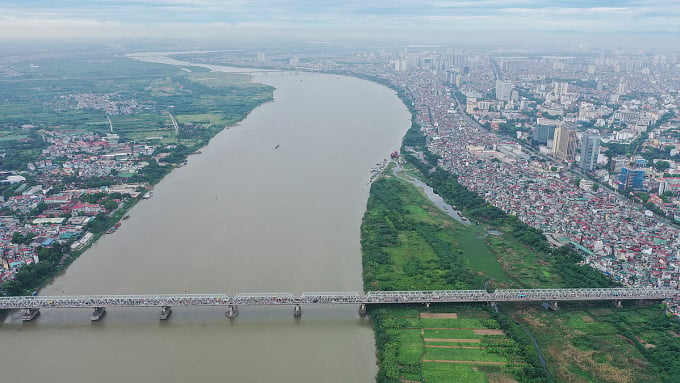
The sandbar area in the middle of the Red River. Photo: Ngoc Thanh
However, according to the flood control and dike system planning for the Red River and Thai Binh River, this area is designated "for economic and social development activities but no construction of buildings or houses is permitted."
Therefore, the Deputy Director of the Department of Planning and Architecture believes that Hanoi needs to be granted special policies to overcome difficulties and obstacles in the detailed planning of the park area in the middle of the Red River.
District leaders also pointed out many shortcomings in the management of residents and land in the riverside area. Mr. Pham Tuan Long, Chairman of Hoan Kiem District, said that many people have migrated from other provinces and are living in floating houses, affecting the environmental hygiene and landscape of the Red River. Land violations are increasing, with many households arbitrarily erecting temporary shacks, houses with bamboo frames and thatched roofs, or building permanent houses.
Meanwhile, the residents of Hoan Kiem district live along the Red River at a high density, lacking public spaces. According to Mr. Long, despite many shortcomings, the sandbar in the middle of the river is "an opportunity to leverage the advantages of green space and waterfront scenery, meeting the recreational needs of the people."
"We have agreed not to develop the area into an urban zone, designating the mid-river area for community activities, exploiting the historical, cultural, and heritage values along the river associated with the natural beauty of the Red River," Mr. Long said.
Mr. Nguyen Manh Ha, Chairman of Long Bien District, also stated that Long Bien District currently has 180 hectares of riverside land, mostly used for agricultural production, growing fruit trees, ornamental plants, and vegetables. The shortcomings in land management include the inability to sign contracts for many areas by the ward People's Committees, leading to violations of dike regulations, misuse of land, and illegal dumping of waste.
"The first policy mechanism that needs to be addressed is granting the Hanoi government the authority to decide on the use and exploitation of land resources. Specifically, the Capital City Law and the amended Land Law grant the city the authority to decide on the exploitation of agricultural land along riverbanks," said the Chairman of Long Bien District.
Multi-park model
Regarding the detailed planning of the Red River mid-river area, Dr. Architect Ta Nam Chien, Chairman of Ba Dinh District, proposed a Red River park plan encompassing the entire mid-river area and riverside areas; and a renovation and upgrading area including concentrated residential areas outside the dike in the following wards: Phuc Tan, Chuong Duong (Hoan Kiem District), Phuc Xa (Ba Dinh District), Tu Lien, Quang An, Nhat Tan (Tay Ho District) and Ngoc Thuy (Long Bien District).
At the same time, the city is creating squares in the central area, creating spatial focal points and connecting landscape values such as Long Bien Bridge, Dong Xuan Market, Hang Dau Water Tower, etc.
Dr. Nguyen Van Tuyen, an architect from the University of Construction, assessed the sandbar in the middle of the Red River as "an ecological gem in the heart of Hanoi, which has long become the largest and most unique bird sanctuary in the capital." This area also features a layering of urban heritage, including the Long Bien Bridge and the heritage sites on both sides of the river. Therefore, Dr. Tuyen proposed developing the Red River sandbar into various themed park models.
Specifically, the ecotourism park model focuses on promoting unique landscapes and ecological environments, developing semi-submerged forest systems, ecological nurseries, research gardens, sandy beaches, water bodies, and restoring native flora and fauna.
This historical and cultural park model promotes cultural and religious exchange. The park centers around the Long Bien Bridge urban heritage site, with the Red River landscape as a backdrop, forming cultural spatial routes connecting the heritage sites on both banks and the entire Red River green corridor.
The science park model focuses on scientific and technological research and innovation. Planned functions include a science and technology center, a science incubator, and an innovation garden.
Meanwhile, Dr. Phan Dang Son, President of the Vietnam Architects Association, suggested that the sandbar be transformed into a traditional agricultural ecological park, combining high technology, that is, a type of agricultural garden representing different regions of Vietnam, with biodiversity of food crops and fruit trees. Camping, experiential activities, dining, and picnics could be organized there.
The alluvial plains on both sides of the river can be used to create functional areas for parks and green spaces, areas for planting short-term crops and ornamental flowers, combined with creating flexible spaces for regular artistic interaction, organizing sports activities, and community activities.
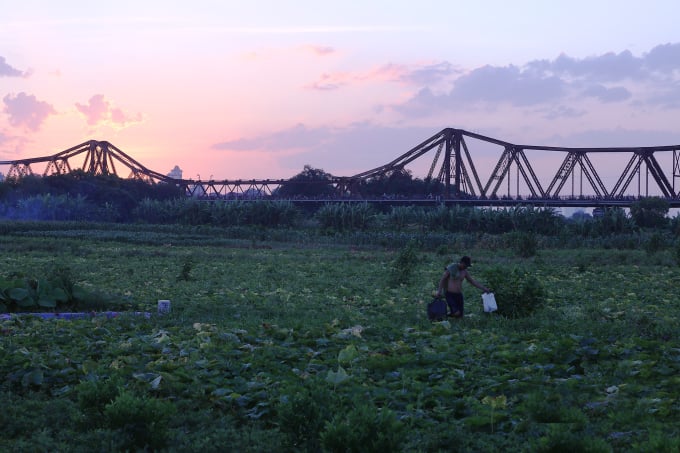
Locals mainly grow agricultural crops on the sandbar. Photo: Ngoc Thanh
According to the Red River urban zoning plan, the river flows through the inner city from Thang Long Bridge to Thanh Tri Bridge, with a population of over 181,000 and a total area of approximately 686 hectares. This area is planned as a multi-functional zone including public cultural facilities, commercial and service areas, and landscaped spaces, with a historical spatial axis connecting West Lake and Co Loa.
To implement the plan, the Hanoi People's Committee assigned four districts—Hoan Kiem, Long Bien, Ba Dinh, and Tay Ho—to study the project "Developing the sandbars in and along the Red River into a multi-functional cultural park," with funding from the districts' budgets.
Source link

![[Photo] Prime Minister Pham Minh Chinh holds a phone call with the CEO of Russia's Rosatom Corporation.](/_next/image?url=https%3A%2F%2Fvphoto.vietnam.vn%2Fthumb%2F1200x675%2Fvietnam%2Fresource%2FIMAGE%2F2025%2F12%2F11%2F1765464552365_dsc-5295-jpg.webp&w=3840&q=75)

![[Photo] Closing Ceremony of the 10th Session of the 15th National Assembly](/_next/image?url=https%3A%2F%2Fvphoto.vietnam.vn%2Fthumb%2F1200x675%2Fvietnam%2Fresource%2FIMAGE%2F2025%2F12%2F11%2F1765448959967_image-1437-jpg.webp&w=3840&q=75)



























![[OFFICIAL] MISA GROUP ANNOUNCES ITS PIONEERING BRAND POSITIONING IN BUILDING AGENTIC AI FOR BUSINESSES, HOUSEHOLDS, AND THE GOVERNMENT](https://vphoto.vietnam.vn/thumb/402x226/vietnam/resource/IMAGE/2025/12/11/1765444754256_agentic-ai_postfb-scaled.png)

































Comment (0)