

The draft Law on Emergency Situations stipulates that, if necessary, the Prime Minister may apply measures not currently prescribed by law and report to the competent authority as soon as possible.
Empowering more proactive and assertive action.
On the afternoon of March 14th, the Standing Committee of the National Assembly discussed the draft Law on Emergency Situations. National Assembly Vice Chairman Tran Quang Phuong chaired the discussion.

General Nguyen Tan Cuong, Chief of the General Staff and Deputy Minister of National Defense, presents the report (Photo: National Assembly Media).
At the session, on behalf of the drafting agency, General Nguyen Tan Cuong, Chief of the General Staff and Deputy Minister of National Defense, presented the report on the necessity and purpose of enacting the law, the viewpoints on drafting the law, and the main contents of the draft Law on Emergency Situations.
Accordingly, the purpose of enacting the Law is to ensure the uniformity, consistency, and enhance the effectiveness and efficiency of the legal system regarding states of emergency.
At the same time, the law will establish a legal basis for law enforcement to enhance proactive response and timely and effective remediation in emergency situations.
General Nguyen Tan Cuong stated that the draft Law focuses on two policies that were approved by the Government in Resolution No. 118 of 2024 and reported to the National Assembly for inclusion in the Program for drafting laws and ordinances in Resolution No. 55 of 2024.
These include measures applied in emergency situations, the authority of certain entities to organize, direct, manage, and decide on the application of special measures in emergency situations; measures to support businesses; and relief and assistance for people responding during and after emergency situations.
Explaining the practical basis for drafting the law, General Nguyen Tan Cuong pointed out that even during the Covid-19 pandemic, although no state of emergency had been declared, some measures similar to those of a state of emergency were applied to respond to the epidemic.
The process of combating the Covid-19 pandemic has yielded many valuable lessons, while also revealing limitations and shortcomings in the organization and implementation of laws regarding states of emergency.
In the context of the first major pandemic, many difficult situations, obstacles, and shortcomings arose that needed to be addressed immediately.
This includes the need to empower the Government and the Prime Minister to make more proactive and decisive decisions on necessary and flexible measures to meet the requirements of disease prevention, control, and containment.
Therefore, the draft law stipulates that, if necessary, the Prime Minister may apply measures not prescribed by current law and report to the competent authorities of the Party and the National Assembly as soon as possible.

Chairman of the National Assembly's Committee on National Defense, Security and Foreign Affairs, Le Tan Toi, presents the verification report (Photo: National Assembly Media).
Presenting the verification report, the Chairman of the National Assembly's Committee on National Defense, Security and Foreign Affairs, Le Tan Toi, stated that the Standing Committee agreed on the necessity of enacting the Law based on the political, legal, and practical grounds as presented by the Government.
This committee believes that the enactment of the law aims to promptly address the shortcomings and limitations in the practical implementation of laws on emergency situations, especially since the Covid-19 pandemic.
Regarding the review of the authority, procedures, and processes for declaring and announcing a state of emergency (Article 9), the Standing Committee basically agreed with the draft.
However, further research and clarification are needed regarding the grounds for declaring a state of emergency to ensure consistency.
Establishing grounds for declaring a state of emergency must meet both objective and subjective factors, going beyond level 3 civil defense; at the same time, there must be criteria to avoid arbitrary application that could affect socio-economic development and people's lives.
There have been suggestions to review the Prime Minister's authority to make such proposals under Clause 1, because the Constitution only stipulates that the Standing Committee of the National Assembly has the right to decide on the declaration of a state of emergency, without specifying the Prime Minister's authority.
Another opinion suggested further clarification of the grounds, basis, and procedures for ministries or provincial People's Committee chairmen to request the Prime Minister to propose to the National Assembly Standing Committee the declaration of a state of emergency.
In what cases is a state of emergency declared at the local level, and in what cases is it declared nationwide? If at the local level, when is it at the provincial level, and when at a lower level?
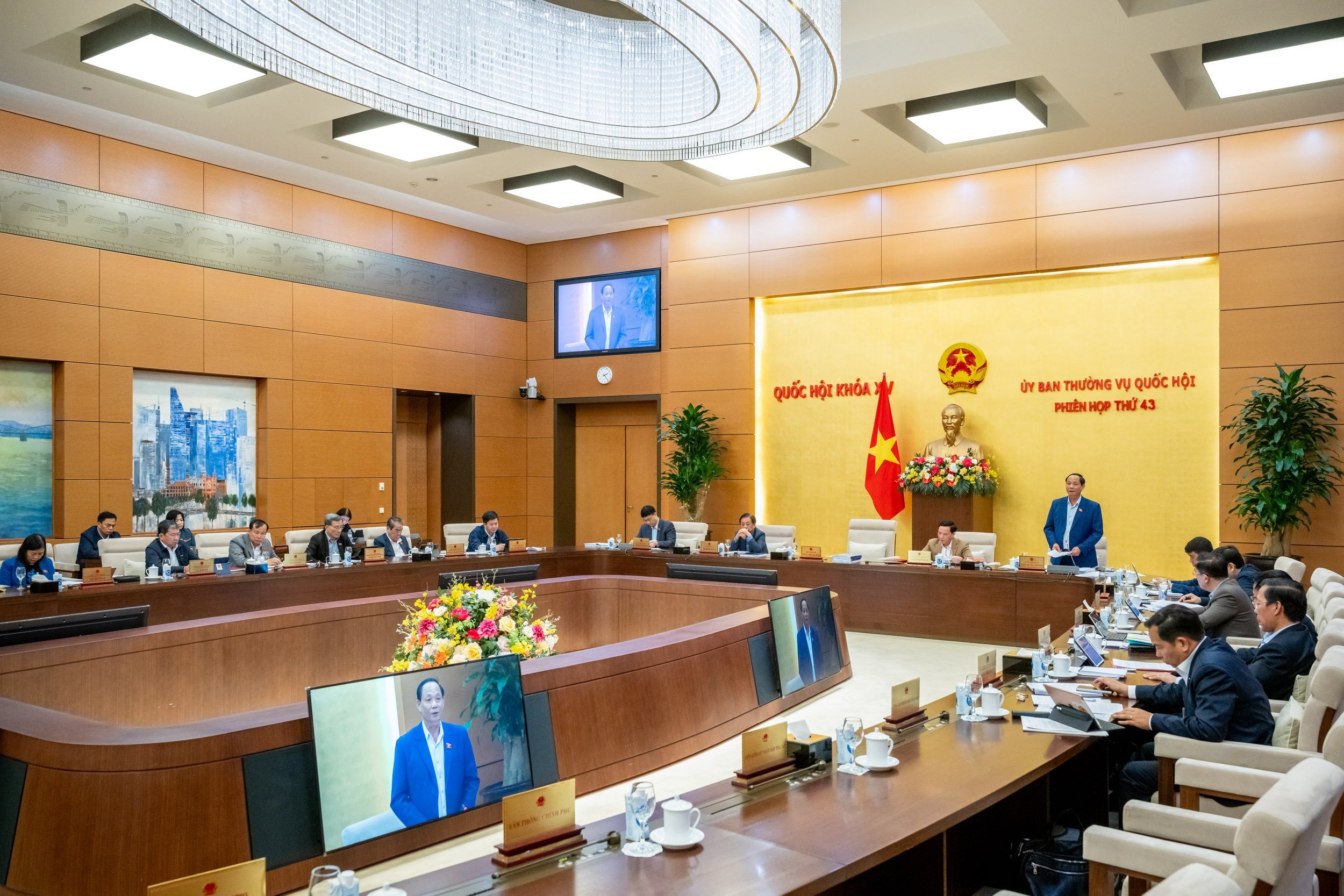
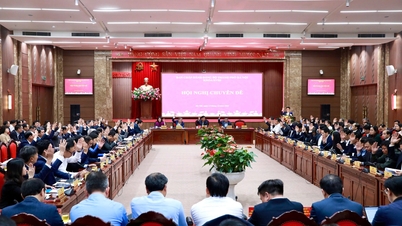
View of the session (Photo: National Assembly Media).
The draft law stipulates four groups of measures to be applied, corresponding to four types of emergency situations.
The Standing Committee of the National Defense, Security and Foreign Affairs Committee basically agreed with the regulation authorizing the Prime Minister: In necessary cases, the Prime Minister may apply measures not currently stipulated by law.
However, to ensure compliance with the Constitution, it is proposed that the content of these measures must conform to the principles stipulated in Article 3, and further clarification is needed regarding the effective date, target groups, and specific measures to ensure feasibility…
Eligible to be submitted to the National Assembly at the 9th Session
During the session, delegates discussed the purpose of enacting the law, the draft law's documentation, consistency within the legal system, scope of application, definitions of terms, the application of emergency situations and related laws, and measures to be applied in the event of declaring an emergency.
In his concluding remarks, Vice Chairman of the National Assembly Tran Quang Phuong agreed with the necessity of enacting the law, and generally agreed with many contents of the draft law submitted by the Government and the contents of the review.

Deputy Speaker of the National Assembly Tran Quang Phuong delivers the concluding remarks at the session (Photo: National Assembly Media).
The draft law fundamentally adheres to the Party's guiding principles on reforming and improving the law-making process and the need for a change in thinking about lawmaking, and is ready to be submitted to the National Assembly for consideration and comments at the 9th session.
The Vice Chairman of the National Assembly requested the drafting agency to review and refine the regulations on applicable measures to ensure they do not conflict with or overlap with Level 1, Level 2, and Level 3 civil defense measures and civil measures applied in emergency situations as stipulated in the Law on Civil Defense; and to delegate authority to the Prime Minister to apply measures not currently regulated by law or that differ from existing laws.
This ensures flexibility in responding to and handling emergencies.
Source: https://www.baogiaothong.vn/de-xuat-trong-tinh-trang-khan-cap-thu-tuong-co-the-ap-dung-cac-bien-phap-khac-luat-192250314170818236.htm


![[Photo] Prime Minister Pham Minh Chinh attends the Conference summarizing and implementing tasks of the judicial sector.](/_next/image?url=https%3A%2F%2Fvphoto.vietnam.vn%2Fthumb%2F1200x675%2Fvietnam%2Fresource%2FIMAGE%2F2025%2F12%2F13%2F1765616082148_dsc-5565-jpg.webp&w=3840&q=75)










































































Comment (0)