

Due to the impact of Typhoon No. 3, many provinces and cities have been flooded in recent days. This creates favorable conditions for mosquitoes that transmit dengue fever to breed and develop.
Experts believe that the risk of disease outbreaks will increase in the near future if proactive and coordinated preventive measures are not implemented.
 |
| Illustrative image |
According to a report from the Hanoi Center for Disease Control (CDC), during the week (from September 6th to September 13th), the entire city recorded 227 cases of dengue fever (an increase of 37 cases compared to the previous week).
Among the districts with the most patients, Dan Phuong leads with 57 cases, followed by Ha Dong with 17 cases, Hai Ba Trung with 15 cases, Thach That with 15 cases, and so on.
From the beginning of 2024 to the present, Dan Phuong district has recorded 810 cases of dengue fever. This is also the locality with the highest number of dengue fever cases this year in Hanoi.
In addition, the city also has 9 dengue fever outbreaks, including 3 active outbreaks in La Thach village (Phuong Dinh commune), Tho Vuc village ( Dong Thap commune), and cluster 1 (Ha Mo commune) of Dan Phuong district; and 2 outbreaks in Nghia Dung street (Phuc Xa ward, Ba Dinh district)...
According to the Quang Ninh Provincial Center for Disease Control, from the beginning of 2024 to the present, the province has recorded 127 cases of dengue fever, with the highest number of cases in Ha Long (56 cases), Cam Pha (19 cases), and Uong Bi (14 cases).
Most cases were recorded sporadically. However, the provincial health department recorded several clusters of cases in Hong Ha ward (Ha Long City); Yen Thanh and Thanh Son wards (Uong Bi City); and Cua Ong ward (Cam Pha City).
In Quang Yen town, from September 13th to 17th, the town's Medical Center received and treated 5 cases of dengue fever. One of these cases had complications including mucosal bleeding and thrombocytopenia, and was transferred to a higher-level facility for treatment.
Reportedly, all 5 dengue fever cases in Quang Yen town are new outbreaks, located in Tien An commune and Quang Yen ward, Yen Giang district.
The Quang Ninh Provincial Center for Disease Control warns that the dengue fever epidemic is currently entering its annual peak season, which usually occurs from September to November.
The weather during this period is unpredictable, and the heavy rainfall creates favorable conditions for mosquitoes to breed and spread disease.
Assessing the current dengue fever situation in the city, Deputy Director of the Hanoi CDC, Khong Minh Tuan, said that dengue fever occurs year-round, but the number of cases usually increases during the rainy season.
In particular, the period from September to November each year is considered the "peak" season for dengue fever outbreaks due to the humid weather and heavy rainfall creating a favorable environment for the Aedes mosquitoes that transmit the disease to breed and develop.
Hanoi has now entered the peak season for dengue fever, with complex and unpredictable weather conditions, including heavy rainfall. Monitoring results from several outbreak areas show high insect indices exceeding risk thresholds. Therefore, it is predicted that the number of dengue cases will continue to increase in the coming period.
According to Mr. Tran Dac Phu, senior advisor at the Vietnam Center for Emergency Response to Public Health Events, after floods, diseases transmitted by vectors (intermediate hosts) such as mosquitoes are at high risk of spreading.
A prime example of this is dengue fever. Many people mistakenly believe that prevention only involves protecting against mosquito bites at night. However, mosquitoes that transmit dengue fever bite during the day, with the most intense biting in the early morning and late evening. These mosquitoes typically perch in dark corners, on clothing, bedding, clotheslines, and other household items.
Mosquitoes that transmit dengue fever only lay their eggs in containers of clean, clear water. Therefore, if people believe that mosquitoes lay eggs in dirty places or sewers, and only focus on clearing foul-smelling, stagnant sewers, they will not be able to prevent dengue fever at all.
According to Mr. Khong Minh Tuan, in recent days, the city's CDC has coordinated with relevant units to monitor environmental sanitation and disease prevention activities in flood-affected areas in the districts of Chuong My, Thach That, Dong Anh, Phu Xuyen, My Duc, Quoc Oai, etc.
Although dengue fever is a very old disease, the concern is that each outbreak presents its own unique challenges. One of these challenges is that when infected, people often go directly to private clinics or hospitals, instead of public hospitals or health centers.
This leads to an inability to monitor cases early and handle outbreaks promptly. If an outbreak isn't addressed within the first three days, and is left untreated until the fifth day, the risk of it spreading and escalating increases significantly. Once an outbreak reaches 10 patients, it can quickly escalate to 20-30 patients.
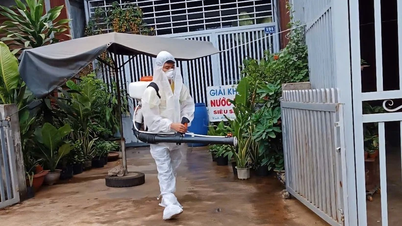
Facing the risk of disease outbreaks following Typhoon No. 3, the Dan Phuong District Health Center has urgently deployed disinfection and environmental sanitation spraying at many severely flooded areas in the communes of Hong Ha, Trung Chau, and Tan Hoi. In addition, district health officials are also carrying out environmental disinfection, guiding people on how to treat water sources for drinking and daily use, and implementing measures to prevent and control diseases after the floods.
To effectively prevent and control dengue fever, according to Mr. Khong Minh Tuan, health centers in districts, counties, and towns need to strengthen the organization of surveillance, early detection, and thorough and timely handling of dengue fever cases and outbreaks occurring during and after floods; and maintain the work of monitoring and detecting patients at the assigned health facilities.
At the same time, strengthen communication and guidance for people in flood-affected areas on environmental remediation measures and methods for eliminating mosquito larvae.
Eliminating mosquito larvae is a sustainable measure to prevent and control dengue fever outbreaks, while spraying chemicals to kill mosquitoes is only a stopgap measure.
Therefore, it is necessary to educate and encourage people to voluntarily eliminate mosquito larvae through small actions such as: covering water containers tightly, introducing fish into large water tanks, turning over containers that can hold water, and clearing away waste around the house that can collect rainwater, including bottles, boxes, tree hollows, etc. This will help limit the spread of disease in the community.
Many people believe that mosquitoes that transmit dengue fever only live in stagnant public ponds, sewers, etc. However, Aedes mosquitoes thrive in stagnant water sources such as fish tanks, flower vases, rock gardens, and rainwater collected in broken pieces of pottery in gardens, neighborhoods, or on rooftops and construction sites. Therefore, it is necessary to eliminate these stagnant water containers that provide breeding grounds for Aedes mosquitoes.
It is necessary to clean the house, turn over all mosquito breeding grounds to kill mosquito larvae, before spraying insecticide to kill adult mosquitoes.
For more effective mosquito control, spraying should be done in the morning, as dengue mosquitoes are active during the day, most actively in the early morning hours and before sunset. It's important to note that insecticides remain effective for up to 6 months after application.
Many people believe that once someone has had dengue fever, they won't get it again. This is not entirely true. Dengue fever is caused by the Dengue virus, which has four strains: DEN-1, DEN-2, DEN-3, and DEN-4. All four strains are capable of causing the disease.
Therefore, if a person has previously had dengue fever, their body may produce antibodies during the illness. However, the immunity formed is specific to each individual strain. The patient may not be reinfected with the old strain of the virus but can still be infected with a new strain, thus potentially contracting dengue fever again.
Regarding treatment, many people believe that when suffering from dengue fever, only electrolyte replacement should be given, and coconut water should be avoided because it does not help with rehydration and makes it difficult to identify complications.
This is completely wrong. In dengue fever, high fever for many consecutive days will cause the patient to become dehydrated and lose fluids. The simplest way to replenish fluids is to give the patient Oresol.
However, many patients find it difficult to drink Oresol. This can be replaced with coconut water, orange juice, grapefruit juice, or lemon juice to replenish lost fluids. Furthermore, these fruits contain many minerals and vitamin C, which help boost immunity and strengthen blood vessel walls.
Source: https://baodautu.vn/dich-sot-xuat-huyet-co-nguy-co-tang-cao-sau-mua-lu-d225374.html
























![[Photo] Prime Minister Pham Minh Chinh holds a phone call with the CEO of Russia's Rosatom Corporation.](/_next/image?url=https%3A%2F%2Fvphoto.vietnam.vn%2Fthumb%2F1200x675%2Fvietnam%2Fresource%2FIMAGE%2F2025%2F12%2F11%2F1765464552365_dsc-5295-jpg.webp&w=3840&q=75)












































Comment (0)