

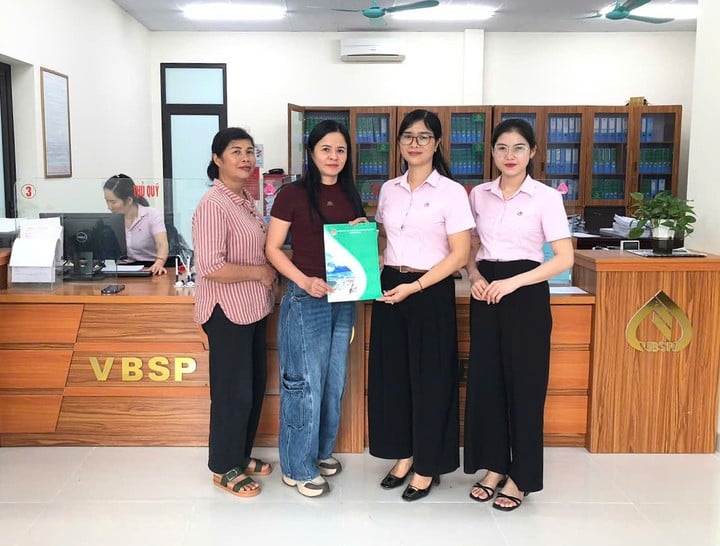
Na Hang: Credit policies boost STEM movement in mountainous region.
Na Hang currently has over 29,000 inhabitants, of which more than 80% are ethnic minorities. The lives of the people here mainly depend on agriculture and forestry, with an average per capita income of only about 43 million VND per year. Due to its remote and isolated terrain, the poverty rate in the district is expected to remain at 15.6% in 2024.
In that context, the Social Policy Bank (NHCSXH) of Na Hang district has become an important pillar, implementing 18 preferential credit programs with a total outstanding loan balance of over 665 billion VND, directly supporting 5,810 borrowing households. Of this amount, more than 38 billion VND was specifically allocated to the loan program for disadvantaged students, helping more than 1,200 students continue their studies at secondary, college, and university levels.
Mr. Nguyen Van Hung – Director of the Social Policy Bank of Na Hang district – said: “For us, each loan is not just a number, but an opportunity for a child to continue their education, for a family to believe that their child's future will be brighter. There have been many cases where, after graduation, students have returned to their hometowns to guide students in STEM projects, spreading the spirit of creativity to the next generation.” Thanks to credit capital and investment from the National Target Program on Education in Ethnic Minority Areas, 100% of schools in the district now have solid classrooms, and many schools are equipped with STEM classrooms and basic experimental equipment.
Since 2022, the Na Hang District Department of Education and Training has implemented the "STEM School" model in 9 out of 15 junior high schools, attracting more than 1,000 students to participate in creative clubs. Many ideas from small classrooms have made it to larger competitions. Models such as the "Solar-powered anti-mold lamp" by students from Hong Thai Junior High School won second prize in the 2024 provincial science and technology competition; or the "Automatic water filter using renewable energy" by a group of students from Nang Kha Junior High School was selected for display at the Tuyen Quang Provincial STEM Festival 2025. These products not only demonstrate intelligence but also reflect the problem-solving abilities of students in the highlands – learning from their own lives.
Ms. Tran Thi Nga, a teacher at Na Hang Secondary School, shared: “Previously, students mainly learned theory, with very little practical application. When introduced to the STEM method, they get to do things themselves, experiment, make mistakes, and learn from their own experiences. These small models help them realize that science isn't far away; it's right here in their daily lives.”
According to the Na Hang District Department of Education and Training, in just two years, local students have won 30 district-level awards and 8 provincial-level awards in high school science and technology competitions. 36 teachers have received training in STEM teaching methods, with 8 of them receiving the "Innovative Teacher" award from the Tuyen Quang Department of Education and Training.
To sustain the movement, the district coordinated with the government, the education sector, the Social Policy Bank, and the Youth Union to organize four STEM training courses for teachers and administrators; and mobilized over 2.5 billion VND from social contributions to equip them with materials, tools, and mini-computers for teaching. Alongside this, programs such as "Na Hang Youth Creativity Festival," "I Love Science," and "Happy School - Creative Classroom" attracted thousands of students and parents. Many local businesses also contributed recycled materials and learning equipment, making the STEM movement more sustainable and accessible.
Credit policies are also cleverly integrated with household economic development programs. Many households that borrow money from students are advised to develop small-scale production plans, thereby stabilizing their income to ensure their children do not have to drop out of school. This approach helps to form a closed support chain of "capital - education - employment," in which education and knowledge become central.
These efforts have yielded tangible results. By 2025, 100% of junior high school graduates in the district will continue their education at high school or vocational school, and the dropout rate will decrease to only 0.5%, significantly lower than the 3% in 2020. The percentage of schools meeting national standards has reached 14 out of 14 communes and towns; of which 6 schools have achieved Level II standards. Notably, Na Hang currently ranks second in Tuyen Quang province in the number of high school students participating in provincial-level science and technology projects.
The Secretary of the Na Hang District Party Committee, Mr. Ma Quang Hieu, affirmed: “Developing education and science is the most important soft infrastructure. When policy credit is delivered to the right places, it not only helps alleviate poverty but also inspires the aspiration to rise up through knowledge. Na Hang District will continue to invest in expanding the STEM education model to all junior high schools and some primary schools, striving to have at least 10 innovative models winning provincial or national awards each year.”
The story in Na Hang is proof of the effectiveness of combining innovative financial and educational policies. When credit capital is used correctly to invest in people instead of just in infrastructure, it can create sustainable change. In this remote mountainous area, the light from solar-powered lamps made by the students themselves not only dispels the darkness but also illuminates the path to the future. Each preferential loan becomes a seed of knowledge, nurturing the dreams of ethnic minority students to rise above their circumstances.
In the heart of Tuyen Quang province, the STEM movement is spreading rapidly, becoming a new symbol of the spirit of "learning for change." And it is the compassionate policy funding that is quietly supporting this journey, helping students in the mountainous Na Hang region not only "get to learn," but also "dare to dream and dare to create."
Center for Science and Technology Communication
Source: https://mst.gov.vn/dua-khoa-hoc-den-mien-nui-khi-tin-dung-chinh-sach-lam-nen-cho-doi-moi-sang-tao-197251023202202642.htm

![[Photo] Closing Ceremony of the 10th Session of the 15th National Assembly](/_next/image?url=https%3A%2F%2Fvphoto.vietnam.vn%2Fthumb%2F1200x675%2Fvietnam%2Fresource%2FIMAGE%2F2025%2F12%2F11%2F1765448959967_image-1437-jpg.webp&w=3840&q=75)



![[Photo] Prime Minister Pham Minh Chinh holds a phone call with the CEO of Russia's Rosatom Corporation.](/_next/image?url=https%3A%2F%2Fvphoto.vietnam.vn%2Fthumb%2F1200x675%2Fvietnam%2Fresource%2FIMAGE%2F2025%2F12%2F11%2F1765464552365_dsc-5295-jpg.webp&w=3840&q=75)





































![[OFFICIAL] MISA GROUP ANNOUNCES ITS PIONEERING BRAND POSITIONING IN BUILDING AGENTIC AI FOR BUSINESSES, HOUSEHOLDS, AND THE GOVERNMENT](https://vphoto.vietnam.vn/thumb/402x226/vietnam/resource/IMAGE/2025/12/11/1765444754256_agentic-ai_postfb-scaled.png)












































Comment (0)