

Metals markets rallied after the Fed's decision.
According to the Vietnam Commodity Exchange (MXV), the commodity market reacted positively after the US Federal Reserve (FED) decided to lower the benchmark interest rate by another 25 basis points at its meeting on December 10th. This move brought the federal funds rate to a range of 3.5 - 3.75%, the lowest level since November 2022, and the third cut this year.
The metals market was dominated by green, with 7 out of 10 commodities rising in price. Notably, COMEX copper prices recovered by more than 0.6%, reaching $11,802 per ton after two sessions of weakness. The main reason was lower interest rates, which pulled the US dollar index (DXY) down 0.6% to 98.66 points, ending a four-session winning streak and making USD-denominated metals more attractive.
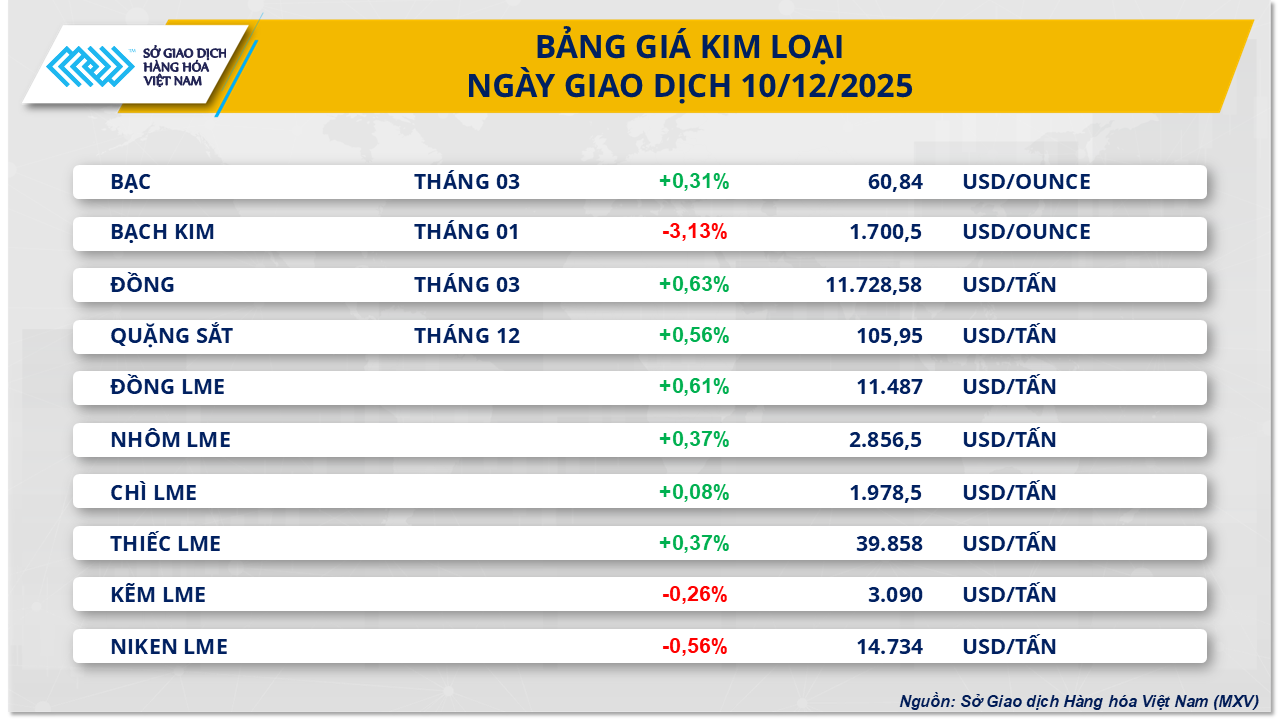
Other supporting factors
The upward trend in copper prices was further bolstered by policy signals from China, the world's largest copper consumer. Beijing reaffirmed its commitment to maintaining an active fiscal policy and a "slightly accommodative" monetary stance to support the economy . Additionally, news that China is considering new measures for the real estate sector, such as mortgage subsidies and reduced transaction costs, also positively impacted expectations for copper demand in the construction industry.
However, the market is still monitoring the risk that the US may impose import tariffs on refined copper next year. According to the US Geological Survey (USGS), the US will consume approximately 1.6 million tons of refined copper in 2024, with nearly half coming from imports. Copper inventories at COMEX warehouses have increased to over 403,000 tons, 4.8 times higher than at the beginning of the year, indicating that the market is preparing for potential supply fluctuations.
Agricultural products are under selling pressure.
In contrast to metals, the agricultural commodities market saw selling pressure prevail, with 5 out of 7 commodities closing in the red. Corn prices recorded a decrease of more than 0.8%, falling to $174.8 per ton.
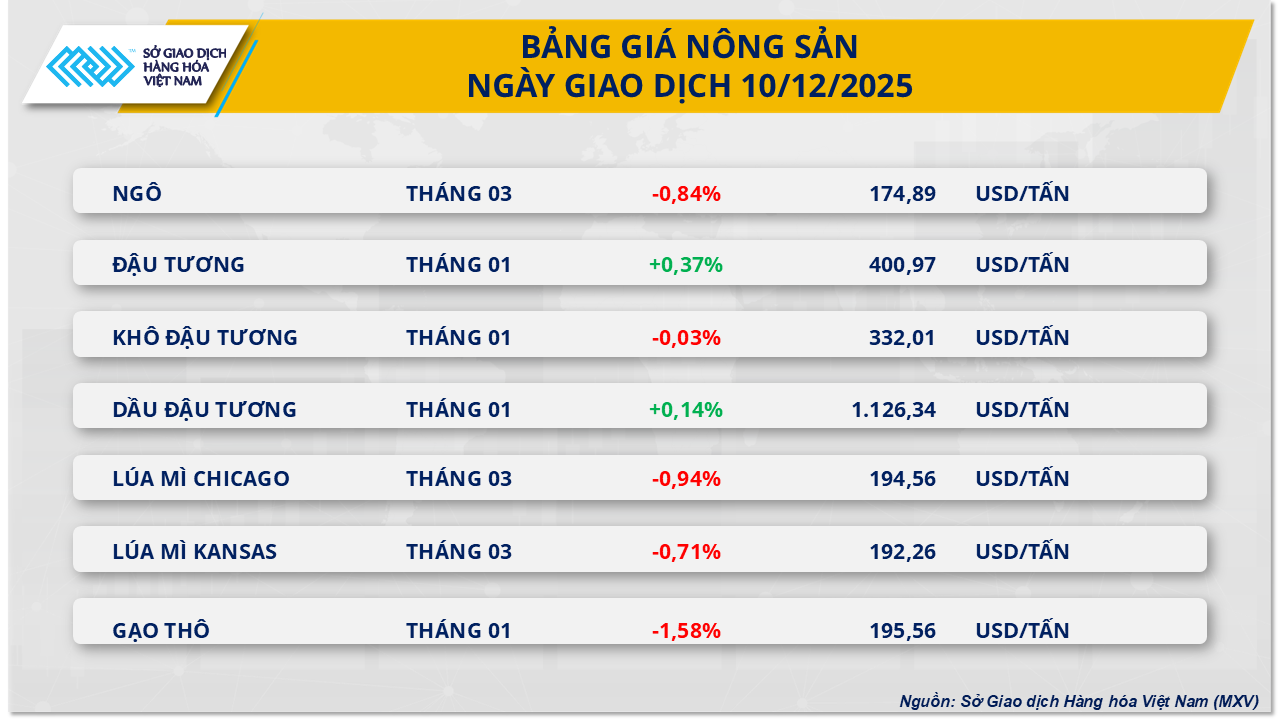
Reasons for the decline in corn and wheat prices.
Downward pressure on corn prices stems from a less-than-optimistic supply-demand picture. A report from the US Energy Information Agency (EIA) showed ethanol production for the week ending December 5th fell by nearly 2%. Simultaneously, data from the European Commission (EC) indicated that EU corn imports for the 2025-2026 crop year have decreased by more than 20% compared to the same period the previous year.
Supply is expected to expand after Argentina, the world's third-largest corn exporter, announced plans to cut export taxes on agricultural products. Specifically, the export tax on corn will be reduced from 9.5% to 8.5%.
For wheat, abundant global supply continues to put downward pressure on prices. Chicago spring wheat futures for January 2026 delivery fell 0.94% to below $195 per ton, while Kansas winter wheat retreated to $192.3 per ton, its lowest level since early December. The latest U.S. Department of Agriculture (USDA) Global Agricultural Supply and Demand Report (WASDE) also reinforced the view of abundant wheat supply, maintaining downward pressure on the grain group.
Source: https://baolamdong.vn/fed-ha-lai-suat-gia-dong-comex-vuot-11800-usdtan-409576.html





![[Photo] General Secretary and President To Lam presides over a meeting on preparations for the review of one year of operation of the three-tiered government system.](https://vphoto.vietnam.vn/thumb/1200x675/vietnam/resource/IMAGE/2026/06/02/1780391821195_a1-bnd-4595-9717-jpg.webp)

























![[Image] Affirming the aspirations and new standards of the Vietnamese real estate market in the new era.](https://vphoto.vietnam.vn/thumb/1200x675/vietnam/resource/IMAGE/2026/06/03/1780441948766_giai-thuong-bat-dong-san-2026-minh-duy-6-7364-jpg.webp)





































































Comment (0)