

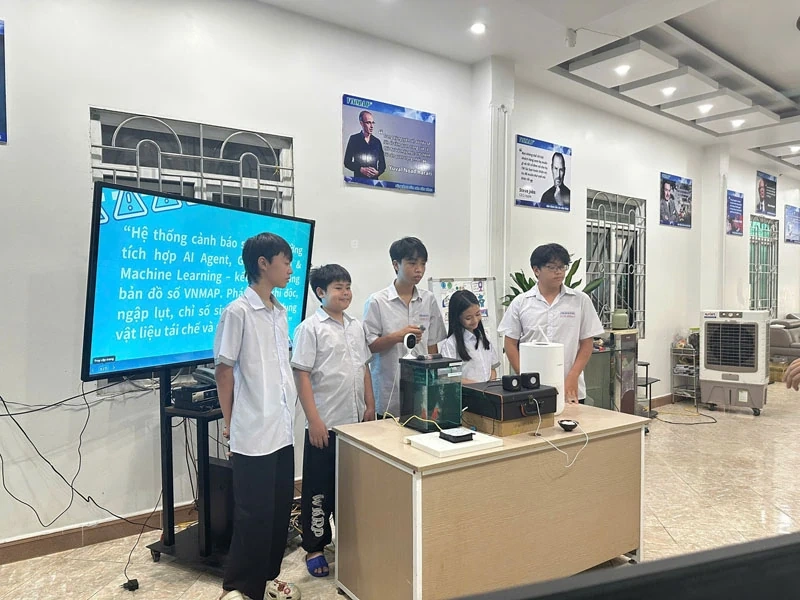
The team of authors is working on a project for an early warning system solution for the environment.
Based on this practical need, a group of four students, under the guidance of Ms. Nguyen Thi Hoa, an English teacher at Minh Khai Secondary School in Hac Thanh Ward, collaborated on a project to develop an integrated environmental early warning system using AI Agent, Generative AI, and Machine Learning – connected to the VNMAP digital map platform; detecting toxic gases, flooding, and survival indicators – utilizing recycled materials and renewable energy. The solution also aims to make a practical and humane contribution, applying high technology to protect the living environment, human and animal health, promoting green, smart, and safe living, and working towards the goal of "For a green, safe, and sustainable community."
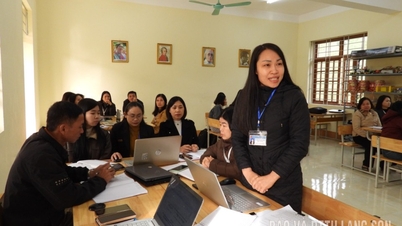
Discussing the objectives of the solution, Ms. Nguyen Thi Hoa, an English teacher at Minh Khai Secondary School, shared: The solution aims at core objectives, which are monitoring and providing early warnings of environmental risks in living spaces through a sensor system combined with artificial intelligence (AI, ML), connected to the VNMAP digital map platform. The system automatically monitors indicators such as temperature, humidity, toxic gases, fine dust, gas leaks, water levels, smoke, noise, etc., to detect abnormal situations early. Simultaneously, it automates the handling of environmental incidents based on intelligent context, providing voice alerts, alarms, LED lights, and controlling output devices such as air purifiers, water pumps, and misting systems. For example: detecting toxic gases will immediately trigger a voice alert and send a message to the user; detecting dry air will automatically activate the misting system; overflowing or dirty fish tanks will suggest solutions via AI; Flood risks will be warned based on topographic and water level data.
Simultaneously, the solution integrates environmental data with the VNMAP platform to build real-time early warning maps, supporting communities and local authorities in environmental management, disaster risk prevention, and smart urban and rural planning. It promotes sustainable development and green living through the use of recycled materials, solar energy, reduced electronic waste, and greenhouse gas emissions – contributing to the implementation of the National Green Growth Strategy and the National Digital Transformation Program.
Furthermore, the solution also demonstrates advantages in connecting STEM education with real-life situations, enhancing students' innovative capacity, helping the younger generation develop technological thinking, problem-solving skills, and a responsible, proactive digital citizenship spirit in the face of environmental challenges.
Regarding the product's structure, Nguyen Viet Thanh An, a student from Ham Rong High School (a member of the author team), stated: The solution is designed as a complete integrated system, combining hardware, software, and a digital platform. It is capable of intelligent environmental measurement and warning, operates stably thanks to renewable energy, uses recycled materials, and is suitable for deployment on a household and community scale. The software – the control algorithm and digital platform connection – is built on a core technology of artificial intelligence (AI) combined with intelligent agents (AI Agents) capable of self-learning, adapting, and reacting flexibly to changing environmental situations. The hardware – electronic devices and recycled materials – are designed to be minimalist, sustainable, and easy to assemble, including environmental sensors connected to an ESP32 microcontroller with Wi-Fi and Bluetooth connectivity. This central processor collects and processes data from the sensors and transmits it to the AI system.
In particular, the model utilizes recycled materials from plastic waste (such as PET plastic bottles, HDPE plastic containers, cardboard, old electronic components, etc.) to manufacture the device casing and stand – contributing to raising environmental awareness and reducing costs. The device's power is supplied by mini solar panels combined with rechargeable batteries, suitable for areas without grid electricity or in emergency situations (floods, power outages, etc.).
Ms. Nguyen Thi Hoa further explained: To perfect the solution, the team of authors conducted research, development, and optimization for nearly two years with the following main steps: surveying and selecting suitable equipment; designing the electrical circuit, creating wiring diagrams, soldering the circuits, and testing the sensors; programming the control software on Arduino and ESP32; designing the FUXA monitoring interface, connecting with the camera and VNMAP; conducting practical tests at home, analyzing the collected data, adjusting and refining the solution; optimizing recycled materials, clean energy, and the scalability for households, schools, and communities.
In principle, the solution operates completely automatically, following a closed-loop process. This is also the first innovative solution designed, built, and tested by students in Vietnam. It is a pioneering model combining AI, AI generation, machine learning, open map data, and green energy in a highly community-based environmental warning system, practically serving individual households and communities – especially in disadvantaged areas. The solution clearly demonstrates novelty, uniqueness, integration, feasibility, and social, educational, and environmental value.
With its creativity and outstanding advantages, the solution, after being submitted to provincial and national youth innovation competitions, proudly won first prize at the provincial level; second prize at the national level, and the project was selected to participate in the International Exhibition of Science and Technology Innovation in Seoul (South Korea) from December 2-7, 2025.
Text and photos: Le Phuong
Source: https://baothanhhoa.vn/giai-phap-xanh-vi-cong-dong-nbsp-trong-ky-nguyen-so-271776.htm





































































Comment (0)