

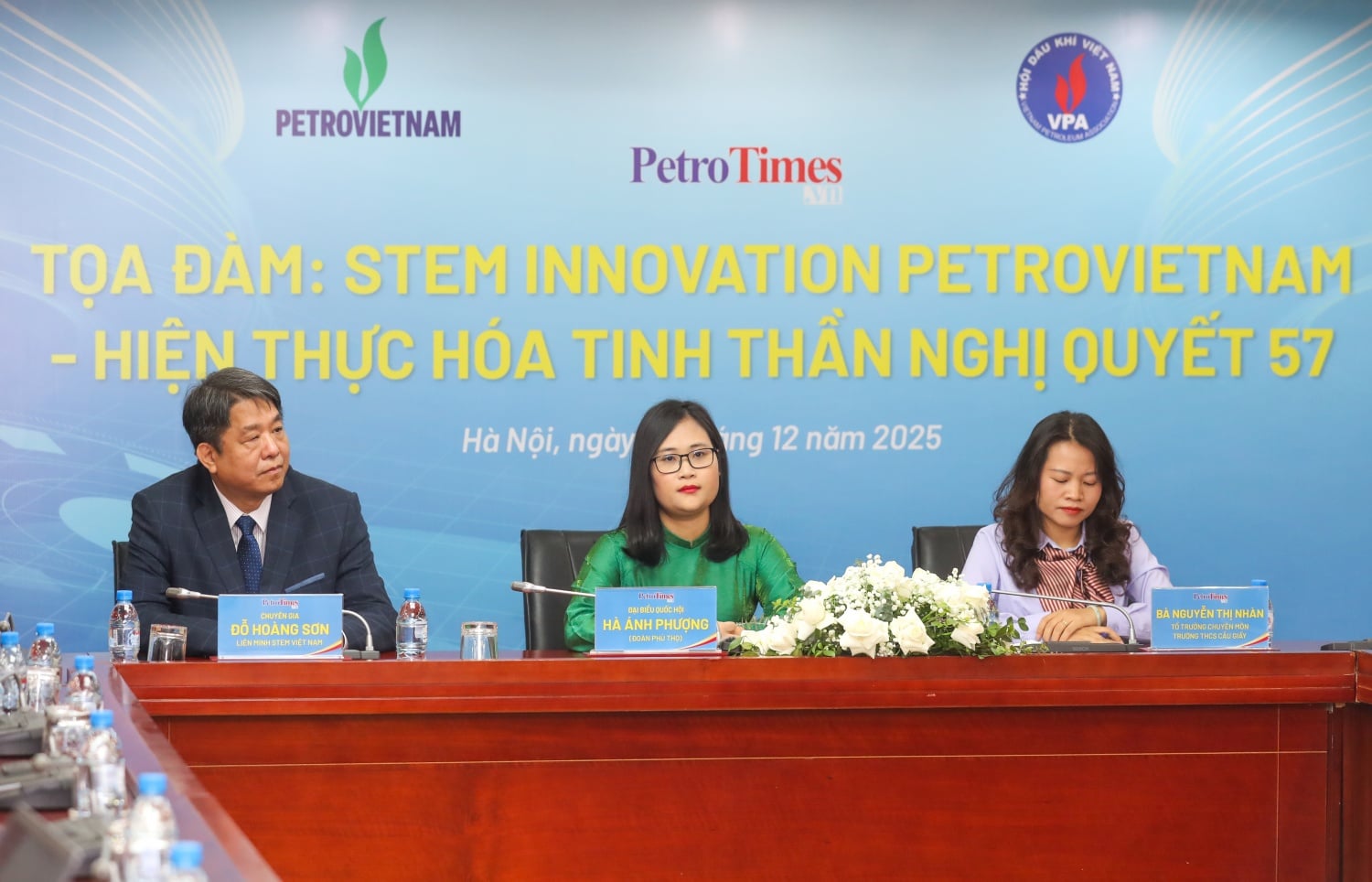
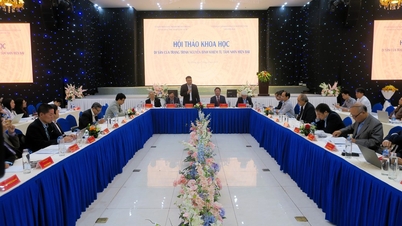
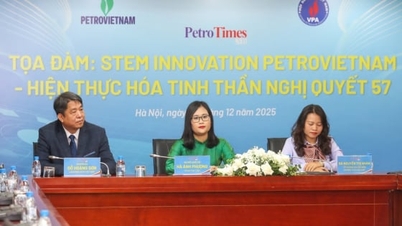
At the seminar “STEM Innovation Petrovietnam - Realizing the spirit of Resolution 57”, held on the morning of December 7 in Hanoi, experts and teachers shared many inspirational stories about opening the door for Vietnamese students to innovate.
Laying the foundation for a generation of innovation
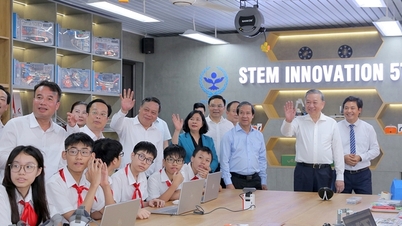
From the idea of General Secretary To Lam, the Vietnam National Industry and Energy Group (Petrovietnam) has coordinated with the Ministry of Education and Training to implement the "STEM Innovation Petrovietnam" program, building 100 international standard STEM rooms for middle schools and high schools in 34 provinces and cities in 2025. The special feature of this program is that it not only provides facilities but also builds a "STEM ecosystem" with many activities such as: Teacher training; international connections to help students access global innovation standards, aiming to spread to 10,000 schools in the period 2035-2045.
Ms. Nguyen Thi Nhan (Head of the Professional Group of Cau Giay Secondary School, Hanoi) shared: Cau Giay Secondary School was very honored to have General Secretary To Lam visit and present a STEM room in May 2025. With such a meaningful and special gift, the school has made really big turning points in STEM education .
Previously, teaching in schools was often at the level of approaching STEM or having STEM activities in teaching but not methodical and systematic. Since the STEM Innovation program of Petrovietnam has accompanied, teaching in schools has had a certain roadmap and effectiveness.
The school's Board of Directors has had very close guidance and long-term strategies, not just mass activities. There have been intensive training sessions, the Board of Directors has invited more experts to teach to improve awareness of STEM as well as the effectiveness of STEM.
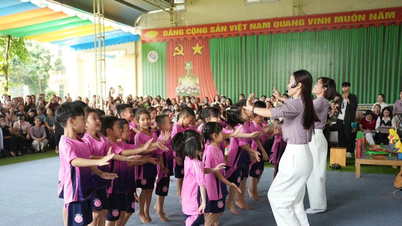
The teachers of Cau Giay Secondary School are always enthusiastic about learning and innovating. When the Petrovietnam STEM Innovation program was implemented at the school, the teachers quickly approached it, were not afraid of difficulties and really invested time and effort to bring STEM into teaching. The school's students are also very active, always showing creativity and especially devoted to STEM activities.
National Assembly delegate Ha Anh Phuong (Phu Tho), who was honored as a "Global Teacher" for her creative educational achievements, especially in bringing ethnic minority students to international education through technology, shared a profound memory about STEM from a very special project of the students she directly taught. It was a research project on plastic straws by ethnic minority students. The students had almost no means or experimental equipment to perform basic steps such as separating hydrogen and oxygen during the interdisciplinary study of Physics - Chemistry. Therefore, the students and their teachers came up with a very creative way: going to bakeries to ask for support in borrowing tools and suitable heat sources for the experiment. When they needed to make a straw cutter, they also did not have the conditions to buy the equipment. They collected scrap components, assembled them themselves and finally created a working cutter.
Ms. Ha Anh Phuong expressed: “I always remember the image of children who had no money, no machinery, but “necessity is the mother of invention”, persevering step by step to complete the project. That experience not only made the children grow up a lot, but the success of this project also opened up opportunities for them to connect with 50 countries, learn and share with international STEM experts, and improve their skills and knowledge. To me, that is the clearest proof of the power of STEM education - a journey that helps students overcome the limits of their circumstances to reach greater things.”
In addition, emphasizing the importance of connecting common platforms in the STEM community, Ms. Ha Anh Phuong said: This connection is very meaningful. Students in mountainous areas as well as in cities - places with development conditions can all use a common platform, thereby helping to reduce regional gaps, students have equal learning opportunities, create a common playground, share experiences... From there, forming a STEM student community to learn, share, do inter-school and inter-regional projects; approach international standards, contributing to improving the quality of Vietnamese education.
Technology and digital learning environments - an important part of the teaching and learning process
Mr. Do Hoang Son, a pioneer expert in STEM education in Vietnam, a key member of the Vietnam STEM Alliance, said: In the current context, the world is carrying out the 4th Industrial Revolution, international competition is very fierce. Therefore, digital transformation is considered a strategic issue, vital to the nation in implementing the Resolution of the 14th Party Congress and the vision of 100 years of Vietnam.
The Ministry of Education and Training has included the concept of STEM education in the 2018 General Education Program, which can be considered a very important step in the history of educational development. Based on the definition in the program, STEM is an interdisciplinary education integrating science, technology, engineering and mathematics; learning through practice and connecting with the surrounding life context.
There are 3 levels in STEM education. The first is the universal level, STEM education for all students is now a mandatory requirement since the 2018 General Education Program. The implementation of STEM in the locality has become an indicator to evaluate the completion of the task. The second is STEM for groups of students with career orientation and improvement needs, through clubs. The third is the group of students studying STEM at the level of breakthrough creativity, participating in major playgrounds at the national and international levels. According to Mr. Do Hoang Son, when implementing the Petrovietnam STEM Innovation room system, this model has fully met all three of the above functions.
Mr. Do Hoang Son shared the story of bringing a leading international expert from VEX Robotics - who had visited many labs around the world to Cau Giay Secondary School (Hanoi), the expert commented that this was the most modern STEM room he had ever seen. This comment was not because of the form, but because of the structure, design, level of investment and optimization for education. Currently, Cau Giay Secondary School has more than 40 VEX Robotics teams competing very enthusiastically. Or in Lang Son, recently an open STEM tournament was organized, with the participation of Chinese experts. The fact that students from all over Vietnam compete according to US standards, making serious technical handbooks, can be seen that Vietnam is carrying out a strong reform, moving from simple competitions to real education.
Mr. Do Hoang Son also emphasized: To promote STEM education, science - technology, digital transformation and innovation of a country is a very long process, requiring synchronous implementation of many contents, from infrastructure construction, expert training, human resource development, system connection to building culture, science - technology in society. This is an area in which Vietnam still lacks experience, there is still much to do.
Therefore, it is necessary to first review some new concepts and perspectives, including the role of the “teacher”. If we still understand the teacher in the traditional way - as someone who stands in front of the class to impart knowledge, Vietnam cannot have enough tens of millions of teachers to teach all the knowledge of the digital transformation era. Therefore, technology and digital learning environments must become an important part of the teaching and learning process. STEM festivals and practical experience activities are the new “teachers”, directly bringing knowledge and experience, while training qualities and abilities for students.
Notably, according to the direction of the Ministry of Education and Training, the system of 100 STEM Innovation Petrovietnam rooms will be used as 100 training and knowledge transfer centers, serving the new training and retraining of secondary school teachers nationwide. This is a very meaningful contribution to promoting STEM education and educational innovation in general in Vietnam.
Investing in modern, synchronous STEM rooms means building a minimum learning infrastructure so that every student, whether in urban or mountainous areas, has the opportunity to access STEM education in a systematic and substantial way.
Source: https://baotintuc.vn/giao-duc/giao-duc-stem-mo-canh-cua-cho-hoc-sinh-viet-nam-doi-moi-sang-tao-20251207131221953.htm
































































Comment (0)