

According to the General Department of Customs, South Korea is the second largest market, after China, for importing Vietnamese fruits and vegetables, accounting for approximately 5% of the total fruit and vegetable export market share.
Three main agricultural products that contributed significantly to Vietnam's exports to South Korea were bananas, mangoes, and sesame seeds. Specifically, banana exports reached $35.4 million, nearly tripling compared to the same period last year. Mango exports reached $24 million, a 72% increase, and sesame seeds reached nearly $30 million, a 62% increase.
In addition, other items such as dragon fruit, watermelon, shiitake mushrooms, durian, and pineapple also recorded strong growth ranging from 40% to 217% compared to the same period. Notably, exports of almonds, a type of nut from Vietnam, reached nearly $2 million, a 244-fold increase.
Explaining this upward trend, a representative of the Korean Business Association in Vietnam said that the purchasing power of Korean consumers has recovered after the pandemic, and the prices of Vietnamese fruits are also cheaper.
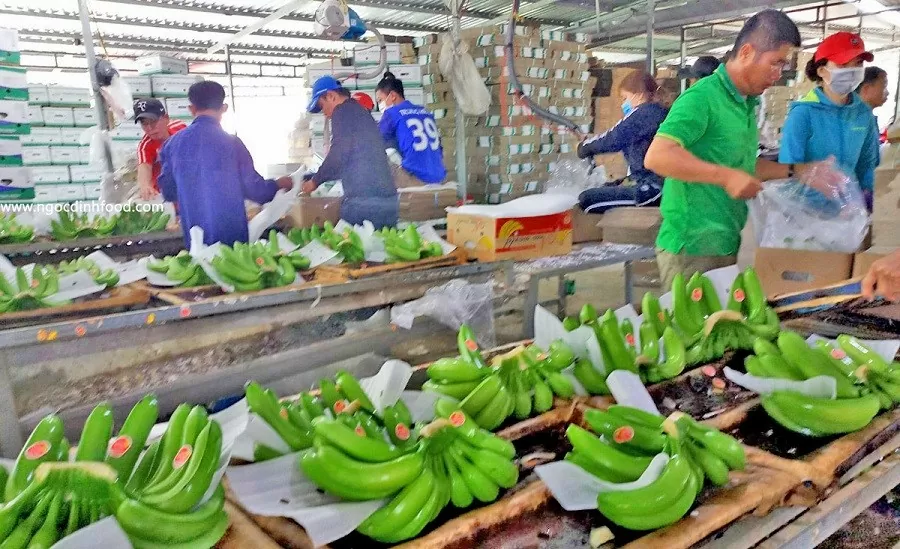 |
| Banana exports to South Korea reached $35.4 million, nearly tripling compared to the same period last year. (Photo: Dau Tu Newspaper) |
Mr. Hong Sun, President of the Korean Chamber of Commerce in Vietnam (KOCHAM), stated: For Korea, domestic agricultural production costs are rising. Therefore, the proportion of imported fruits is increasing. Koreans are becoming familiar with and increasingly consuming mangoes, durians, and many other tropical fruits. They wouldn't eat them even if they were given to them for free, but now they willingly buy them. Therefore, creating national brands like New Zealand's kiwi is important, as people can eat them with confidence because they are government-recognized brands.
Representatives of banana exporting businesses in Gia Lai province say their products are increasingly gaining favor with South Korean consumers and are widely available in major supermarket chains such as Lotte Mart. The bananas, grown in the highlands of Lo Pang commune, Mang Yang district, Gia Lai province, are distinguished by their thick peels and rich, sweet flavor.
Mr. Dang Phuc Nguyen, General Secretary of the Vietnam Fruit and Vegetable Association, noted that the scale of fruit and vegetable imports from South Korea is continuously growing. It is projected that in the first seven months of the year, South Korea's fruit and vegetable imports from Vietnam will reach US$190 million and are likely to continue to increase sharply during the year-end holiday season.
Bananas alone have a market size of over $300 million in South Korea annually. Therefore, this fruit still has significant potential for growth and market share expansion in the country.
Besides bananas, items such as watermelons, pineapples, strawberries, grapes, mangoes, and jackfruit are also attracting consumer interest in this country. To compete with fruits from Thailand and the Philippines, Vietnamese goods need to meet food safety and hygiene standards and packaging requirements that suit this market. Recently, many Korean supermarket chains such as Lotte and Emart have worked directly with Vietnamese farmers, cooperatives, and businesses to ensure quality from the planting to processing stages.
![[Photo] Prime Minister Pham Minh Chinh holds a phone call with the CEO of Russia's Rosatom Corporation.](/_next/image?url=https%3A%2F%2Fvphoto.vietnam.vn%2Fthumb%2F1200x675%2Fvietnam%2Fresource%2FIMAGE%2F2025%2F12%2F11%2F1765464552365_dsc-5295-jpg.webp&w=3840&q=75)


![[Photo] Closing Ceremony of the 10th Session of the 15th National Assembly](/_next/image?url=https%3A%2F%2Fvphoto.vietnam.vn%2Fthumb%2F1200x675%2Fvietnam%2Fresource%2FIMAGE%2F2025%2F12%2F11%2F1765448959967_image-1437-jpg.webp&w=3840&q=75)


















![[OFFICIAL] MISA GROUP ANNOUNCES ITS PIONEERING BRAND POSITIONING IN BUILDING AGENTIC AI FOR BUSINESSES, HOUSEHOLDS, AND THE GOVERNMENT](https://vphoto.vietnam.vn/thumb/402x226/vietnam/resource/IMAGE/2025/12/11/1765444754256_agentic-ai_postfb-scaled.png)


























































Comment (0)