

(NLĐO) - Data from NASA's Dawn spacecraft reveals a series of factors linked to the potential for life on the dwarf planet Ceres.
According to Space.com, new analysis from the Andalusian Institute of Astrophysics (Spain), based on data from the Dawn spacecraft, has identified 11 regions rich in organic material – the basic building blocks of life – on the dwarf planet Ceres.
In addition, Ceres is rich in water, as well as the energy source necessary for living organisms to be born and nurtured for a long time.
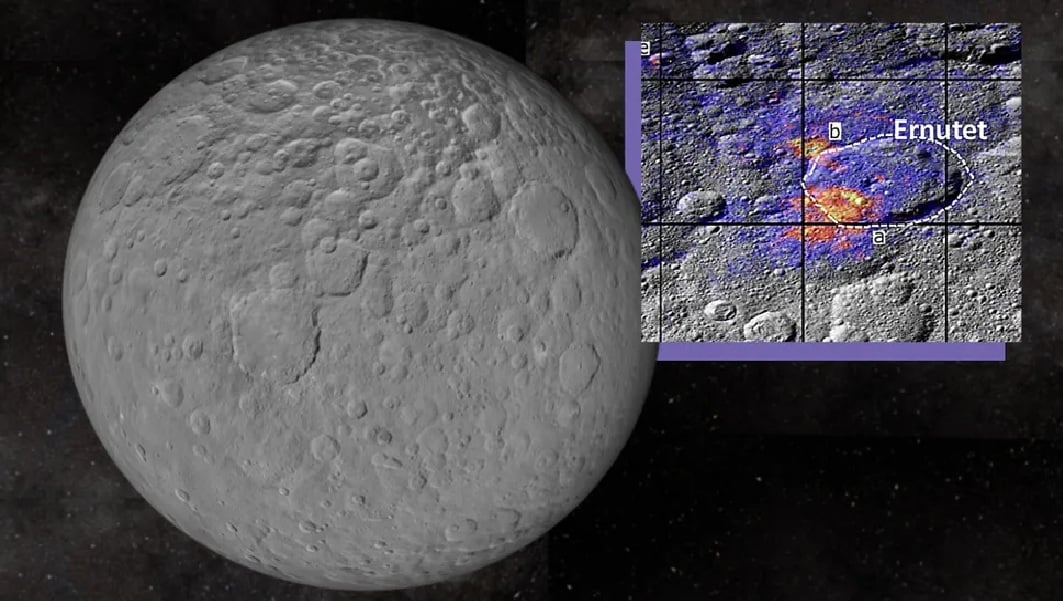
The dwarf planet Ceres and a magnified image of an area potentially harboring evidence of life - Photo: NASA
Ceres is the only dwarf planet in the asteroid belt between Mars and Jupiter, with a diameter of approximately 930 km, and is the second wettest celestial body in the Solar System, after Earth.
Traces of organic matter have been identified on Ceres before, but previous studies suggested that these were introduced from external sources.
Because Ceres lacks a strong magnetosphere like Earth, its surface is heavily affected by cosmic radiation, powerful enough to destroy all organic materials in a short period of time.
In a new study—published in the scientific journal Planetary Science Journal —scientists have proven another hypothesis: Ceres' organic matter comes from within, where its rocky crust protects it from radiation.
"The significance of this discovery lies in the fact that if these are endogenous materials, it would confirm the existence of internal energy sources that could support biological processes," said Dr. Juan Luis Rizos, head of the research team.
Within the rich dataset from Dawn, the research team was particularly interested in compounds discovered in an area at Ceres' equator called the Ernutet impact crater.
Most of the organic matter-rich areas discovered are concentrated there.
Materials at sites surrounding the Ernutet crater have been exposed to more solar radiation than materials within the impact crater itself.
This reduces the spectral characteristics of the exposed materials, making them harder to detect in the Dawn data.
Most notably, there is an area between the Urvara and Yalode basins of Ceres, where the most organic matter is found, dispersed by asteroid impacts that shaped these basins.
These were the most violent impacts Ceres has ever experienced, so the material must have originated from deeper regions than material ejected from other basins or craters.
The amount of material the research team discovered suggests that organic molecules must exist in large quantities beneath the surface of Ceres.
This is not unreasonable, because Ceres has a composition similar to carbonaceous chondrite meteorites, which are the earliest materials in the solar system and contain the earliest seeds of life.
"The idea of an organic reservoir in a remote and seemingly barren location like Ceres raises the possibility that similar conditions could exist on other celestial bodies in the Solar System," the authors anticipate.
Source: https://nld.com.vn/hanh-tinh-lun-giua-sao-hoa-va-sao-moc-co-the-co-su-song-196241208090915598.htm


![[Photo] Prime Minister Pham Minh Chinh holds a phone call with the CEO of Russia's Rosatom Corporation.](/_next/image?url=https%3A%2F%2Fvphoto.vietnam.vn%2Fthumb%2F1200x675%2Fvietnam%2Fresource%2FIMAGE%2F2025%2F12%2F11%2F1765464552365_dsc-5295-jpg.webp&w=3840&q=75)






















































Comment (0)